Musée Reinet House
Une fenêtre particulière de cet ancien presbytère est restée perpétuellement fermée pendant plus d'un siècle.
L'histoire complète se débloque dans le tour
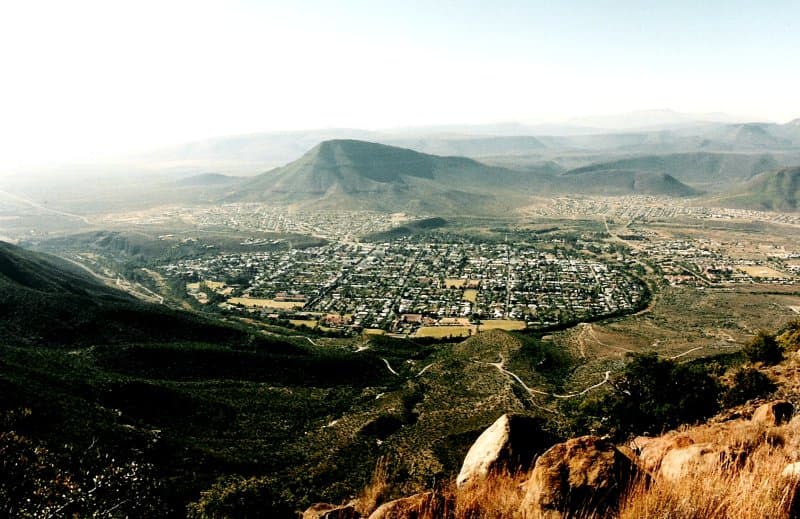 Africaspotter / CC BY-SA 3.0, via Wikimedia Commons
Visite audio autoguidée de Graaff-Reinet — parcours GPS à pied, lecture hors ligne, narration en 32 langues.
“Là où les plaines du Karoo rencontrent les imposantes dolérites, une ville d'une beauté résiliente.”
Pas les cartes postales. Les histoires que même les habitants ignorent — soufflées à l'oreille, là où elles se sont passées.
Une fenêtre particulière de cet ancien presbytère est restée perpétuellement fermée pendant plus d'un siècle.
Certains noms de rues de Graaff-Reinet rappellent un sentiment particulier du XVIIIe siècle concernant son emplacement éloigné.
Il existe un dialecte local à Graaff-Reinet qui mélange parfaitement deux langues sud-africaines majeures.
Découvrez tous les secrets de Graaff-Reinet
Chaque adresse, chaque révélation en entier — dans ton oreille, là où elle s'est passée.
Tu choisis tes lieux. Tu marches. La voix te révèle ce que les autres ignorent.


Votre visite audioguidée de Graaff-Reinet vous attend — choisissez vos lieux, votre langue, et lancez-vous dès votre arrivée.
AcheterLume intègre un guide en réalité augmentée. Levez votre téléphone : sa caméra montre la rue devant vous, avec une flèche lumineuse posée sur l'image réelle qui pointe toujours vers votre prochain arrêt — aucune carte à déchiffrer, aucun mauvais virage. Comme tout dans Lume, ça fonctionne entièrement hors-ligne.
Graaff-Reinet, la quatrième plus ancienne ville d'Afrique du Sud et la plus ancienne du Cap-Oriental, se trouve dans un méandre de la rivière Sundays, presque entièrement encerclée par le parc national de Camdeboo. Cette colonie du Karoo, établie en 1786 par la Compagnie néerlandaise des Indes orientales, servait de poste commercial et militaire vital. Sa position unique au sein du vaste paysage aride du Karoo, caractérisé par de vastes plaines et des montagnes lointaines, lui confère un caractère distinct. L'architecture de la ville, avec plus de monuments nationaux que toute autre ville d'Afrique du Sud, raconte une histoire de son passé durable.
Graaff-Reinet est un lieu où l'histoire est visiblement gravée dans ses rues et ses bâtiments. C'est une ville qui a été témoin d'événements historiques importants, d'une république éphémère à la fin du XVIIIe siècle à un rôle dans le Grand Trek et la Seconde Guerre des Boers. Au-delà de son importance historique, Graaff-Reinet est un centre agricole, particulièrement réputé pour son industrie du mohair et l'élevage de moutons et d'autruches.
Les origines de Graaff-Reinet remontent à 1786, lorsque la Compagnie néerlandaise des Indes orientales (VOC) l'a fondée comme poste commercial et militaire. Elle a été nommée d'après Cornelis Jacob van de Graaff, alors gouverneur de la Colonie du Cap, et son épouse, Cornelia Reinet. La ville s'appelait initialement 'de Wiljdgelegen Colonie van Graaff-Reinet', ce qui signifie 'la Colonie Sauvagement Située de Graaff-Reinet', un témoignage de sa position frontalière éloignée.
En 1795, les burghers, frustrés par la taxation de la VOC, se déclarèrent une 'Colonie de Graaff-Reinet' indépendante, cherchant la tutelle du gouvernement néerlandais. Cette période d'autonomie fut de courte durée avant que la ville ne soit réannexée à la Colonie du Cap. Graaff-Reinet a également servi de point de départ crucial pour de nombreux groupes de Voortrekkers, y compris ceux menés par Gerrit Maritz et Piet Retief, pendant le Grand Trek de 1835-1842.
La ville est devenue un centre pour les opérations militaires britanniques dans le Cap-Oriental pendant la Seconde Guerre des Boers. En 1901, Graaff-Reinet fut le site de procès pour les rebelles boers capturés, neuf d'entre eux étant condamnés à mort, dont huit furent exécutés par un peloton d'exécution à la périphérie de la ville. Un monument se dresse dans la ville pour commémorer ces Boers tombés au combat.
Graaff-Reinet a abrité des figures notables, dont Robert Mangaliso Sobukwe, un éminent activiste anti-apartheid, et Andries Pretorius, un important soldat et homme d'État boer. En février 2026, la ville a été officiellement renommée Robert Sobukwe Town. La ville est célébrée pour ses maisons et bâtiments historiques bien conservés, la seule rue Cradock en offrant plus de cinquante. Les efforts de préservation de ce patrimoine sont évidents dans des projets comme la restauration de Reinet House, un presbytère de style Cape Dutch construit entre 1805 et 1812, qui fonctionne désormais comme un musée.
Graaff-Reinet offre un voyage à travers le temps avec son remarquable patrimoine architectural. La ville a la particularité de posséder plus de monuments nationaux que toute autre en Afrique du Sud. Une promenade le long de Cradock Street révèle plus de cinquante maisons historiques protégées. Le musée Reinet House, un presbytère de style Cape Dutch magnifiquement restauré du début du XIXe siècle, présente des meubles d'époque et des artefacts historiques, y compris une vigne de raisin Black Acorn plantée en 1870 qui porte encore des fruits. Le complexe muséal comprend également le Mill House et le Wagon House. À proximité, l'Old Library Museum, ouvert en 1847, et le Military History Museum enrichissent davantage l'expérience historique.
Autour de la ville, le parc national de Camdeboo est une merveille naturelle, englobant presque entièrement Graaff-Reinet. Sa caractéristique la plus emblématique est la Vallée de la Désolation, un paysage dramatique de piliers de dolérite imposants offrant des vues imprenables sur les plaines du Karoo. Le parc offre également des possibilités de randonnée, avec des sentiers comme le Crag Lizard Trail. Pour une expérience botanique unique, la pépinière Obesa abrite l'une des plus grandes collections privées de cactus et de plantes succulentes au monde.
Graaff-Reinet connaît des étés chauds et des hivers froids, secs et venteux. La saison chaude s'étend de fin novembre à mi-mars, avec des températures maximales quotidiennes moyennes supérieures à 30°C (87°F), tandis que la saison fraîche s'étend de fin mai à mi-août, avec des températures maximales quotidiennes moyennes inférieures à 21°C (71°F). Le mois le plus froid est juillet, avec une température minimale moyenne de 5°C (41°F), et le plus chaud est janvier, avec une température maximale moyenne de 33°C (92°F). La meilleure période pour les activités par temps chaud est de mi-octobre à début mai. Pour une exploration confortable, envisagez la fin de l'automne (avril et mai) ou le début du printemps (septembre et octobre). Le printemps apporte une nouvelle croissance, des fleurs épanouies et les célèbres jacarandas de la ville en pleine floraison.
Graaff-Reinet est généralement considérée comme une destination relativement sûre, mais comme pour tout voyage, il est conseillé d'être conscient de son environnement, surtout la nuit. Il est recommandé de garder ses affaires en sécurité et d'éviter les zones désertes. Lors de l'exploration, envisagez de vous déplacer en groupe et de rester dans les rues bien éclairées et animées. La langue principale parlée à Graaff-Reinet est l'afrikaans, suivi du xhosa et de l'anglais. Bien que l'afrikaans soit dominant, l'anglais est largement compris, et de nombreux habitants parlent un mélange unique connu sous le nom de 'Graaffrikaans'.
Les options d'hébergement vont des maisons d'hôtes et des B&B aux chalets indépendants et aux hôtels, de nombreux établissements reflétant le charme historique de la ville. Dîner à Graaff-Reinet offre un avant-goût de la cuisine du Karoo, avec des restaurants servant des spécialités locales comme l'agneau du Karoo. Les restaurants populaires incluent De Camdeboo Restaurant, Frontiers Karoo Restaurant, Hello You et Maria's Coffee Roastery.
Graaff-Reinet en coréen, en chinois ou en hébreu — et dans 29 autres langues, chaque étape narrée par une voix native. La plus large gamme de langues de tous les audioguides autoguidés.
Disponible en :