L'Ancienne Prison (The Old Gaol)
Cette imposante prison du XIXe siècle cache une sombre vérité sur les spectacles publics.
L'histoire complète se débloque dans le tour
 Public domainPublic domainfalsefalse This work has been released into the public domain by its author, Tim giddings at English Wikipedia. This applies worldwide.In some countries this may not be legally possible; if so:Tim giddings grants anyone the right to use this work for any purpose, without any conditions, unless such conditions are required by law.Public domainPublic domainfalsefalse / Public domain, via Wikimedia Commons
Visite audio autoguidée de Makhanda — parcours GPS à pied, lecture hors ligne, narration en 32 langues.
“Là où les échos des conflits frontaliers rencontrent un paysage artistique florissant.”
Pas les cartes postales. Les histoires que même les habitants ignorent — soufflées à l'oreille, là où elles se sont passées.
Cette imposante prison du XIXe siècle cache une sombre vérité sur les spectacles publics.
Au-delà de son charme victorien et de ses outils astronomiques, ce musée abrite un dispositif optique unique.
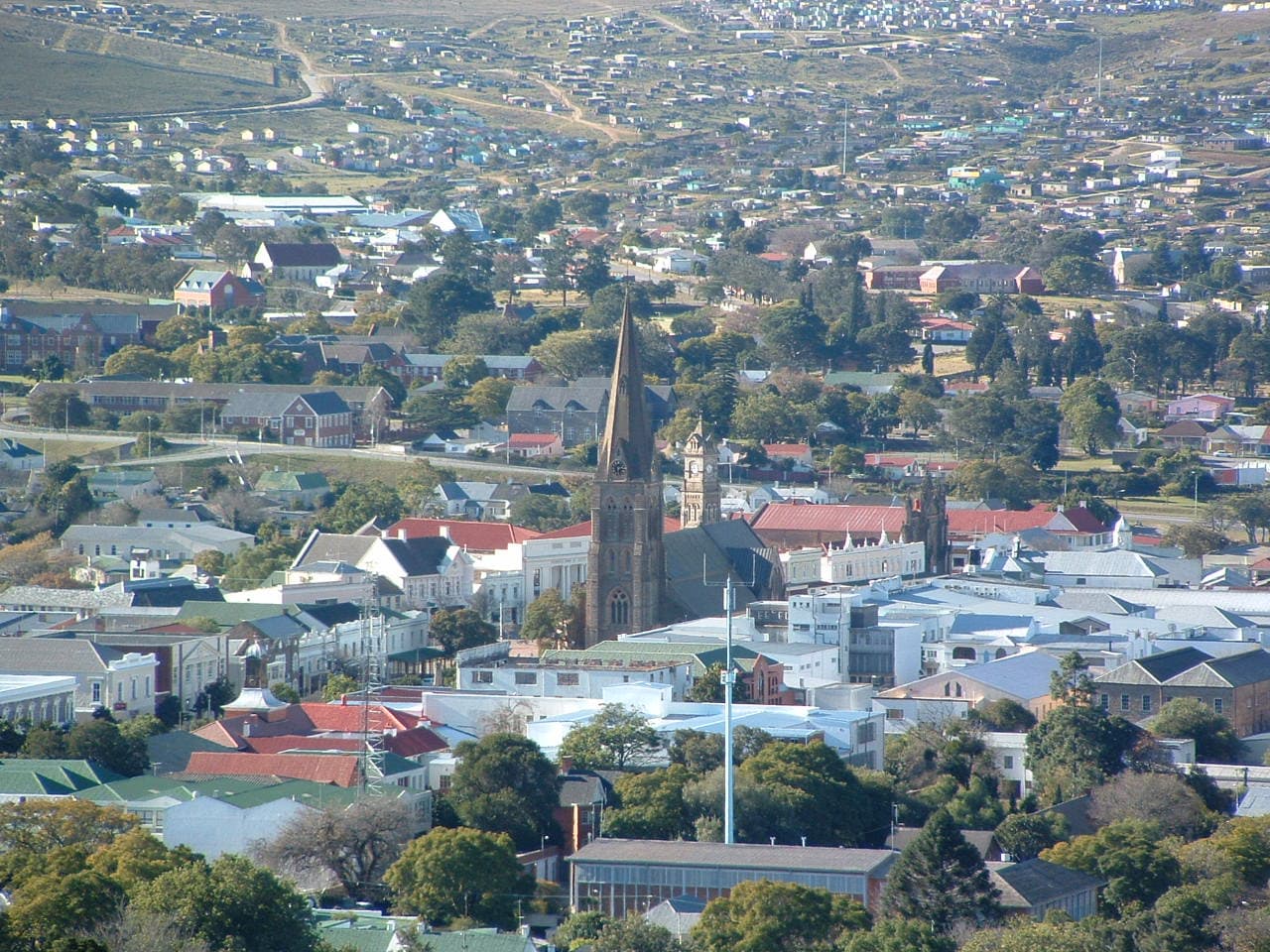
Cette cathédrale, avec sa flèche élancée, révèle une chronologie architecturale particulière.
Découvrez tous les secrets de Makhanda
Chaque adresse, chaque révélation en entier — dans ton oreille, là où elle s'est passée.
Tu choisis tes lieux. Tu marches. La voix te révèle ce que les autres ignorent.


Votre visite audioguidée de Makhanda vous attend — choisissez vos lieux, votre langue, et lancez-vous dès votre arrivée.
AcheterLume intègre un guide en réalité augmentée. Levez votre téléphone : sa caméra montre la rue devant vous, avec une flèche lumineuse posée sur l'image réelle qui pointe toujours vers votre prochain arrêt — aucune carte à déchiffrer, aucun mauvais virage. Comme tout dans Lume, ça fonctionne entièrement hors-ligne.
Makhanda, anciennement connue sous le nom de Grahamstown, est une ville de la province du Cap-Oriental en Afrique du Sud, située à environ 125 kilomètres au nord-est de Gqeberha (Port Elizabeth). Elle repose sur les pentes boisées des montagnes Suur, près de la source de la rivière Kowie. Fondée en 1812 comme avant-poste militaire britannique pendant les tumultueuses guerres frontalières du Cap, Makhanda est devenue un important centre culturel et éducatif.
La ville est souvent surnommée la « Ville des Saints » en raison de ses nombreuses églises magnifiques, affichant un mélange de styles architecturaux qui racontent son passé riche et complexe. Au-delà de son architecture historique, Makhanda est une ville universitaire dynamique, abritant l'Université Rhodes, la Bibliothèque nationale sud-africaine pour les aveugles et la Bibliothèque internationale de musique africaine, toutes contribuant à son atmosphère académique et artistique animée.
Les origines de Makhanda remontent à 1812, lorsque le colonel John Graham l'établit comme poste de garnison frontalier, initialement nommé Grahamstown. Cet emplacement stratégique visait à sécuriser le territoire britannique près des terres Xhosa pendant une période de conflit continu. L'arrivée des colons britanniques en 1820 a solidifié sa présence coloniale, et en quelques décennies, elle est devenue la deuxième plus grande ville de la Colonie du Cap après Le Cap.
La ville a joué un rôle central dans les guerres frontalières du Cap, une série de conflits entre les peuples Xhosa locaux et les colons néerlandais et britanniques qui ont duré près d'un siècle. Makhanda contient de nombreux monuments commémoratifs de ces guerres, y compris le Mémorial d'Egazini, un monument aux Xhosa morts au combat. Le nom original de la ville, Grahamstown, honorait le colonel John Graham, une figure connue pour ses tactiques brutales pendant ces conflits.
Dans un acte significatif de réparation symbolique pour réparer un passé injuste, la ville a été officiellement renommée Makhanda le 2 octobre 2018. Le nouveau nom rend hommage à Makhanda ka Nxele, un guerrier, prophète et philosophe Xhosa qui a mené une attaque majeure contre la garnison britannique en 1819. Ce changement de nom, qui a suivi près de 20 ans de discussions, reflète un effort national plus large pour transformer le paysage patrimonial de l'Afrique du Sud et reconnaître l'histoire indigène.
Tout au long de son histoire, Makhanda a également favorisé une forte tradition d'éducation et de culture. L'Université Rhodes a été fondée en 1904, et la ville est devenue le siège d'institutions comme le Musée d'Albany (établi en 1855) et le Musée national de littérature anglaise (aujourd'hui Amazwi South African Museum of Literature). Elle est également réputée pour accueillir le National Arts Festival, le plus grand rassemblement artistique multidisciplinaire d'Afrique, qui transforme annuellement la ville en un centre de créativité.
Makhanda offre un large éventail d'attractions, mêlant histoire, culture et beauté naturelle. La Cathédrale Saint-Michel et Saint-George est un monument emblématique avec son style néo-gothique victorien et la flèche la plus haute d'Afrique du Sud, atteignant 54 mètres. Les visiteurs peuvent explorer le Musée de l'Observatoire, autrefois la maison de l'horloger et astronome amateur Henry Carter Galpin, qui présente d'anciens instruments astronomiques et la seule Camera Obscura victorienne fonctionnelle de l'hémisphère sud.
Le Complexe du Musée d'Albany, créé en 1855, est l'un des plus anciens musées d'Afrique du Sud et comprend plusieurs sites, dont le Musée des sciences naturelles et le Musée d'histoire. Le Monument national des colons de 1820 commémore l'arrivée des colons britanniques et offre des vues imprenables sur la ville. Pour les amateurs de littérature, le Musée de littérature sud-africaine Amazwi (anciennement le Musée national de littérature anglaise) abrite de vastes archives.
Au-delà des bâtiments historiques, explorez les Jardins botaniques de Makana pour une promenade tranquille ou l'observation des oiseaux. La Réserve naturelle Thomas Baines, située à 15 km de Makhanda, offre la possibilité d'observer des buffles du Cap, des koudous et diverses espèces d'antilopes. Fin juin et début juillet, la ville s'anime avec le National Arts Festival, le plus grand festival artistique d'Afrique, proposant un large éventail de spectacles et d'expositions.
Makhanda bénéficie de températures agréables tout au long de l'année, avec des températures maximales moyennes diurnes allant de 22°C en juillet à 29°C en février. La ville connaît une saison sèche distincte de mai à août, ce qui en fait les mois idéaux pour explorer sans beaucoup de pluie. Mai et juin apportent des journées chaudes et des nuits fraîches, excellentes pour la randonnée. Le National Arts Festival se déroule généralement de la dernière semaine de juin à la première semaine de juillet, transformant la ville en un centre culturel. Pour l'observation de la faune dans les réserves voisines, les mois d'hiver plus frais et secs (mai à septembre) sont souvent recommandés car les animaux se rassemblent autour des points d'eau.
Makhanda est située à environ 125 kilomètres au nord-est de Gqeberha (Port Elizabeth) et à 160 kilomètres au sud-ouest d'East London. Le trajet depuis Gqeberha prend environ une heure et demie. Les principales cartes de crédit internationales sont largement acceptées. La monnaie locale est le Rand (R), divisé en 100 cents. L'électricité fonctionne à 220/230 volts CA à 50 cycles par seconde, utilisant des prises à trois broches, donc un adaptateur peut être nécessaire.
Bien que Makhanda offre une riche expérience culturelle, les visiteurs doivent être conscients des précautions de sécurité générales courantes dans les zones urbaines. Il est conseillé de consulter les ressources locales pour obtenir des informations de sécurité actualisées. Pour explorer les sites historiques et les musées de la ville, beaucoup sont idéalement situés à proximité, ce qui facilite la navigation à pied ou avec de courts trajets en voiture.
Makhanda en coréen, en chinois ou en hébreu — et dans 29 autres langues, chaque étape narrée par une voix native. La plus large gamme de langues de tous les audioguides autoguidés.
Disponible en :