Basilica of St. Martin
Beneath the serene facade of Greding's landmark church, a surprising, centuries-old secret awaits discovery.
Full story unlocks in the tour
 Derzno / CC BY-SA 3.0, via Wikimedia Commons
Self-guided audio walking tour of Greding — GPS route, offline playback, story-driven narration in 32 languages.
“Where ancient stone guards quiet stories, and the wild world beckons.”
Not the postcards. The stories even locals don't know — whispered in your ear, right where they happened.
Beneath the serene facade of Greding's landmark church, a surprising, centuries-old secret awaits discovery.
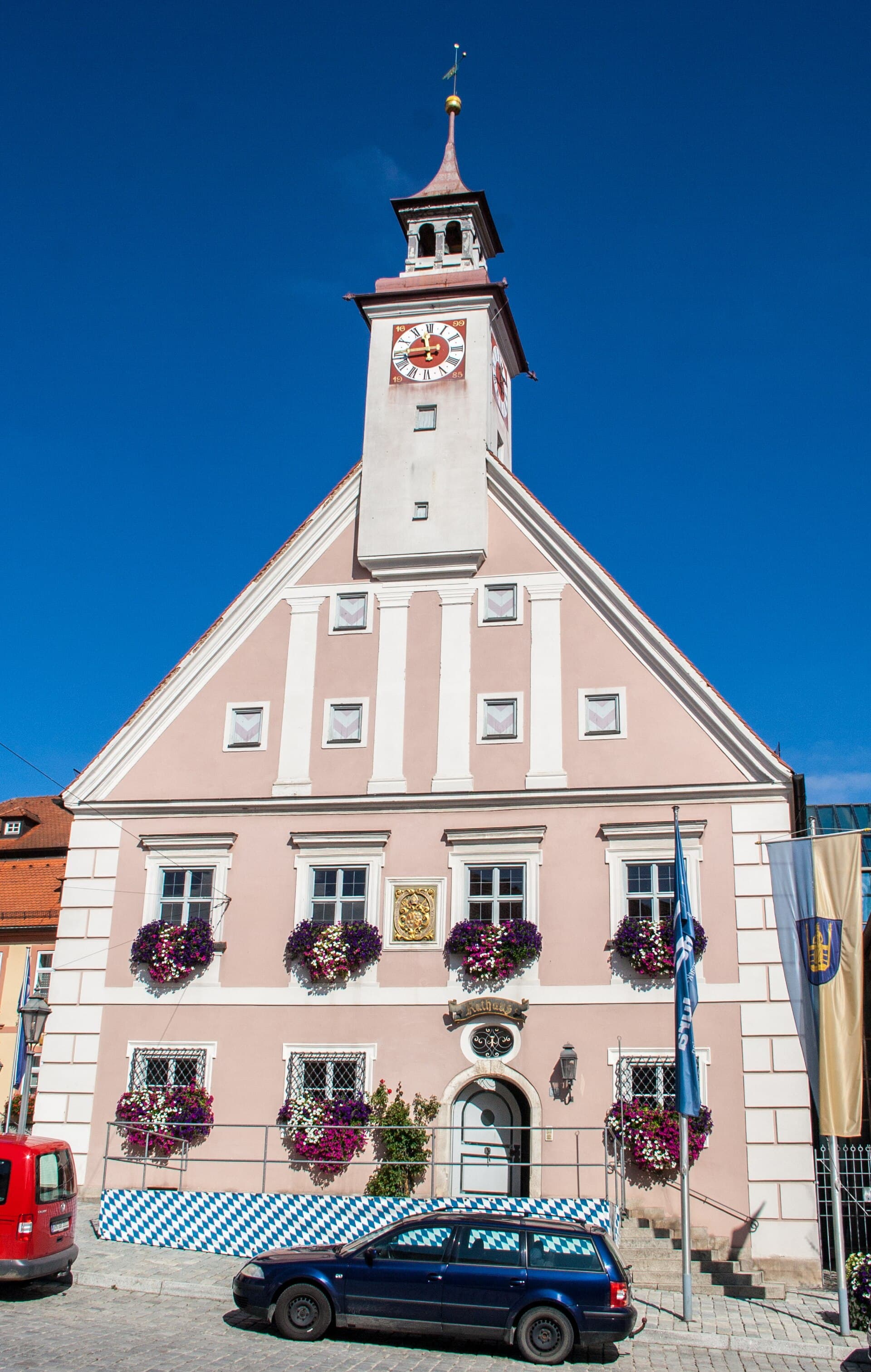
The current Baroque town hall isn't Greding's first; its predecessor met a fiery end during a tumultuous period.
This medieval defense isn't just for show; many of its ancient towers have found a surprising second life.
Discover every secret of Greding
Every address, every reveal in full — in your ear, right where it happened.
You pick your stops. You walk. The voice reveals what the others miss.


Your self-guided audio tour of Greding is ready — pick your landmarks, choose your language, and start the moment you arrive.
BuyLume has a built-in augmented-reality guide. Hold your phone up and its camera shows the street ahead of you, with a glowing arrow laid over the real view that always points to your next stop — no map to puzzle over, no wrong turns. Like everything in Lume, it works fully offline.
Greding, a town in Bavaria, Germany, is a place where history is etched into the very stone of its buildings and protective walls. With roots stretching back to early settlements between 10,000 BC and 6,000 BC, and a recorded township since 1091, Greding offers a tangible link to the past. It is often referred to as the "City of 21 Towers" due to its remarkably preserved medieval town wall. Situated in the Altmühltal Nature Park, Greding provides a blend of historical exploration and the quiet beauty of the natural world.
Beyond its ancient fortifications, Greding is a community with a population of around 7,000, encompassing 31 villages. The town serves as a gateway to outdoor activities within the Franconian Jura, offering numerous cycling and hiking trails. Whether you are drawn to its architectural heritage, the tranquility of its natural surroundings, or the lively local festivals, Greding presents a compelling destination for those seeking an authentic German experience.
The town's location in the south-eastern corner of Middle Franconia means it borders two neighboring Bavarian districts, Eichstätt and Neumarkt, as well as the regions of Upper Bavaria and Upper Palatinate, making it a central point for regional exploration.
The history of Greding stretches back millennia, with evidence of early settlements, including animal jawbones and charcoal fires, dating from between 10,000 BC and 6,000 BC. Traces of a Celtic settlement have also been discovered, dating from 450-350 BC. The first known written record of Greding as a township appeared in 1091.
During the 11th century, the Greding estate came under the ownership of the Bishops of Eichstätt, a jurisdiction that would remain in place until 1803. This long period of ecclesiastical rule significantly shaped the town's development and architecture. The impressive 1.25 km town wall, with its fortified gatehouses and towers, was erected during the rule of Prince Bishop Friedrich IV, Count of Öttingen (1383–1415). Though a major fire in 1503 destroyed two gatehouses, a tower, and part of the town hall, much of the wall still stands today, earning Greding its nickname, "The City of 21 Towers."
Greding, like many German towns, suffered significantly during the Thirty Years' War (1618-1648). In 1633, Swedish troops burned the original town hall to the ground in an attempt to extort ransom money from the citizens. The Parish Church of St. James also fell victim to the conflict, being consumed by fire before its reconstruction in 1725. This period of destruction was followed by rebuilding, and the current Baroque town hall, thought to be the work of Eichstätt architect Jakob Engel, was erected in 1699.
Following the secularization, Greding, along with its constituent villages like Hausen, came under the Grand Duchy of Tuscany and then Bavaria in 1806. In more recent history, Greding has seen administrative changes, with Hausen becoming a district of Greding on January 1, 1972, and the town itself joining the newly formed district of Roth on July 1, 1972. Today, Greding continues to preserve its heritage while embracing its role as a regional center within the Altmühltal Nature Park.
Greding offers a captivating blend of historical architecture and the quiet beauty of its landscape. Begin your exploration with the Stadtmauer, the town wall, of which 1.25 km still stands from its 14th-century origins. Along this defensive wall, you'll encounter several impressive gates, including the Eichenstätter Tor, the Fürstentor, and the Nürnberger Tor.
At the heart of Greding is the Marktplatz, where you'll find the Baroque-style Rathaus (Town Hall), built in 1699. Also on the Marktplatz is the former Fürstbischöfliches Schloss (Prince Episcopal Palace), a 17th-century architectural piece that even includes its own hunting lodge.
Dominating the skyline is the Basilica of St. Martin, a 12th-century Romanesque church considered Greding's landmark. Inside, admire Rococo artwork, 15th-century frescoes, and a 12th-century chapel dedicated to St. Michael. Another significant religious site is the Parish Church of St. James, rebuilt in 1725 after the original was destroyed during the Thirty Years' War.
For those interested in local culture and history, Greding presents two museums: the Museum Natur und Mensch (Nature & Man Museum) and the Sparkassenmuseum (Banking Museum), offering a glimpse into natural history and banking practices before the digital age. Beyond the town's architectural marvels, the surrounding Altmühltal Nature Park provides ample opportunities for hiking and cycling, allowing you to immerse yourself in the Franconian landscape.
The best time to visit Greding for warm-weather activities and exploring its outdoor offerings is from late June to late August, when daily high temperatures average above 67°F. July is typically the warmest month, with an average high of 73°F and the clearest skies. If you prefer milder weather and fewer crowds, the shoulder seasons of spring (April to June) and fall (September to October) are ideal. During these times, temperatures are comfortable, and you can enjoy cultural events and festivals without the peak summer crowds. Fall, in particular, brings colorful foliage and harvest markets. Winter, from November to March, is cold, snowy, and mostly cloudy, with average daily high temperatures below 42°F.
Greding is conveniently located near junction 57 of the A9 autobahn, making it easily accessible by car. The town is also served by local and regional buses, with direct connections to major cities like Nuremberg, Munich, and Berlin. A bus service connects Greding with Kinding (Altmühltal) railway station, which is on the Nuremberg–Ingolstadt high-speed railway.
For visitors, the Tourist Information office is situated directly on the Marktplatz within the Archaeology Museum Greding. Here, you can receive advice on local attractions, obtain informational materials, hiking and cycling maps, and guidebooks for Greding and the Altmühltal Nature Park.
Accommodation options in and around Greding include hotels and guesthouses. While exploring, be aware that many shops in Germany are closed on Sundays, a culturally and legally enforced day of rest. Also, pay attention to designated bike lanes, as cyclists take their space seriously.
Greding in Korean, in Chinese or in Hebrew — and 29 more languages, every stop narrated by a native voice. The widest language range of any self-guided audio tour.
Available in: