Le musée Knauf
Iphofen abrite les opérations mondiales d'une grande entreprise de matériaux de construction, et leur musée contient une collection inattendue.
L'histoire complète se débloque dans le tour
 Berthold Werner / Public domain, via Wikimedia Commons
Visite audio autoguidée de Iphofen — parcours GPS à pied, lecture hors ligne, narration en 32 langues.
“Là où les remparts anciens épousent les crus contemporains.”
Pas les cartes postales. Les histoires que même les habitants ignorent — soufflées à l'oreille, là où elles se sont passées.
Iphofen abrite les opérations mondiales d'une grande entreprise de matériaux de construction, et leur musée contient une collection inattendue.
Les défenses médiévales de la ville restent remarquablement intactes, mais un segment a jadis servi une fonction très spécifique et tout à fait pratique.
Cet hôtel accueillant possède un passé enraciné à la fois dans la vie monastique et dans une industrie locale vitale.
Découvrez tous les secrets de Iphofen
Chaque adresse, chaque révélation en entier — dans ton oreille, là où elle s'est passée.
Tu choisis tes lieux. Tu marches. La voix te révèle ce que les autres ignorent.


Votre visite audioguidée de Iphofen vous attend — choisissez vos lieux, votre langue, et lancez-vous dès votre arrivée.
AcheterLume intègre un guide en réalité augmentée. Levez votre téléphone : sa caméra montre la rue devant vous, avec une flèche lumineuse posée sur l'image réelle qui pointe toujours vers votre prochain arrêt — aucune carte à déchiffrer, aucun mauvais virage. Comme tout dans Lume, ça fonctionne entièrement hors-ligne.
Iphofen, une charmante ville de la région franconienne en Allemagne, offre un voyage à travers le temps avec son architecture médiévale remarquablement préservée et sa culture viticole florissante. Cette ville, d'environ 4 500 habitants, est reconnue pour son enceinte médiévale complète, ses bâtiments vénérables et ses vastes vignobles. Les visiteurs peuvent flâner le long des ruelles anciennes, admirer les façades à colombages et explorer une place du marché qui semble intouchée par le passage des siècles. Iphofen offre une évasion tranquille, mêlant histoire, culture et la splendeur naturelle de la campagne franconienne.
L'histoire documentée d'Iphofen remonte à 741 après J.-C., lorsqu'elle apparaît pour la première fois comme une cour royale franconienne. Ses récoltes étaient revendiquées par le nouveau diocèse de Würzburg, et la ville occupait une position stratégique sur une route importante reliant Francfort, Würzburg, Fürth et Ratisbonne. En 1293, Iphofen reçut le statut de ville de l'évêque de Würzburg, signalant son importance alors que l'évêché étendait sa portée territoriale et établissait Iphofen comme sa colonie frontalière du sud-est.
Tout au long des XIVe et XVe siècles, le diocèse de Würzburg a progressivement acquis des droits auprès d'autres familles nobles ayant des intérêts à Iphofen, consolidant ainsi son commandement. Les défenses de la ville ont commencé à se former, la phase initiale de l'enceinte étant achevée en 1349 et des zones supplémentaires incorporées en 1421. La construction de l'impressionnante église Saint-Guy, une fusion de styles gothique, Renaissance et début baroque, commença en 1414, témoignant de l'esprit durable de la ville malgré les difficultés financières rencontrées par ses 1 800 habitants de l'époque.
La prospérité d'Iphofen au Moyen Âge reposait sur le vin, le gypse et le bois. Les évêques de Würzburg ont continué à façonner l'évolution de la ville jusqu'à la sécularisation en 1810, lorsque Iphofen est devenue une partie permanente du Royaume de Bavière. Le XVIe siècle a été témoin de l'influence du prince-évêque Julius Echter de Mespelbrunn, un théologien, politicien et bâtisseur éminent, d'après qui le vignoble le plus célèbre d'Iphofen est nommé. La ville a également traversé des périodes de peste et la guerre de Trente Ans, avec des forces mercenaires affectant la région dès 1620. Plus récemment, Iphofen est devenue la base de la plus grande entreprise familiale de gypse au monde, Knauf, qui y a établi sa première usine en 1949.
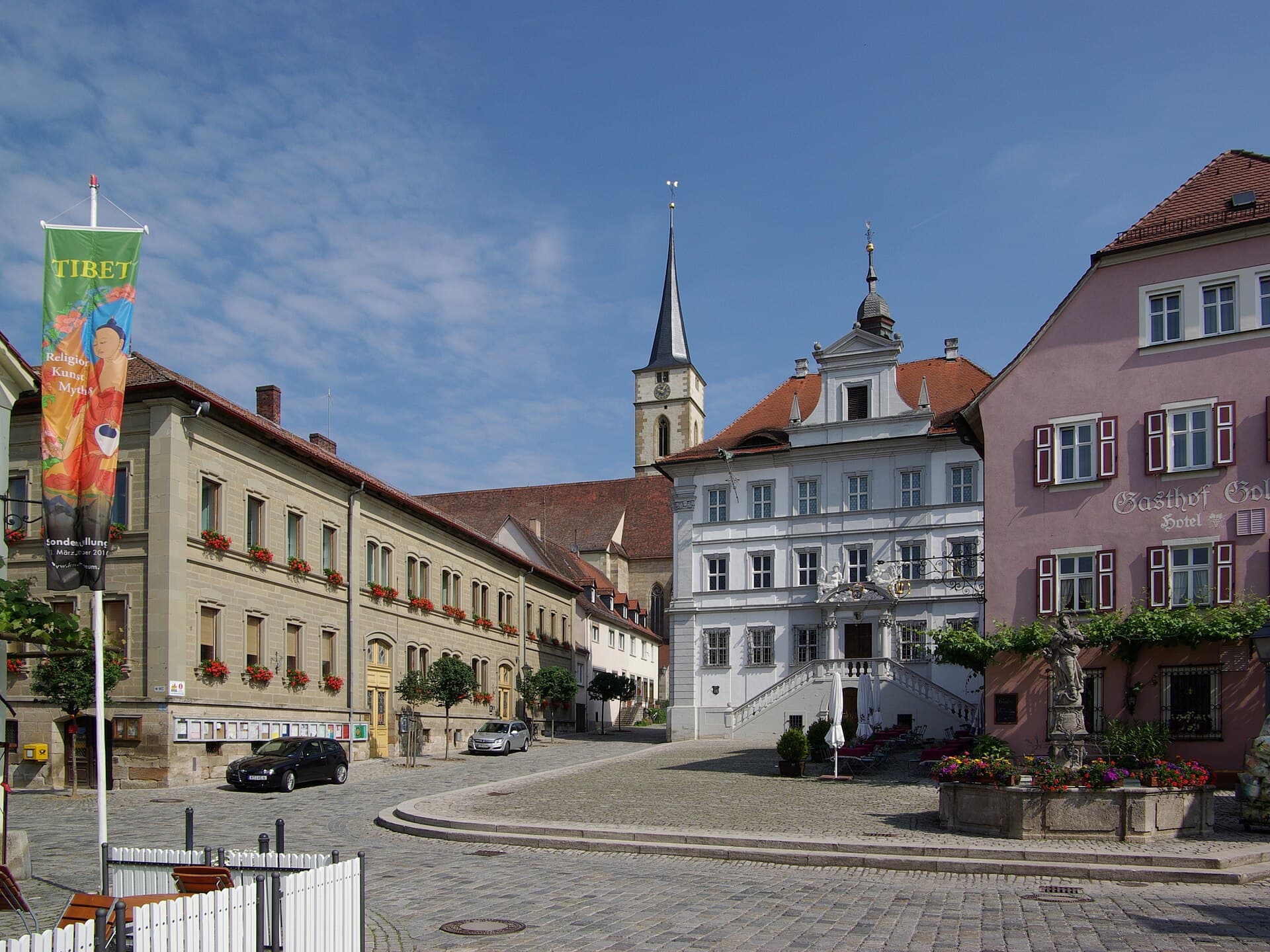
Commencez votre exploration dans l'Altstadt, ou vieille ville, d'Iphofen, où des structures médiévales bien entretenues, des résidences à colombages et d'anciennes ruelles étroites invitent à des promenades sans hâte. La Marktplatz, ou place du marché, sert de point central pour s'imprégner de l'atmosphère, peut-être avec un repas ou une boisson dans un établissement local. Ici, vous trouverez l'hôtel de ville baroque, datant de 1716-1718, et le Marienbrunnen, une fontaine ornée d'une sculpture baroque de Marie.
Visitez l'église Saint-Veit (également connue sous le nom de Saint-Guy), un exemple impressionnant d'architecture gothique qui intègre également des éléments de la Renaissance et du début du Baroque. À l'intérieur, observez une sculpture de la Vierge du XVe siècle sculptée dans le tilleul et des vitraux historiques du chœur. L'enceinte médiévale complète de la ville, avec ses portes et ses tours, est une caractéristique importante, offrant un lien tangible avec le passé d'Iphofen. Pour une compréhension plus approfondie du patrimoine de la région, le musée Knauf d'Iphofen présente l'histoire et la culture locales, aux côtés de sa collection inattendue de reproductions de reliefs anciens. Ne manquez pas l'occasion de découvrir la célèbre culture viticole d'Iphofen ; dégustez les vins locaux dans les nombreuses caves de la ville ou empruntez un sentier viticole à travers les vignobles environnants.
La période la plus favorable pour visiter Iphofen pour les activités par temps chaud s'étend de fin juin à début septembre. Durant cet intervalle, les températures maximales moyennes quotidiennes dépassent 20 °C (69 °F), juillet étant le mois le plus chaud, avec une moyenne de 24 °C (75 °F). Le ciel est le plus clair en août, et bien que juillet connaisse le plus de précipitations, les conditions humides sont rares tout au long de l'année. Le printemps (avril-juin) et l'automne (septembre-octobre) offrent également un temps agréable avec moins de visiteurs, ce qui en fait d'excellentes périodes pour explorer la ville et les vignobles. Le festival du vin d'Iphofen, ou Marktpltaz Winzerfest, a lieu chaque année le deuxième week-end de juillet.
Iphofen est située dans le district de Kitzingen, en Bavière, en Allemagne, à environ 9 km au sud-est de Kitzingen et à environ 10 km du Main. La grande ville la plus proche est Würzburg. Vous pouvez arriver à Iphofen en train, la gare étant située à environ 800 mètres de la vieille ville. Une fois en ville, la vieille ville est facilement traversable à pied. L'Office de Tourisme est situé sur la place de l'église et fournit des conseils utiles et des informations régionales. Pour les repas, la place du marché offre de nombreux restaurants et cafés. De nombreuses caves proposent des dégustations, et la Vinothek Iphofen présente une large sélection de 20 vignerons locaux.
Iphofen en coréen, en chinois ou en hébreu — et dans 29 autres langues, chaque étape narrée par une voix native. La plus large gamme de langues de tous les audioguides autoguidés.
Disponible en :