Güstrow Palace Ballroom
Imagine dancing beneath a ceiling that narrates adventures from wild landscapes, far removed from the expected European forests.
Full story unlocks in the tour
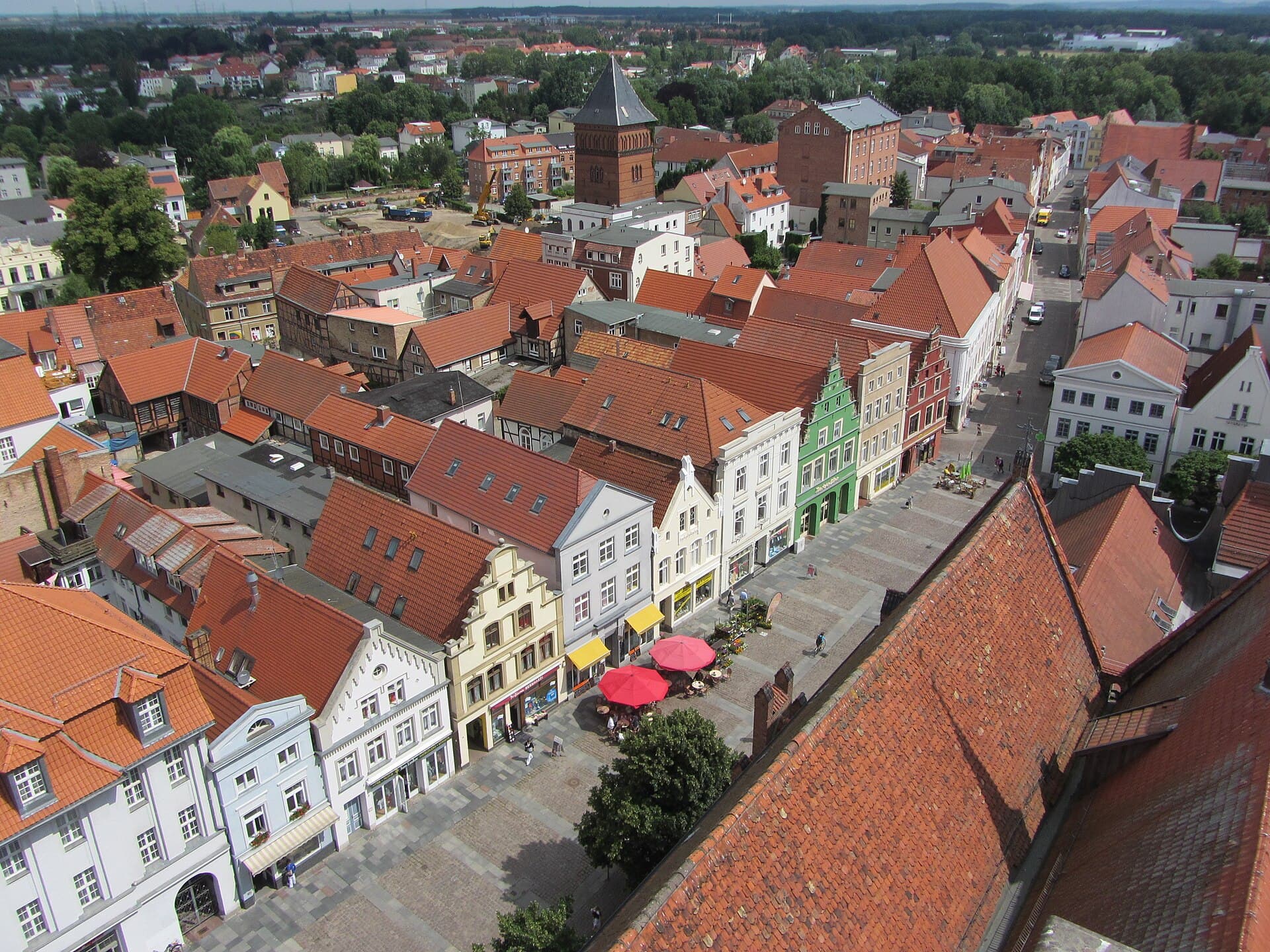 Niteshift (talk) / CC BY-SA 3.0, via Wikimedia Commons
Self-guided audio walking tour of Güstrow — GPS route, offline playback, story-driven narration in 32 languages.
“Where Renaissance grandeur meets Brick Gothic mystery, overseen by a floating angel.”
Not the postcards. The stories even locals don't know — whispered in your ear, right where they happened.
Imagine dancing beneath a ceiling that narrates adventures from wild landscapes, far removed from the expected European forests.
This imposing Brick Gothic church carries a secret about its very designation.
A chapel in Güstrow occupies a site with a much older, and somber, past.
Discover every secret of Güstrow
Every address, every reveal in full — in your ear, right where it happened.
You pick your stops. You walk. The voice reveals what the others miss.
Your self-guided audio tour of Güstrow is ready — pick your landmarks, choose your language, and start the moment you arrive.
BuyLume has a built-in augmented-reality guide. Hold your phone up and its camera shows the street ahead of you, with a glowing arrow laid over the real view that always points to your next stop — no map to puzzle over, no wrong turns. Like everything in Lume, it works fully offline.
Güstrow, officially recognized as 'Barlachstadt' since 2006, is a city in Mecklenburg-Vorpommern that beautifully intertwines centuries of history with a significant artistic legacy. It lies approximately 45 kilometers south of Rostock on the Nebel River, embraced by a verdant expanse of five lakes—Inselsee, Sumpfsee, Parumer See, Grundloser See, and Gliner See—and several forests, creating a serene environment.
At its core, a compelling old town unfolds, where magnificent Brick Gothic structures stand alongside the impressive Renaissance Güstrow Palace. The city's profound past as a ducal residence and a vital market center resonates through its architecture and atmosphere. Today, Güstrow invites visitors to explore its cultural treasures, savor its natural surroundings, and delve into the poignant works of Ernst Barlach.
Güstrow's origins trace back to the early 13th century, its name stemming from the Polabian 'Guščerov,' meaning 'lizard place.' The town began to coalesce around a Wendish castle constructed in 1219, a location now occupied by the Renaissance palace. Duke Heinrich Borwin II, grandson of Henry the Lion, is credited with establishing the settlement between 1219 and 1226, and Güstrow received its municipal charter in 1228.
From 1235 to 1436, Güstrow functioned as the residence for the Wendish princes of Werle, solidifying its position as a center of noble authority. Following the division of Mecklenburg in 1520, Güstrow ascended to prominence as the capital of the Duchy of Mecklenburg-Güstrow, serving as the primary residence for its dukes until 1695. This era saw the construction of the magnificent Güstrow Palace, initiated in 1558 for Duke Ulrich.
The town faced considerable adversity throughout its existence, including devastating fires in 1503, 1508, and 1512, with the palace itself succumbing to flames in 1556. One of Güstrow's most dramatic political episodes occurred during the Thirty Years' War (1628–1629) when the Catholic general Albrecht von Wallenstein briefly governed the short-lived Duchy of Mecklenburg from Güstrow. The ducal lineage of Mecklenburg-Güstrow concluded in 1695, and the duchy was absorbed into Mecklenburg-Schwerin.
In the 20th century, Güstrow became profoundly linked with the expressionist sculptor Ernst Barlach, who resided and worked in the town from 1910 until his death in 1938. His deeply human-centered art, including the iconic "Floating Angel" in the cathedral, earned Güstrow the official designation 'Barlachstadt' in 2006. The town also endured the impact of World War II, serving as a site for a labor camp and a Gestapo prison, and later became part of East Germany. Today, Güstrow stands as a testament to its enduring narrative, from medieval beginnings to its modern identity as a cultural focal point.
Güstrow presents a compelling array of sights, artfully combining historical architecture with significant artistic contributions. The Güstrow Palace (Schloss Güstrow), a Renaissance architectural triumph, is a prime destination. Built for Duke Ulrich, its design uniquely blends Italian, French, and German influences. While the interior is currently undergoing extensive renovation, its magnificent stucco ceilings, particularly in the ballroom with exotic hunting scenes, are celebrated. The restored Renaissance garden, with its lavender beds and hornbeam arbors, is freely accessible and offers a delightful walk.
The Güstrow Cathedral (Dom zu Güstrow), a striking example of North German Brick Gothic, was constructed between 1226 and 1335. Inside, discover a late Gothic high altar, the tombs of Duke Ulrich III and his wives, and the renowned "Floating Angel" sculpture by Ernst Barlach, a poignant memorial to World War I victims. Nearby, the Church of the Holy Spirit houses the first North German Nativity Museum, presenting a diverse collection of nativity scenes.
For art enthusiasts, the Ernst Barlach Museums Güstrow, situated in his historic studio house and the Gertrudenkapelle, display the world's largest collection of his sculptures, graphics, and writings. The Market Square is another central point, featuring the neoclassical Town Hall and impressive gabled houses. Beyond the city center, the Wildpark-MV offers an immersive wildlife experience with bears, lynxes, and wolves, including unique wolf walks at dusk. The Inselsee, one of the five surrounding lakes, provides opportunities for swimming and relaxation.
The most favorable period to visit Güstrow for warm-weather pursuits extends from late June to early September. During these months, temperatures are comfortable, with an average high of 73°F (23°C) in July. The skies are clearest in July, making it ideal for exploring the city's outdoor attractions and enjoying the surrounding lakes. Spring (March to May) and fall (September to October) also offer pleasant weather with milder temperatures and fewer crowds, perfect for sightseeing and outdoor activities like hiking and cycling. Winters are long and cold, with average lows of 29°F (-2°C) in January.
Güstrow enjoys excellent connectivity, situated approximately 45 km south of Rostock. It serves as the southern terminus of the Rostock S-Bahn, providing convenient rail access. The Bützow-Güstrow Canal offers a navigable link to the Warnow River, popular with tourists. Once in Güstrow, the city center is easily traversable on foot, and city buses operated by OVG (Omnibusverkehrsgesellschaft Güstrow) are available for broader exploration.
For those interested in guided experiences, public city tours and unique night watchman tours by lantern light are offered, providing insights into Güstrow's history and narratives. The local Tourist Information Office, often co-located with the city museum, can provide maps, brochures, and assistance with accommodations. Consider the Güstrow ErlebnisCard for potential savings on admission and rentals.
Güstrow in Korean, in Chinese or in Hebrew — and 29 more languages, every stop narrated by a native voice. The widest language range of any self-guided audio tour.
Available in: