Marktplatz (Market Square)
The central market square of Neustrelitz isn't just a pretty face; its singular design holds a secret about the city's very foundation.
Full story unlocks in the tour
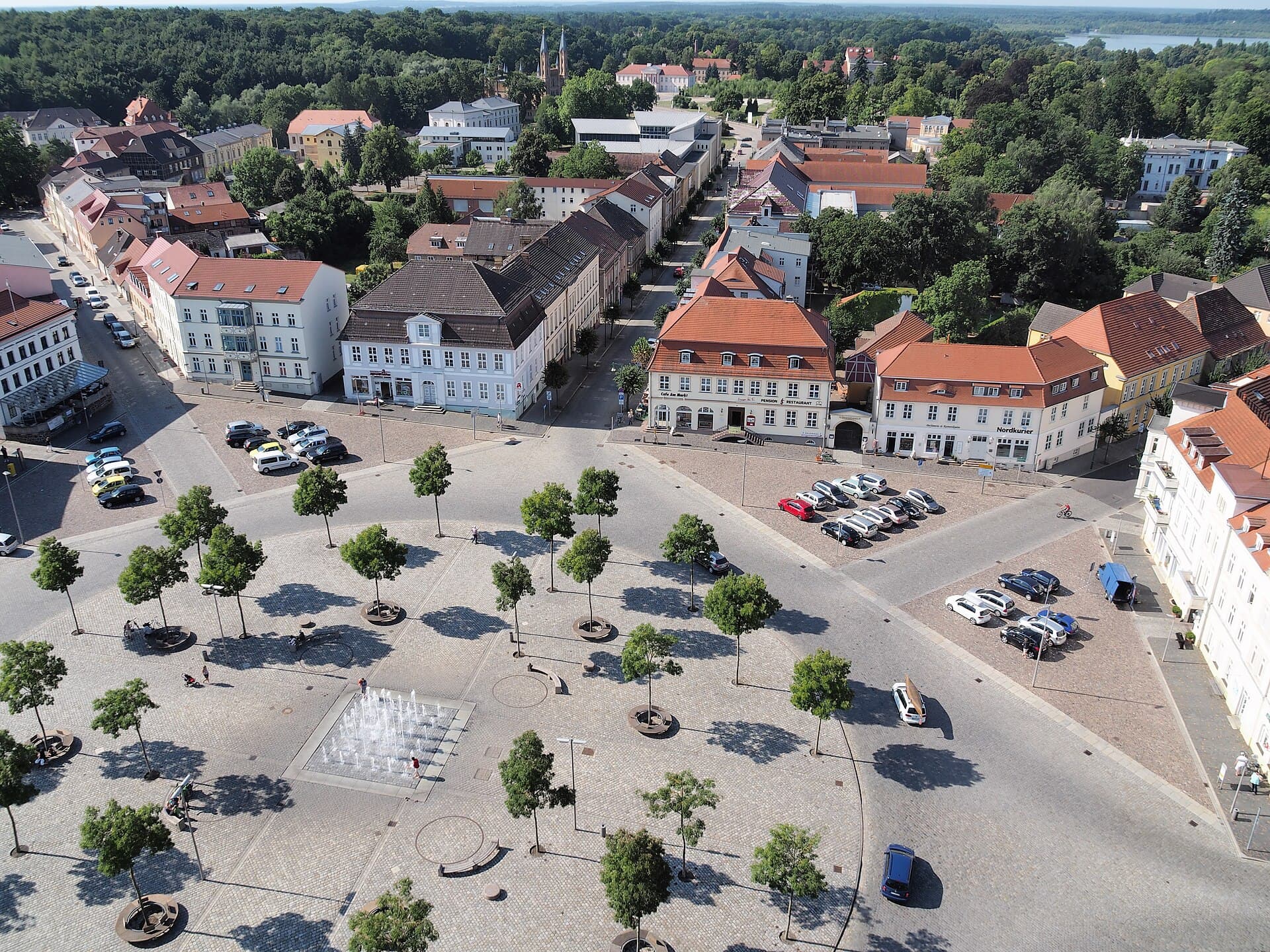 Harke / CC BY-SA 3.0, via Wikimedia Commons
Self-guided audio walking tour of Neustrelitz — GPS route, offline playback, story-driven narration in 32 languages.
“Where Baroque grandeur meets tranquil lakes, a star-shaped city awaiting discovery.”
Not the postcards. The stories even locals don't know — whispered in your ear, right where they happened.
The central market square of Neustrelitz isn't just a pretty face; its singular design holds a secret about the city's very foundation.
While the grand palace itself is gone, the gardens hold a poignant secret about a beloved queen and a quiet tribute.
This elegant building in the palace gardens possesses a dual identity, having served two very different purposes across the centuries.
Discover every secret of Neustrelitz
Every address, every reveal in full — in your ear, right where it happened.
You pick your stops. You walk. The voice reveals what the others miss.
Your self-guided audio tour of Neustrelitz is ready — pick your landmarks, choose your language, and start the moment you arrive.
BuyLume has a built-in augmented-reality guide. Hold your phone up and its camera shows the street ahead of you, with a glowing arrow laid over the real view that always points to your next stop — no map to puzzle over, no wrong turns. Like everything in Lume, it works fully offline.
Neustrelitz, a former ducal residence city in Mecklenburg-Vorpommern, Germany, offers a captivating blend of Baroque architecture and natural splendor. Situated on the shore of the Zierker See within the Mecklenburg Lake District, the city stands as a testament to careful planning and a deep historical narrative. Its singular star-shaped city layout, radiating from the central Marktplatz, is a rare sight in Europe and lends a distinctive character to its urban landscape.
The city's connection to its surrounding natural environment is undeniable. With the Zierker See at its doorstep and the expansive Müritz National Park nearby, Neustrelitz serves as a gateway to serene lakes, dense forests, and diverse wildlife. Whether you are drawn to historical landmarks, quiet strolls, or active outdoor pursuits, Neustrelitz presents an inviting destination that harmonizes cultural heritage with the calm of the Mecklenburg region.
The origins of Neustrelitz trace back to a devastating fire in 1712 that consumed the castle and town of Strelitz, the former capital of the Duchy of Mecklenburg-Strelitz. The ducal family was compelled to relocate to a hunting lodge on the Zierker See. Between 1726 and 1731, this hunting lodge was transformed into a Baroque, three-story palace by architect Christoph Julius Löwe. In 1733, Duke Adolf Friedrich III made this new palace his principal residence, and around it, the city of Neustrelitz, meaning 'New Strelitz,' began to take shape.
Neustrelitz was established in 1733 as a late Baroque planned city, a rarity in Europe. Its most striking feature is the one-hectare square Marktplatz, from which eight streets fan outwards like the points of a star. This singular design, influenced by plans from Brunswick master builder Christoph Julius Löwe, reflects the Baroque era's emphasis on order and symmetry. The city officially became the capital of Mecklenburg-Strelitz in 1736 and remained the ducal seat until 1918, when the German monarchy concluded.
Throughout the 19th century, the cityscape was significantly shaped by Friedrich Wilhelm Buttel, a disciple of the renowned architect Karl Friedrich Schinkel. Buttel was commissioned by the Grand Duke to construct churches, representative buildings, and commercial structures. Notable additions during this period included the redesign of the Orangerie and the construction of the neoclassical Town Hall in 1841. Sadly, the magnificent Neustrelitz Palace, which had served as the main residence for the Grand Dukes, was destroyed by fire on April 29, 1945, during the final days of World War II. While the palace was not rebuilt, its extensive gardens, the Schlossgarten, have been preserved and restored, continuing to tell the story of the city's royal past.
Begin your exploration at the Marktplatz, the star-shaped center of Neustrelitz, where you can admire the Stadtkirche (City Church) and the neoclassical Rathaus (Town Hall). Ascend the 45-meter-high observation deck of the Stadtkirche tower for a sweeping view of the city's distinctive layout. Just a short walk away are the expansive Neustrelitz Palace Gardens (Schlossgarten), a significant landmark even without the palace. Wander through the meticulously maintained grounds, discovering sculptures, fountains, and the Orangerie, now a venue for concerts and dining. Do not miss the Louise Temple, a Greek-style memorial housing the tomb of Queen Louise of Prussia.
For a glimpse into early Slavic life, visit Slawendorf Neustrelitz, an open-air museum on the Zierker See where you can observe and even try ancient crafts. The Kulturquartier Mecklenburg-Strelitz offers insights into regional history and hosts special exhibitions. Nature enthusiasts will appreciate the proximity to Müritz National Park, ideal for cycling, hiking, and water activities, and the scenic Zierker See itself, which offers a 12-kilometer circular walk.
The best time to visit Neustrelitz for warm-weather activities and general outdoor tourism is from mid-June to early September, with a peak in the first week of August. During these months, the weather is typically mild and pleasant, perfect for exploring the lakes and gardens. Spring and autumn also offer pleasant temperatures for hiking and cycling, with fewer crowds. While cooler, the months of November through February can provide a different, quieter experience, and the city's cultural sites are accessible year-round.
Neustrelitz is well-connected by train, with direct services from Berlin taking approximately 1 hour and 13 minutes. Neustrelitz Hauptbahnhof is the main train hub, offering connections for exploring the town and beyond. While there isn't an airport directly in Neustrelitz, Rostock (RLG) is about 81 km away. Once in Neustrelitz, the city center and many attractions are easily walkable. Public transport options are available for longer distances. Consider renting a bike to explore the numerous cycle paths around the lakes and in Müritz National Park. For an extended stay, two to three days are recommended to fully experience the city and its immediate surroundings. German cuisine, including dishes like Bratwurst and Schnitzel, is readily available, alongside options for Mediterranean, Italian, Middle Eastern, and Asian fare.
Neustrelitz in Korean, in Chinese or in Hebrew — and 29 more languages, every stop narrated by a native voice. The widest language range of any self-guided audio tour.
Available in: