Kaiserbrunnen (Emperor Fountain)
The Kaiserbrunnen isn't just a fountain; its bronze figures tell a story that dates back to a legendary catch.
Full story unlocks in the tour
 EPei / CC BY-SA 3.0, via Wikimedia Commons
Self-guided audio walking tour of Kaiserslautern — GPS route, offline playback, story-driven narration in 32 languages.
“Where ancient imperial echoes meet modern innovation and a forest's embrace.”
Not the postcards. The stories even locals don't know — whispered in your ear, right where they happened.
The Kaiserbrunnen isn't just a fountain; its bronze figures tell a story that dates back to a legendary catch.
Beneath the bustling streets of Kaiserslautern lies a network of tunnels.
Beyond its floral displays, this garden show harbors a surprising prehistoric secret.
Discover every secret of Kaiserslautern
Every address, every reveal in full — in your ear, right where it happened.
You pick your stops. You walk. The voice reveals what the others miss.


Your self-guided audio tour of Kaiserslautern is ready — pick your landmarks, choose your language, and start the moment you arrive.
BuyLume has a built-in augmented-reality guide. Hold your phone up and its camera shows the street ahead of you, with a glowing arrow laid over the real view that always points to your next stop — no map to puzzle over, no wrong turns. Like everything in Lume, it works fully offline.
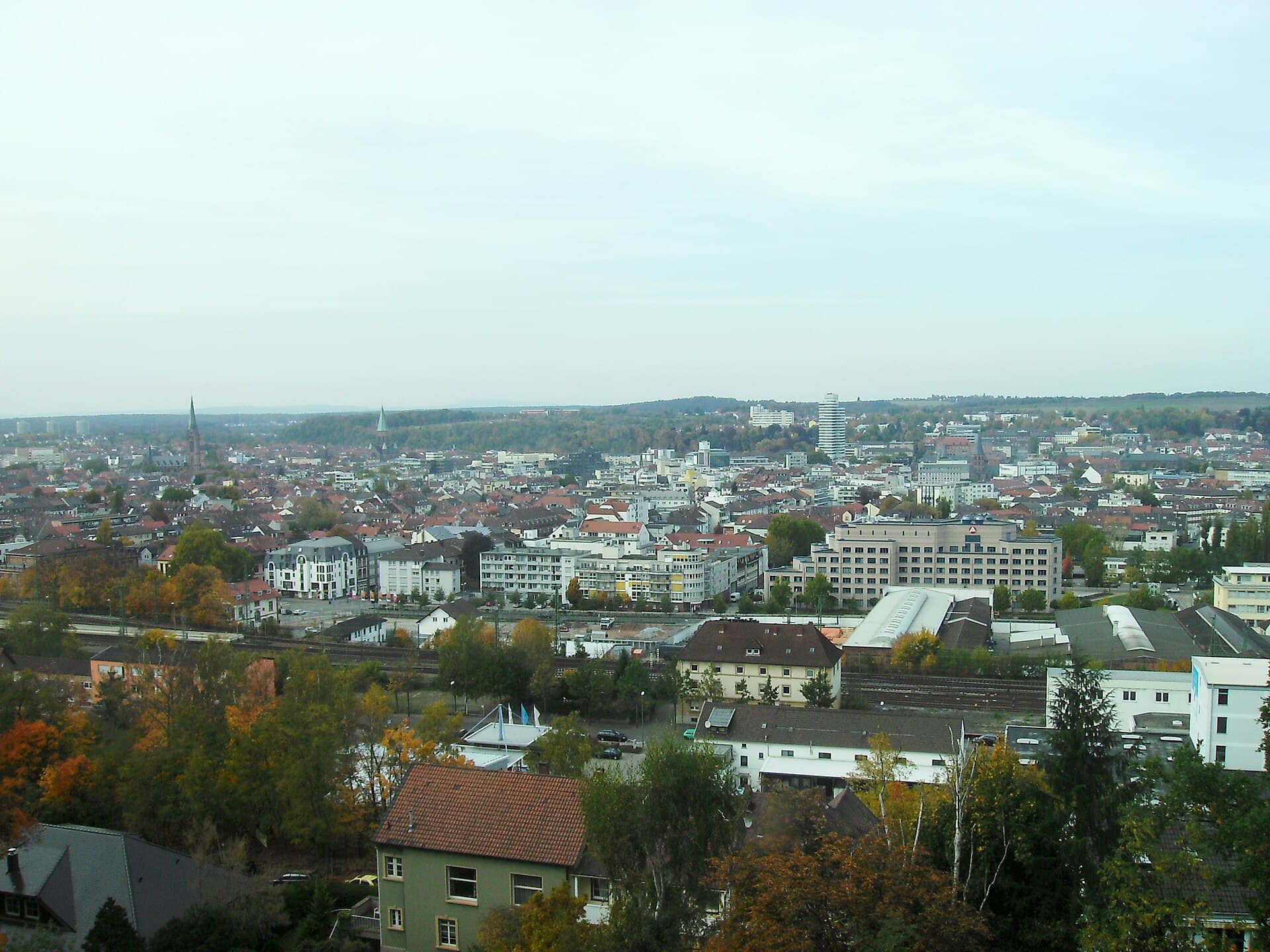
Kaiserslautern, affectionately known as 'K-Town' to many, is a city in southwestern Germany that offers a compelling blend of historical depth and contemporary life. Situated on the edge of the vast Palatinate Forest, it serves as a gateway for nature enthusiasts while maintaining a lively urban atmosphere. With a population of around 100,000, Kaiserslautern manages to feel both welcoming and well-equipped with modern amenities.
The city's character is shaped by its deep historical roots, stretching back to Roman times and prominently featuring Emperor Frederick Barbarossa, who established a royal palace here in the 12th century. This imperial legacy coexists with a significant international community, particularly the large American military presence, which has fostered a unique cultural blend.
Visitors to Kaiserslautern will discover a city that balances green spaces with cultural attractions. From tranquil Japanese gardens to an active football culture centered around the 1. FC Kaiserslautern club, the city provides diverse experiences. It is also a hub for science and IT, home to a technical university and various research institutions.
Kaiserslautern's story begins long before its imperial designation, with settlement traces dating back to 800 B.C., believed to be Celtic. A royal residence existed in the Carolingian period, after 751. The city truly began to take shape in the 12th century when Holy Roman Emperor Frederick I, known as Barbarossa, established a royal palace here between 1152 and 1160. The city's name itself is derived from 'Kaiser' (Emperor) and 'Lauter,' a local stream that historically made the old section of the city an island. Remains of Barbarossa's original castle can still be seen in front of the Rathaus, the city hall.
As the population grew, King Rudolf von Habsburg chartered Kaiserslautern as an imperial city in 1276. The Stiftskirche, the city's oldest church, was constructed between 1250 and 1350, and St. Martin's Church followed in the 14th century, originally as a Franciscan monastery church. A section of the original city wall remains in St. Martin's courtyard. By 1375, Kaiserslautern became part of the Electoral Palatinate.
The city was a focal point of the Palatinate democratic revolution in 1848–49. By 1900, Kaiserslautern had transformed into a significant industrial center, particularly known for ironworks and cotton mills. Georg Michael Pfaff's sewing machine factory, founded in the city, gained worldwide recognition and was a mainstay for many years. However, the 20th century brought immense challenges. Allied bombing during World War II destroyed over 85% of Kaiserslautern. The city underwent significant reconstruction after the war.
The Cold War era saw Kaiserslautern gain prominence as a military base, hosting one of the largest U.S. overseas military installations, Ramstein Air Base. This led to the city's nickname, 'K-Town,' and a unique blend of German and American cultures. In 1969, Kaiserslautern officially became a city with the incorporation of several surrounding communities. The Technical University of Kaiserslautern was founded in 1970, further establishing the city as a center for science and IT. Today, Kaiserslautern continues to evolve, embracing its diverse heritage while looking towards technological innovation.
Begin your exploration at the Kaiserbrunnen (Emperor Fountain), a bronze and sandstone sculpture that visually narrates the city's history, including the famous pike legend. Nearby, discover the Stiftskirche, Kaiserslautern's oldest church, a Gothic hall church dating back to the 13th century. Just behind St. Martin's Church, you can find remnants of the old medieval fortification walls, offering a tangible link to the city's past as a walled settlement.
For a journey through art, the Museum Pfalzgalerie Kaiserslautern showcases paintings, sculptures, and graphic art from the 19th century onward, with a notable focus on German impressionism and expressionism, as well as American art. Nature lovers will appreciate the Japanischer Garten (Japanese Garden), one of the largest Japanese gardens in Europe, providing a serene escape with traditional ponds and tea houses. The Gartenschau Kaiserslautern is another expansive green space, known for its flowerbeds, adventure golf, and a unique open-air dinosaur exhibit with life-sized models.
History buffs can visit the Burg Hohenecken, the ruins of a hilltop castle from around 1200, offering panoramic views of the surrounding area. For a deeper dive into local history, the Theodor-Zink-Museum/Stadtmuseum provides a comprehensive look at Kaiserslautern's past, from prehistoric times to the modern era. Don't miss the Fritz-Walter-Stadion, home to the 1. FC Kaiserslautern football club and a host city for the 2006 World Cup.
The best time to visit Kaiserslautern for warm-weather activities is from late June to early September. During these months, the average daily temperature ranges from pleasant to warm, with July being the hottest month, averaging 75°F (24°C). This period also sees clearer skies, with July being the clearest month. While June has the highest average rainfall, precipitation is moderate throughout the year. Shoulder seasons, like spring and early autumn, offer a good balance of comfortable weather and fewer crowds, potentially leading to better hotel value. For those interested in festivals, garden shows are often held from April to October.
Kaiserslautern is well-connected and accessible. Frankfurt Airport (FRA) is the primary international hub, approximately 88.6 km away, with taxi or car travel taking about 1 hour and 30 minutes. Frankfurt-Hahn Airport (HHN) and Baden-Airpark (FKB) are also viable options, particularly for budget airlines. The city's main train station, Kaiserslautern Hauptbahnhof (KLT), is centrally located, making train travel an efficient way to arrive.
Getting around the city is straightforward. Kaiserslautern has a city bus system, and tickets can be purchased from the driver. Buses also accept US dollars. Cycling is a popular mode of transport, with most streets featuring bicycle lanes. Rental bicycles are available, often from the Central Station. The weather can be changeable, so packing layers, including a waterproof jacket or umbrella, is advisable, even in summer. If your visit coincides with a football match at the Fritz-Walter-Stadion or a major festival, it's recommended to book accommodation in advance due to increased demand.
Kaiserslautern in Korean, in Chinese or in Hebrew — and 29 more languages, every stop narrated by a native voice. The widest language range of any self-guided audio tour.
Available in: