Kronenburg Castle
The castle you observe today is not entirely its original form.
Full story unlocks in the tour
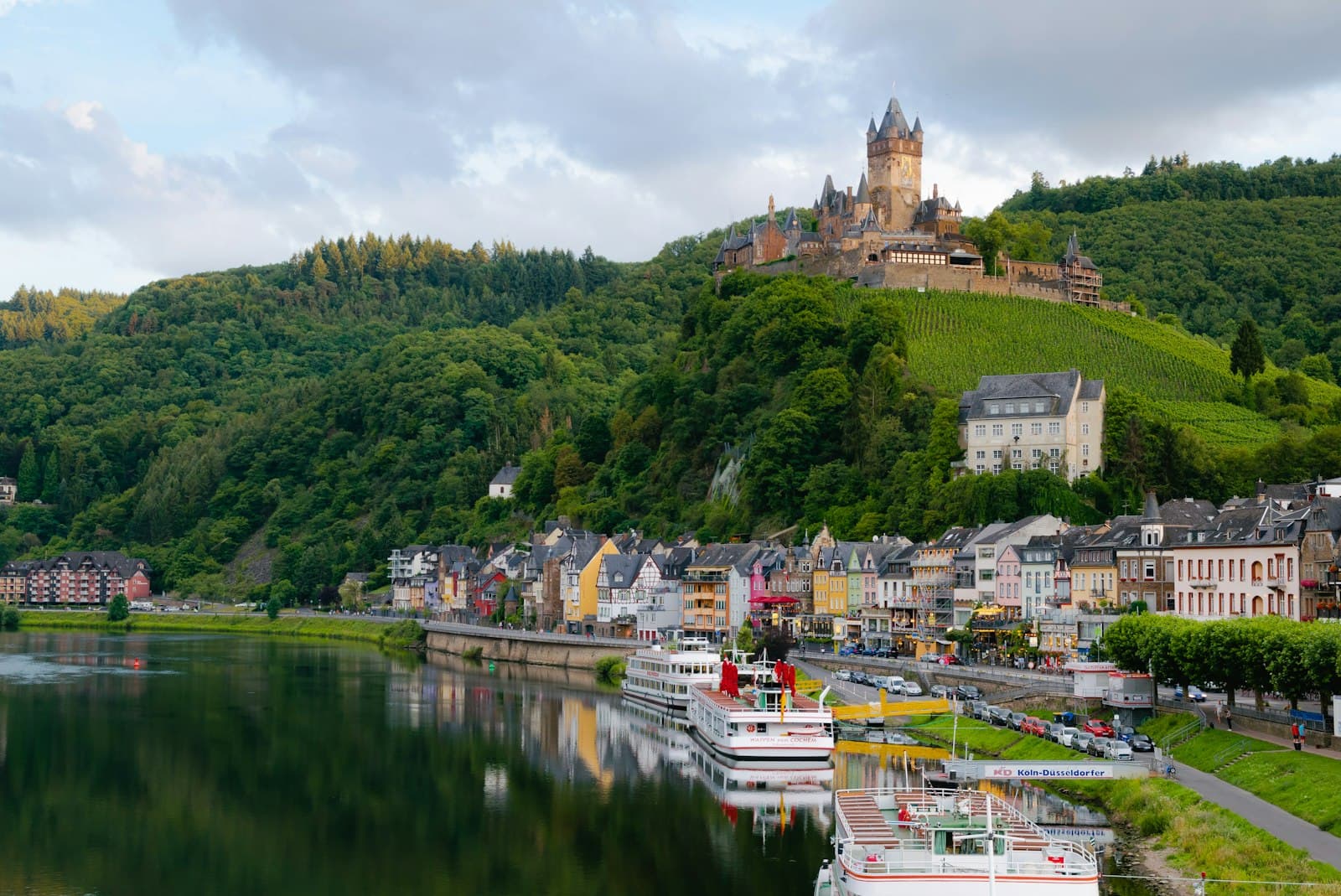 Photo: Kai Pilger / Unsplash
Self-guided audio walking tour of Kronenburg — GPS route, offline playback, story-driven narration in 32 languages.
“Where ancient stones meet the Eifel's calm waters.”
Not the postcards. The stories even locals don't know — whispered in your ear, right where they happened.
The castle you observe today is not entirely its original form.
This 15th-century church safeguards an architectural secret within its walls.
The tranquil lake was not always a natural feature of the terrain.
Discover every secret of Kronenburg
Every address, every reveal in full — in your ear, right where it happened.
You pick your stops. You walk. The voice reveals what the others miss.
Your self-guided audio tour of Kronenburg is ready — pick your landmarks, choose your language, and start the moment you arrive.
BuyLume has a built-in augmented-reality guide. Hold your phone up and its camera shows the street ahead of you, with a glowing arrow laid over the real view that always points to your next stop — no map to puzzle over, no wrong turns. Like everything in Lume, it works fully offline.
Kronenburg, a captivating village in Germany's Eifel region, offers passage through time with its medieval streetscape and the commanding remnants of its castle. Situated on a ridge above the Kyll valley, the village is characterized by narrow passages and structures, some reaching 400 years of age, all embraced by the castle's encircling wall. This carefully preserved character earned Kronenburg the designation of 'Golddorf' (Golden Village) in 2006.
Beyond its historical allure, Kronenburg serves as a gateway to the natural splendor of the Nordeifel Nature Park. The village affords sweeping views over the Kyll valley and the Kronenburger See, inviting visitors to traverse the surrounding landscape through various outdoor pursuits. It is a location where history and nature intertwine, providing a peaceful escape with a profound past.
The chronicles of Kronenburg extend to the 13th century, with Kronenburg Castle first appearing in records in 1277. The Lords of Kronenburg, initially of modest standing, ascended to nobility around 1300. By the close of the 14th century, the final Knight of Kronenburg, Peter, became a vassal of the Counts of Luxembourg, who then maintained authority over the castle until 1795.
The region's political allegiances shifted across centuries, experiencing Spanish dominion and French occupation. In 1795, the French Republic annexed the territory, and in 1809, the confiscated castle was sold at auction. Regrettably, by this juncture, the castle lay in ruins and was subsequently utilized by local residents as a quarry for many decades.
Despite the castle's decline, the settlement around the fortification persisted, with many buildings retaining their external appearance for centuries. The village and its outer bailey sustained damage during World War II. However, Kronenburg has since been acknowledged for its enduring medieval character, earning the designation of 'Golddorf' in 2006. The village has also witnessed an influx of artists since the 19th century, enriching its cultural landscape with art galleries and craft workshops.
Begin your exploration at the Kronenburg Castle ruins, which rise from a rocky spur surveying the village. Though not entirely complete, the remnants of the surrounding wall, two semi-circular towers of the north gate, and the keep provide insight into its 13th-century origins. From these remnants, you will be rewarded with expansive vistas of the Kyll valley and Kronenburger See.
Amble through the village's narrow passages, admiring the carefully preserved half-timbered houses, some dating back 400 years, embraced by the castle's encircling wall. The Parish Church of St. John the Baptist, a 15th-century architectural creation, merits a visit, particularly for its singular central pillar supporting the net vault.
For those who appreciate art, the village hosts art galleries and craft workshops. You can also follow the Kronenburg Art Trail or visit the Dr. Axe Foundation's art atelier at Hasenberghof, which presents rotating exhibitions of 19th-century Düsseldorf Art School paintings.
Below the village, the Kronenburger See offers a spectrum of recreational pursuits. You can follow a circular path around the lake, or engage in boating, sailing, surfing, and fishing. The lake area also presents opportunities for walking and cycling, with paths like the Vennquerbahn Cycle Path nearby.
The most favorable period to visit Kronenburg for warm-weather pursuits extends from late June to late August, when average daily high temperatures exceed 66°F. July is typically the warmest month, with an average high of 73°F. This interval also offers the clearest skies. Alternatively, spring (April-June) and autumn (September-October) provide pleasant weather with fewer crowds, making them ideal for exploring the village and its surrounding nature.
Kronenburg is located in the North Rhine-Westphalia region of Germany, near the German-Belgian border. The medieval village can be reached from Dahlem train station via TaxiBusPlus-line 834, though it requires ordering the bus at least 30 minutes in advance by phone. If arriving by car, parking is available at Burgbering in front of the North Gate and on Burgstraße.
While traversing the village, be prepared for walking on narrow passages and around the castle's encircling wall. For activities at Kronenburger See, note that a parking fee of €4.00 per day per vehicle applies, and a ticket must be obtained from a parking machine. Dogs are allowed at the lake but must be kept on a leash, and there are designated no-dog zones.
Kronenburg in Korean, in Chinese or in Hebrew — and 29 more languages, every stop narrated by a native voice. The widest language range of any self-guided audio tour.
Available in: