Ancient Lixus
Close to Larache rests a city so old, it is said to be the home of a legendary garden and one of Hercules's impossible tasks.
Full story unlocks in the tour
 Ideophagous / CC BY-SA 4.0, via Wikimedia Commons
Self-guided audio walking tour of Larache — GPS route, offline playback, story-driven narration in 32 languages.
“Where the Atlantic breeze carries echoes of ancient myths and colonial memory.”
Not the postcards. The stories even locals don't know — whispered in your ear, right where they happened.
Close to Larache rests a city so old, it is said to be the home of a legendary garden and one of Hercules's impossible tasks.
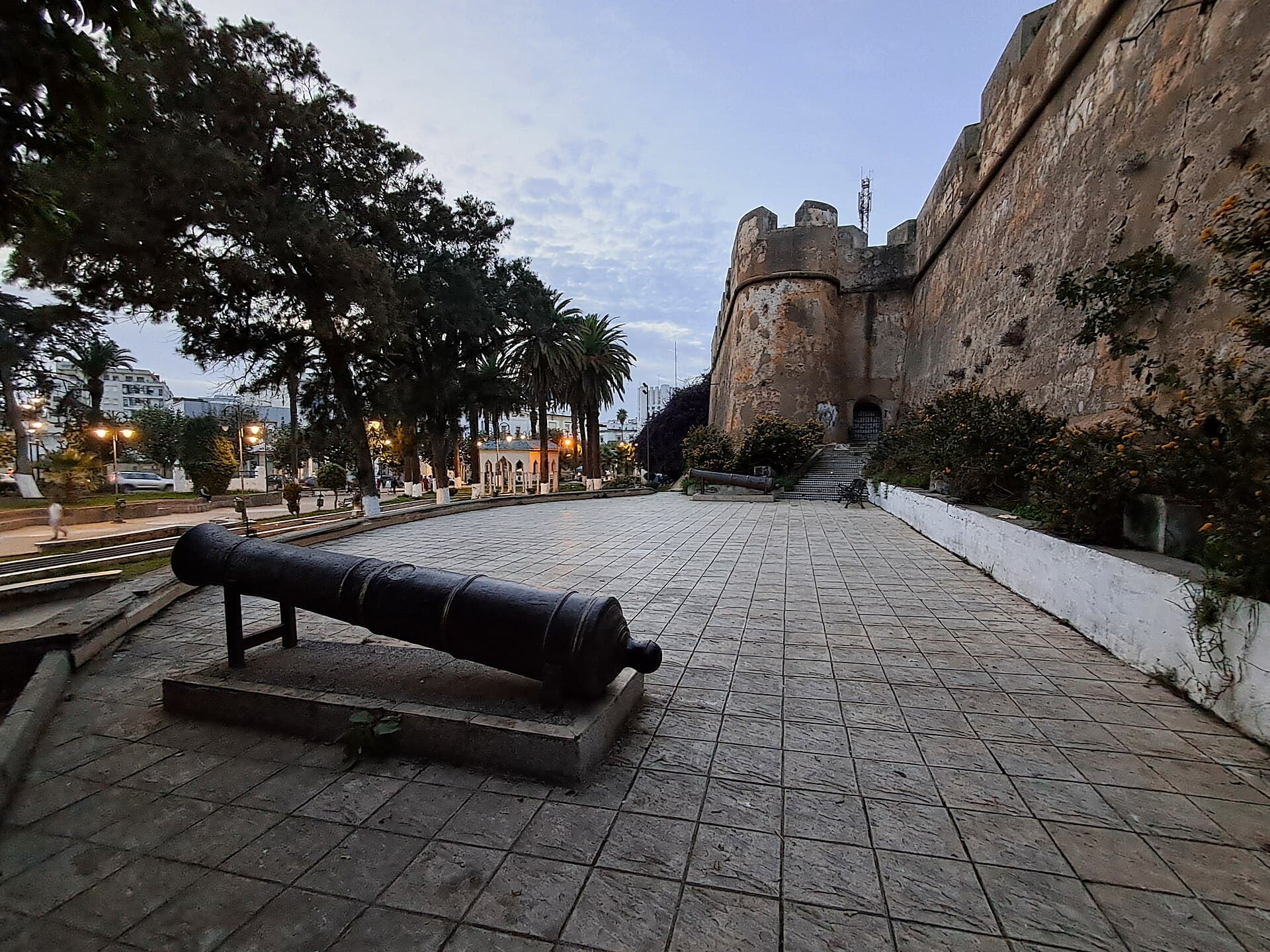
This imposing fortress once protected the port, but its later life took a surprising turn.
Wander through the old town and you will find an unexpected architectural blend in its market.
Discover every secret of Larache
Every address, every reveal in full — in your ear, right where it happened.
You pick your stops. You walk. The voice reveals what the others miss.


Your self-guided audio tour of Larache is ready — pick your landmarks, choose your language, and start the moment you arrive.
BuyLume has a built-in augmented-reality guide. Hold your phone up and its camera shows the street ahead of you, with a glowing arrow laid over the real view that always points to your next stop — no map to puzzle over, no wrong turns. Like everything in Lume, it works fully offline.
Larache, a coastal city on Morocco's northwestern Atlantic coast, offers a captivating blend of history, culture, and seaside allure. Situated at the mouth of the Loukkos River, it is a place where Phoenician origins, Roman remnants, and strong Spanish colonial influences converge, creating a unique atmosphere distinct from other Moroccan cities.
Unlike some of Morocco's more heavily touristed destinations, Larache retains an authentic rhythm of daily life. Its whitewashed buildings, often adorned with blue accents, and its laid-back ambiance invite visitors to slow down and immerse themselves in a deep array of traditions. From lively markets to ancient ruins and an active fishing port, Larache provides a genuine glimpse into Moroccan coastal living.
## From Ancient Lixus to Colonial Crossroads Larache's history stretches back millennia, with its roots intertwined with the ancient city of Lixus, located just 2 miles northeast on the north bank of the Loukkos River. Founded by the Phoenicians around the 12th century BCE, Lixus was successively a Phoenician, Carthaginian, and Roman settlement, making it one of the oldest continuously inhabited sites in the region. Legend even places the mythical Garden of the Hesperides, with its golden apples, in the vicinity of Lixus.
The city of Larache itself is not mentioned in Arabic historical sources until the 13th century, founded by the Idrisite Banu 'Arus who named it 'al-'Ara'ish' for the abundant grapevines. In the late 12th century, the Almohad caliph Ya'qub al-Mansur built a fortress here. Over the centuries, Larache became a strategic port, desired by European powers. The Portuguese briefly occupied it in the 15th century, establishing the Graciosa fortress nearby. The city then gained notoriety as a shipbuilding center for Barbary corsairs, using wood from the Mamora Forest.
In 1610, Larache passed to the Spanish, who held it for nearly 80 years before Moulay Ismail reconquered it for Morocco in 1689. However, Spanish influence would return. From 1911 to 1956, during the colonial era, Larache was part of the Spanish Protectorate in Morocco, profoundly shaping its architecture, urbanism, and cultural identity. This period left an indelible mark, evident in the city's Hispano-Moorish style and the prevalence of Spanish language alongside Arabic. Since Morocco's independence in 1956, Larache has continued its life as an important fishing port, blending its diverse historical layers into a unique coastal identity.
Begin your exploration in the Place de la Libération (formerly Plaza de España), the city's active heart, surrounded by colonial buildings and lively cafes. From here, delve into the Medina of Larache, a labyrinth of narrow streets filled with traditional shops and unique architectural features, including charming umbrella-covered walkways. Do not miss the Kasbah of Larache, an ancient fortress offering wide views over the city, the Loukkos River, and the Atlantic coastline.
Just a short distance away, the Lixus Archaeological Site provides a fascinating journey into antiquity with its Phoenician, Carthaginian, and Roman ruins. Back in town, stroll along the Atlantic Balcony (or corniche) for refreshing sea breezes and views of the fishing port, where you can watch local fishermen in action. The Spanish Cemetery, situated on an elevated point, offers both historical insight and expansive ocean vistas. For a moment of tranquility, visit the Jardines de la República Park or the serene Mausoleum of Moulay Ismail.
The best time to visit Larache is during the spring (March to May) and fall (September to November). During these shoulder seasons, temperatures are mild and pleasant, ranging from 18°C to 27°C (64°F to 81°F), ideal for exploring on foot and enjoying outdoor activities. You will also encounter fewer crowds compared to the peak summer months. Summers (June to August) can be hot, with temperatures reaching up to 35°C (95°F), though coastal breezes offer some relief. Winters (December to February) are mild but can be rainy.
Larache is accessible, with the closest major airport being Tangier Ibn Battouta Airport (TNG), approximately 80 kilometers away. From there, you can take a taxi or rent a car for the 1 to 1.5-hour journey. Buses also connect Larache to major Moroccan cities like Tangier and Casablanca. While Larache is generally safe, standard travel precautions are advised, such as being aware of your surroundings in crowded areas and dressing modestly, especially when visiting religious sites. Cash is recommended as credit cards may not be universally accepted. English is not widely spoken, so some French or Spanish will be helpful, though Arabic is the main language. Do not forget to hydrate and use sunscreen, particularly in warmer months.
Larache in Korean, in Chinese or in Hebrew — and 29 more languages, every stop narrated by a native voice. The widest language range of any self-guided audio tour.
Available in: