The Grand Master's Palace
Beyond its grand halls, the palace once sheltered some unexpected residents.
Full story unlocks in the tour
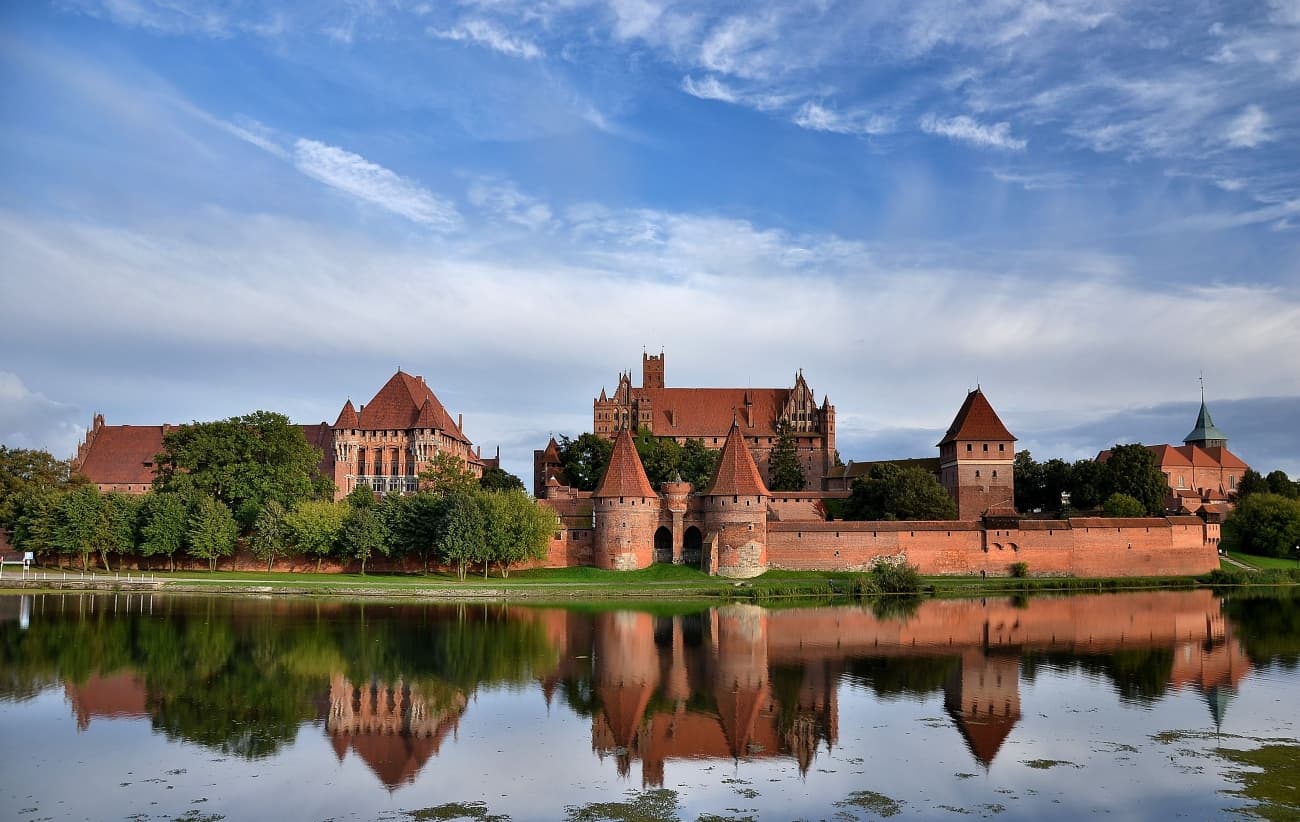 Gregy / CC BY-SA 3.0 pl, via Wikimedia Commons
Self-guided audio walking tour of Malbork — GPS route, offline playback, story-driven narration in 32 languages.
“Where brick speaks of crusaders and kings.”
Not the postcards. The stories even locals don't know — whispered in your ear, right where they happened.
Beyond its grand halls, the palace once sheltered some unexpected residents.
While formidable, the castle's defenses were once overcome in an unusual manner.
The river flowing past the castle carries a legend of a sacred connection to a distant land.
Discover every secret of Malbork
Every address, every reveal in full — in your ear, right where it happened.
You pick your stops. You walk. The voice reveals what the others miss.


Lume has a built-in augmented-reality guide. Hold your phone up and its camera shows the street ahead of you, with a glowing arrow laid over the real view that always points to your next stop — no map to puzzle over, no wrong turns. Like everything in Lume, it works fully offline.
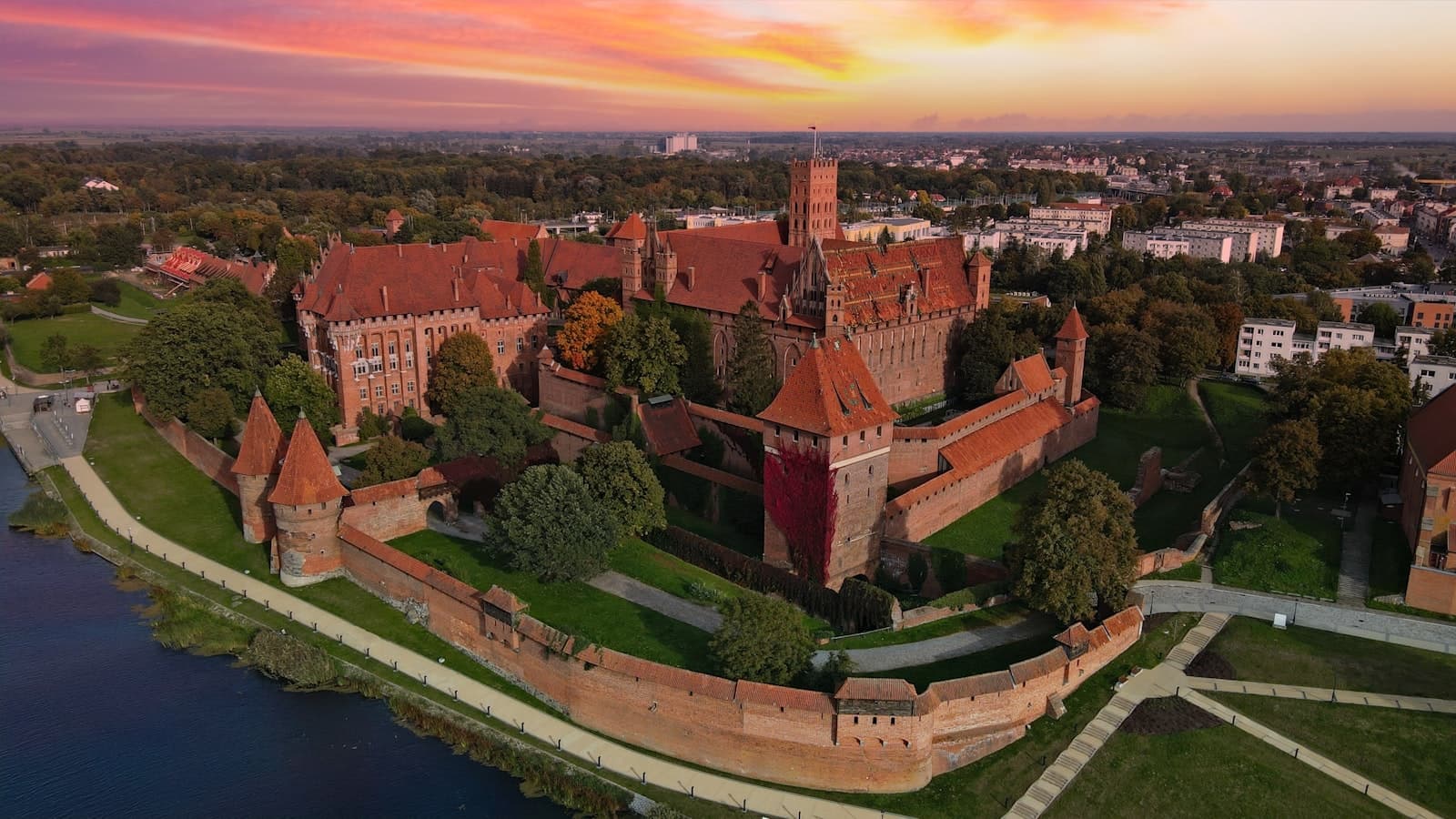
Malbork Castle, a colossal brick fortress in northern Poland, stands as the largest castle in the world by land area, encompassing 21 hectares (52 acres) on the Nogat River's eastern bank. Originally named Marienburg, or 'Mary's Castle,' in honor of the Virgin Mary, it was constructed by the Teutonic Order starting in 1274. This UNESCO World Heritage site is not a single building but a complex of three fortified castles: the High, Middle, and Low Castles, each added as the Order's needs expanded.
Today, Malbork Castle operates as a state-run museum, drawing around 600,000 visitors annually. Its imposing Gothic architecture and intricate details offer a profound journey into medieval history, showcasing the ambition and power of the Teutonic Knights. Visitors can explore its vast courtyards, grand halls, and numerous exhibitions, which collectively house over 40,000 items, including extensive collections of medieval artifacts, armor, and amber. The castle's sheer scale and the stories embedded within its red brick walls make it a captivating destination for anyone interested in European history and architecture.
Malbork is a comfortable day trip from Gdańsk, with frequent direct trains making the journey in under an hour. Whether you choose a comprehensive historical route or a more focused grounds tour, the castle promises an immersive experience that transports you back to the era of crusading knights and monastic states.
Construction of Malbork Castle began around 1274 by the Teutonic Order, a German crusading military and religious order. The Order initially built the fortress to solidify its control over Prussia following the suppression of the Great Prussian Uprising of Baltic tribes. The castle was strategically located on the Nogat River, providing easy access and control over trade routes from the Baltic Sea. By 1309, Malbork, then known as Marienburg, became the seat of the Order's Grand Master, effectively making it the capital of their monastic state. The castle underwent significant expansion until it reached its final form in 1406, becoming the largest brick castle in the world.
Despite its formidable defenses, Malbork Castle faced numerous challenges. It successfully withstood many attempted sieges throughout the 14th century, including a notable two-month siege in 1410 by Polish and Lithuanian forces after the Battle of Grunwald. However, the castle's fate changed in 1457 during the Thirteen Years' War. Bohemian mercenaries, to whom the Teutonic Order owed indemnities, sold the castle to King Casimir IV of Poland. Malbork then served as a Polish royal residence and the seat of Polish institutions for over 300 years, from 1457 until 1772. During this period, Polish kings frequently stayed at the castle, especially when traveling to Gdańsk.
In 1772, with the First Partition of Poland, Malbork was incorporated into Prussia, and the castle began to fall into disrepair. Public campaigns led to restoration efforts that commenced in 1816 and continued until World War II. However, the castle suffered extensive damage in 1945 due to the Russian Army, with losses estimated at 60%. After World War II, Malbork and its castle once again became part of Poland. Restoration efforts resumed in 1961 with the founding of the Castle Museum. In December 1997, Malbork Castle was designated a UNESCO World Heritage site, recognizing its immense historical and architectural significance.
Malbork Castle is a sprawling complex, and a thorough exploration typically takes 3 to 4 hours with an audio guide. The experience is divided into three main zones: the High, Middle, and Low Castles.
Begin your journey in the High Castle (Hochburg, Zamek Wysoki), the oldest part of the complex and the original convent. This four-winged building, designed like a fortified Cistercian monastery, wraps around a central courtyard with a well. Here, you'll find the Chapter House and the Chapel of St. Mary.
Next, move to the Middle Castle, which houses the impressive Grand Master's Palace, once the residence of the Teutonic Order's Grand Master. Do not miss the Knights' Refectory, known for its palm-vaulted ceiling, and the Grand Chapter Hall. The Middle Castle also features an armory and a significant amber exhibition, showcasing one of Europe's largest collections of medieval artifacts.
Finally, explore the Low Castle (Outer Bailey), which once contained workshops, granaries, and other support buildings. The castle grounds also include St. Anne's Chapel and the terraces with the Grand Masters' Garden. For a truly iconic view, cross the bridge over the Nogat River to the west bank, especially at golden hour, to see the castle reflected in the water.
Consider visiting the castle's various permanent and temporary exhibitions, which include collections of weaponry, armor, flags, and an extensive coin collection. During peak season (May to September), an evening 'Son et Lumière' projection and sound show, 'Road of the Knights,' illuminates the castle walls, offering a compressed history of the Teutonic Order.
The ideal time to visit Malbork Castle is during the shoulder seasons—late May, June, or early September—to enjoy mild weather and fewer crowds. Weekdays are generally less busy than weekends. Arriving early in the morning or later in the afternoon can help you avoid the busiest times.
Summer (July and August) offers the warmest weather and longer daylight hours, making it ideal for outdoor events and the evening 'Son et Lumière' show. However, these months also see the largest gatherings of people. While winter offers a quieter, atmospheric experience with snow-covered grounds, the castle is unheated, so dress warmly.
Malbork Castle is open year-round, but hours vary seasonally. From late April to late September, it's typically open daily from 9:00 AM to 8:00 PM (last entry 6:30 PM for interiors). During winter (November to February), hours are significantly reduced, often from 9:00 AM to 1:00 PM or 10:00 AM to 3:00 PM, with some weekday closures. The castle is closed on certain public holidays, including New Year's Day, Easter Sunday, and Christmas.
Tickets are mandatory and include a guided tour (in Polish) or an audio guide (available in multiple languages, including English, German, and Spanish). The Historical Castle Route, covering the entire castle, takes approximately 3.5 hours. Booking tickets online in advance is highly recommended, especially during peak season, to secure your preferred time slot and avoid queues. On Mondays, only the Castle Grounds Route is available, and admission is free, though you still need to collect a free ticket.
Comfortable shoes are essential for navigating the castle's cobbled courtyards and numerous stairs. Dress in layers, as the castle interiors can be cool even on warm days. Parts of the castle are accessible for visitors with mobility issues, including the ticket office, grounds, and some interior areas, with elevators and stair platforms available in certain locations. However, many older sections have uneven surfaces and narrow medieval stairs. Photography without flash or tripod is permitted everywhere, but drones require a museum permit.
On-site amenities include restrooms and a restaurant, Gothic Café and Restaurant, located in the Middle Castle. There are also restaurants in Malbork town, a short walk from the castle entrance. Parking is available in public and private paid car parks near the castle entrance.
Malbork in Korean, in Chinese or in Hebrew — and 29 more languages, every stop narrated by a native voice. The widest language range of any self-guided audio tour.
Available in: