The 'werfs' (artificial mounds)
Marken's houses stand on small hills, but these aren't natural formations.
Full story unlocks in the tour
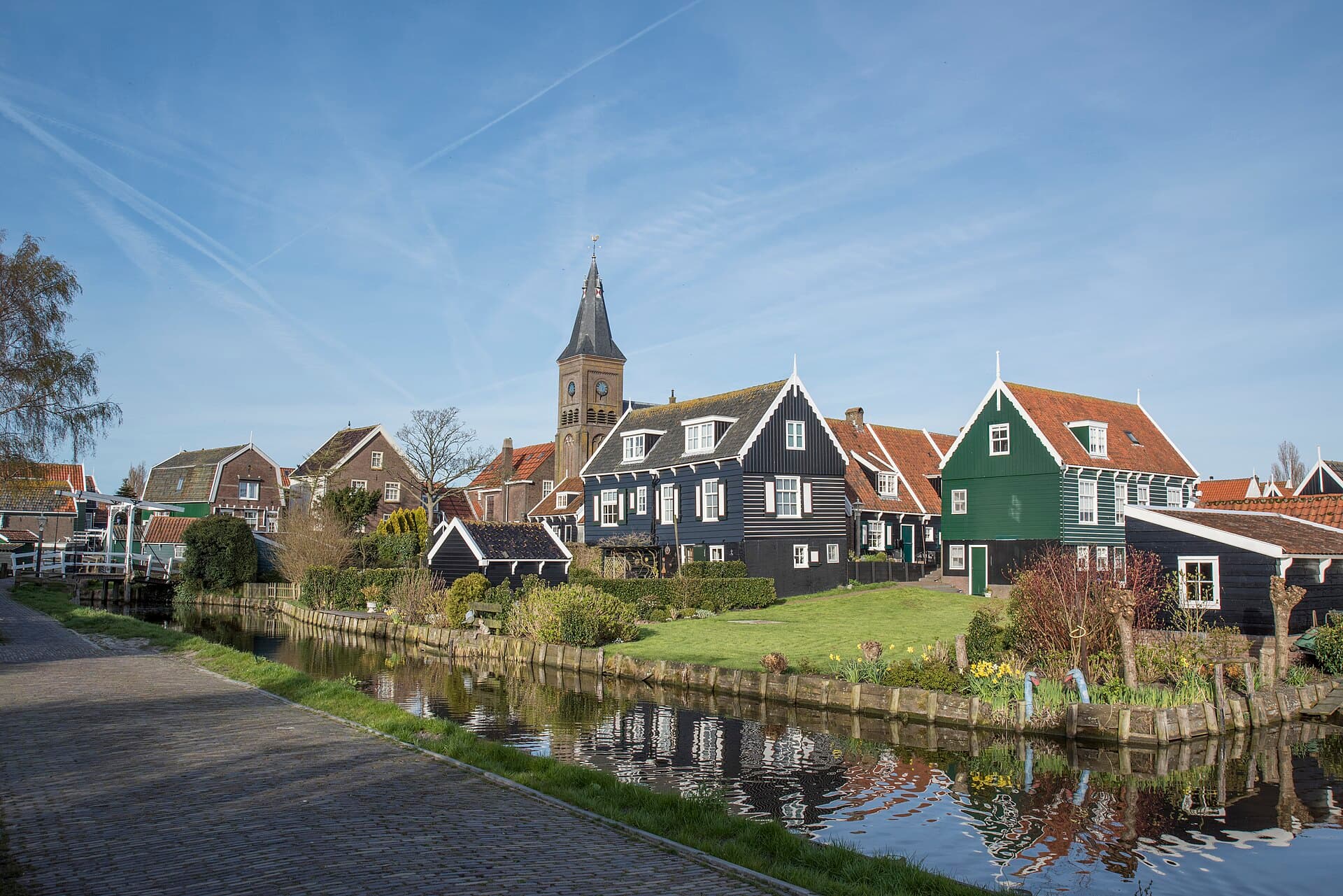 Hnapel / CC BY-SA 4.0, via Wikimedia Commons
Self-guided audio walking tour of Marken — GPS route, offline playback, story-driven narration in 32 languages.
“Where emerald houses meet the sea, and time drifts by on ancient tides.”
Not the postcards. The stories even locals don't know — whispered in your ear, right where they happened.
Marken's houses stand on small hills, but these aren't natural formations.
The colorful traditional clothing of Marken holds a secret about the island's past connections.
The iconic white lighthouse at the tip of Marken has an unexpected tenant.
Discover every secret of Marken
Every address, every reveal in full — in your ear, right where it happened.
You pick your stops. You walk. The voice reveals what the others miss.


Your self-guided audio tour of Marken is ready — pick your landmarks, choose your language, and start the moment you arrive.
BuyLume has a built-in augmented-reality guide. Hold your phone up and its camera shows the street ahead of you, with a glowing arrow laid over the real view that always points to your next stop — no map to puzzle over, no wrong turns. Like everything in Lume, it works fully offline.
Step into a postcard-perfect scene in Marken, a village that feels suspended in time, just a short journey from Amsterdam. Once an isolated island battling the whims of the Zuiderzee, Marken is now a tranquil peninsula, connected to the mainland by a dike built in 1957. Its distinctive green and white wooden houses, built on artificial mounds known as 'werfs,' tell a story of resilience against the water.
As you wander the narrow lanes, you'll discover a community that has fiercely preserved its unique culture, traditions, and even its own dialect. Marken offers a captivating glimpse into a traditional Dutch way of life, where the echoes of a fishing past still resonate in its charming harbor and historic buildings. It’s a place where every corner turned reveals a picturesque scene, inviting you to slow down and immerse yourself in its timeless beauty.
Marken's story begins long before it became the quaint peninsula we see today. Originally connected to the mainland, the area was known as 'borderland,' a name reflected in 'Marken,' as it marked the boundary between water and peatland. However, a series of devastating floods in the 12th and 13th centuries, most notably the Saint Juliana flood in 1164, dramatically reshaped the landscape, transforming Marken into an island in what would become the vast Zuiderzee.
For over seven centuries, this isolation forged a unique identity for Marken. Cut off from the rest of North Holland, its inhabitants, primarily fishermen, developed distinct customs, a unique dialect, and a characteristic architectural style. To survive the constant threat of rising waters, they ingeniously constructed their wooden houses on artificial mounds called 'werfs,' a testament to their enduring spirit. During the 17th century, Marken prospered with booming fishing and shipping industries, a period of economic thriving that lasted until the early 20th century.
The 1916 Zuiderzee Flood was a pivotal moment, causing widespread damage and prompting a national re-evaluation of water management. This disaster was one of the events that ultimately led to the construction of the Afsluitdijk in 1932, which cut off the Zuiderzee from the North Sea, transforming it into the freshwater IJsselmeer and ending Marken's primary source of income from sea fishing. In 1957, a causeway was built, finally connecting Marken to the mainland and transforming it from an island into a peninsula. Despite this connection, Marken has remarkably preserved its authentic character and traditions, making it a living museum of Dutch heritage.
Begin your exploration at Marken's picturesque harbor, where colorful wooden houses line the waterfront and small fishing boats bob gently. From here, wander through the narrow lanes of the car-free old village, best explored on foot. The unique architecture, with its green and white wooden houses often built on 'werfs' (artificial mounds), is a highlight.
Visit the Marker Museum, housed in several restored fishermen's homes, to delve into the island's history, traditional costumes, and the fishing trade that sustained its people for centuries. Don't miss the local wooden shoe workshop, where you can witness the traditional craft of clog carving. For a truly iconic view, take a walk along the dike to the eastern tip of the peninsula to see the 'Paard van Marken' (Horse of Marken) lighthouse, a striking white beacon dating from 1839. While the lighthouse itself is privately inhabited and not open to visitors, the walk offers serene views of the Markermeer.
Consider taking the 'Marken Express' ferry for a scenic 30-minute journey across the Markermeer to the equally charming village of Volendam, offering a different perspective of the Dutch countryside.
The best time to visit Marken is during the spring and summer months, from April to September. During this period, the weather is mild with more sunshine, and temperatures typically range between 18-25 degrees Celsius (64-77 degrees Fahrenheit). Spring offers the added beauty of blooming tulip fields in the surrounding region, while summer provides sunny days perfect for strolling along the harbors and enjoying outdoor cafes. While Marken is charming year-round, some attractions may have reduced hours in the colder months.
Marken is easily accessible from Amsterdam. You can take Metro line 52 to Amsterdam Noord and then change to bus 315, which will take you directly to Marken in about 30 minutes. If you're driving, it's approximately a 20-minute drive from Amsterdam city center, with parking available near the village entrance. The village itself is largely car-free and best explored on foot. You can comfortably see Marken's main sights in 2-3 hours, though photography enthusiasts or those looking to relax by the water might enjoy a longer visit of around 4 hours. Public restrooms are available near the bus stop.
For a combined experience, consider taking the 'Marken Express' ferry between Marken and Volendam. This scenic 30-minute boat ride operates roughly every 30-45 minutes from mid-March to October. Ferry tickets can be purchased at the Volendam harbor kiosk.
Marken in Korean, in Chinese or in Hebrew — and 29 more languages, every stop narrated by a native voice. The widest language range of any self-guided audio tour.
Available in: