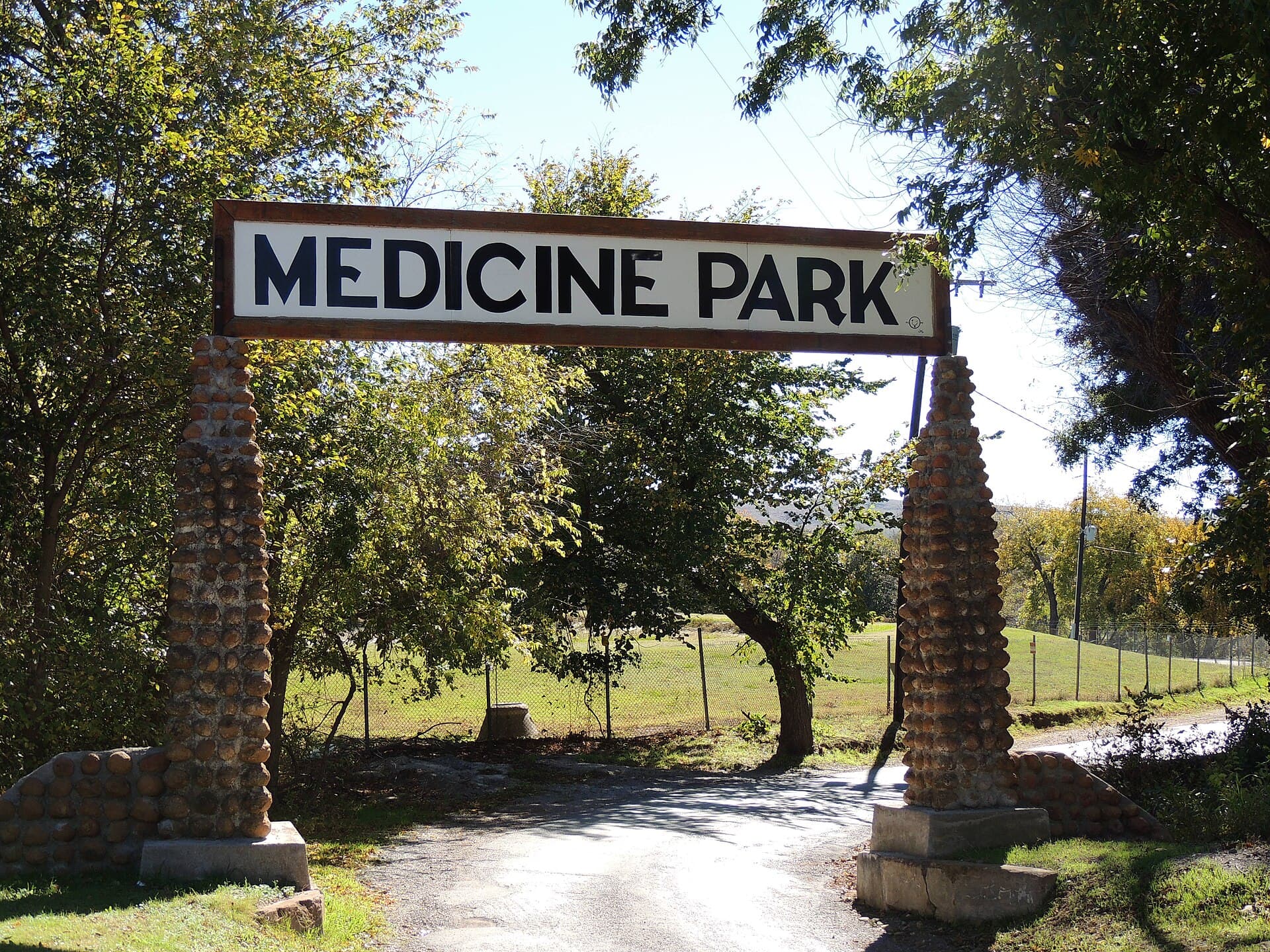
The very name 'Medicine Park' suggests more than just a beautiful spot. What ancient belief inspired its designation?
Jphill19 / CC BY-SA 3.0, via Wikimedia CommonsMedicine Park
Self-guided audio walking tour of Medicine Park — GPS route, offline playback, story-driven narration in 32 languages.
“Where granite stones tell stories of outlaws, artists, and restorative waters.”
Medicine Park, as no one tells it.
Not the postcards. The stories even locals don't know — whispered in your ear, right where they happened.
This historic stone building, now a restaurant, once welcomed a surprising array of individuals. Who might you have encountered during its 'Golden Years'?
Medicine Park's distinct appearance is more than charming; it speaks to a singular local resource. What makes these building blocks so remarkable?
Discover every secret of Medicine Park
Every address, every reveal in full — in your ear, right where it happened.
You pick your stops. You walk. The voice reveals what the others miss.
How long do you have in Medicine Park?
Your self-guided audio tour of Medicine Park is ready — pick your landmarks, choose your language, and start the moment you arrive.
BuyThe story of Medicine Park
Medicine Park, Oklahoma, is a singular stone community situated in the foothills of the Wichita Mountains. Established in 1908 as Oklahoma's inaugural resort town, it swiftly became a favored retreat known for its distinctive architecture, scenic beauty, and calming atmosphere. The town's allure stems from its buildings, many crafted from naturally rounded red granite stones, a geological feature particular to the Wichita Mountains.
Today, Medicine Park presents a fusion of historic character and contemporary appeal, serving as an entry point to the expansive Wichita Mountains Wildlife Refuge. Visitors can wander stone streets, enjoy the spring-fed Medicine Creek, and discover a thriving arts community. The town's enduring spirit and picturesque environment continue to attract travelers seeking outdoor adventure, cultural experiences, and a tranquil escape.
## Origins as Oklahoma's First Resort Medicine Park was established on July 4, 1908, by John William Elmer Thomas, a young lawyer who would later become a U.S. Senator. Thomas envisioned a recreational area and a permanent water source for the nearby city of Lawton. Inspired by local Native American accounts of Medicine Creek's restorative waters, he acquired land and began developing the 'Medicine Park Summer Resort and Health Spa.' The resort quickly gained popularity, offering swimming, boating, and fishing in Bath Lake and Lake Gondola, created by dams on Medicine Creek.
## The Golden Years and Cobblestone Legacy By the 1910s and 1920s, Medicine Park flourished into a lively destination. Visitors lodged in stone cottages, purchased goods at the general store, and dined at the Outside Inn, which served as the community's social core. The town's distinct architecture, constructed almost entirely from naturally rounded red granite stones quarried from the Wichita Mountains, became its defining feature. Medicine Park drew a varied crowd, from families and soldiers from Fort Sill to the affluent, celebrated, and at times infamous, including Will Rogers, Al Capone, Bonnie and Clyde, and Pretty Boy Floyd.
## Decline, Rediscovery, and Renaissance When Senator Thomas sold the resort in 1926, the town's fortunes began to diminish, worsened by the Great Depression and evolving travel preferences. By the 1960s, many structures had fallen into disrepair. However, Medicine Park experienced a significant resurgence starting in the 1980s and 1990s. Community members, notably Candace and David McCoy, initiated restoration projects, revitalizing historic stone buildings and the creek area. This rebirth brought new vitality to the town, leading to the establishment of attractions like the Medicine Park Aquarium & Natural Sciences Center in 2017. In 2019, the Oklahoma legislature acknowledged its singular character by naming it the 'Cobblestone Capital of Oklahoma.'
Begin your exploration with a walk along the stone streets, appreciating the unique architecture that defines Medicine Park. Visit Bath Lake, a historic swimming area fed by Medicine Creek, ideal for a refreshing dip in warmer months or a peaceful stroll along its banks. For those who enjoy the outdoors, Medicine Park serves as an entry point to the Wichita Mountains Wildlife Refuge, a vast expanse home to bison, elk, longhorn cattle, and diverse bird species. Traverse trails like the Yellow, Blue, and Orange Trails, or challenge yourself on the Black Trail to Bear Mountain, all offering expansive views. Drive or hike up Mount Scott for panoramic vistas of southwest Oklahoma. Be sure to visit the Medicine Park Aquarium & Natural Sciences Center, an 8-acre attraction displaying local and exotic aquatic life. Explore local shops for distinctive gifts and art, and enjoy creekside dining at one of the town's restaurants. If you are interested in history, the Holy City of the Wichitas, site of the longest-running passion play in North America, is also nearby.
Medicine Park offers something special throughout the year, but the most pleasant times to visit for comfortable weather are mid-March to May and mid-September to October. During these periods, temperatures are mild and humidity is low, ideal for hiking and outdoor exploration. Summer is popular for swimming in Bath Lake and enjoying various festivals, though temperatures can be quite warm. Even in winter, Bath Lake is a good spot for fishing, and the cooler weather is agreeable for walking alongside Medicine Creek.
Medicine Park is located in Comanche County, Oklahoma, near the city of Lawton and Fort Sill. The closest airport is Lawton-Fort Sill (LAW), approximately 20 km from the city center. While Medicine Park is walkable, a car is recommended for exploring the broader Wichita Mountains Wildlife Refuge and surrounding attractions. Parking can be limited, especially on busy weekends. Many stone cottages are available for rent, providing a distinctive lodging experience. The town offers a variety of local eateries, from casual cafes to historic restaurants. Be aware that some businesses may have limited hours, particularly on weekdays. It is advisable to confirm opening times in advance.
- What is Medicine Park known for?
- Medicine Park is known as Oklahoma's first resort town, celebrated for its distinctive red granite stone architecture, its location at the entry to the Wichita Mountains Wildlife Refuge, and its historic connection to restorative waters and a lively past that drew both celebrities and outlaws.
- Where do the stones in Medicine Park come from?
- The singular, naturally rounded red granite stones used in Medicine Park's construction are found in abundance in the nearby Wichita Mountains. They were quarried and hand-set by early residents.
- Can you swim in Medicine Creek?
- Yes, visitors can swim in Bath Lake, a historic swimming area fed by the clear waters of Medicine Creek, which is quite popular during the warmer months.
- What kind of wildlife can I see near Medicine Park?
- The nearby Wichita Mountains Wildlife Refuge is home to a diverse range of wildlife, including American bison, elk, Texas longhorn cattle, white-tailed deer, prairie dogs, and numerous bird species.
- What famous people visited Medicine Park?
- Medicine Park's history includes visits from notable figures such as Will Rogers, Roy Rogers, Dale Evans, Al Capone, Bonnie and Clyde, and Pretty Boy Floyd. President Theodore Roosevelt also played a role in the nearby wildlife refuge.
- Is Medicine Park family-friendly?
- Yes, Medicine Park is considered a family-friendly destination, offering activities like swimming in Bath Lake, exploring the wildlife refuge, visiting the aquarium, and enjoying a relaxed, welcoming atmosphere.