Phra Pathom Chedi
The colossal golden stupa visible today isn't the original structure. What lies beneath its immense form?
Full story unlocks in the tour
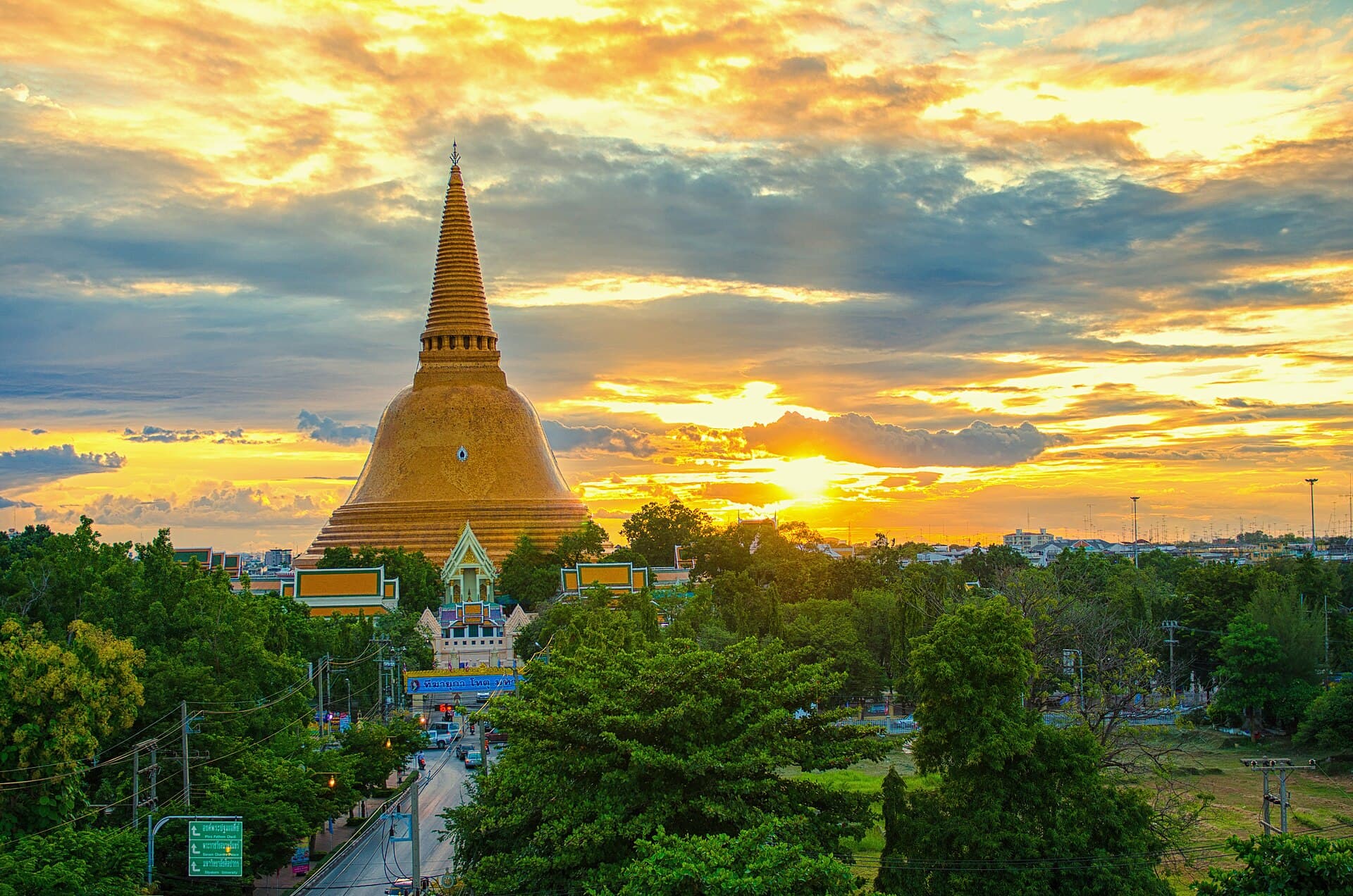 Preecha.MJ / CC BY-SA 4.0, via Wikimedia Commons
Self-guided audio walking tour of Nakhon Pathom — GPS route, offline playback, story-driven narration in 32 languages.
“Where Thailand's Buddhist roots run deepest, crowned by a golden giant.”
Not the postcards. The stories even locals don't know — whispered in your ear, right where they happened.
The colossal golden stupa visible today isn't the original structure. What lies beneath its immense form?
This city, now far inland, was once a bustling seaport. How did it move so far from the coast?
King Rama VI's royal retreat here features a surprising architectural blend.
Discover every secret of Nakhon Pathom
Every address, every reveal in full — in your ear, right where it happened.
You pick your stops. You walk. The voice reveals what the others miss.


Your self-guided audio tour of Nakhon Pathom is ready — pick your landmarks, choose your language, and start the moment you arrive.
BuyLume has a built-in augmented-reality guide. Hold your phone up and its camera shows the street ahead of you, with a glowing arrow laid over the real view that always points to your next stop — no map to puzzle over, no wrong turns. Like everything in Lume, it works fully offline.
Nakhon Pathom, often called Thailand's "First City," is a destination full of spiritual significance, just an hour's journey west of Bangkok. Dominated by the awe-inspiring Phra Pathom Chedi, the tallest stupa in the world, the city offers a profound glimpse into the origins of Buddhism in Thailand. This colossal golden monument, visible for miles, is the heart of a city that was once an ancient capital of the Dvaravati kingdom.
Beyond the grandeur of its central stupa, Nakhon Pathom invites exploration of its royal connections at Sanam Chandra Palace, a unique blend of Eastern and Western architecture. The city's lively markets, particularly the sprawling night market around the chedi, provide a lively sensory experience, showcasing local flavors and authentic Thai life away from the more crowded tourist trails. Nakhon Pathom serves as a compelling day trip or a tranquil overnight escape for those seeking to connect with Thailand's deep cultural heritage.
From ancient archaeological sites to bustling modern markets, Nakhon Pathom seamlessly weaves together its storied past with its present-day charm. It's a place where every corner holds a whisper of history, inviting curious travelers to uncover the layers of its narrative.
## The Cradle of Thai Buddhism Nakhon Pathom's history stretches back over two millennia, earning it the moniker "First City" (Nagara Pathama in Pali). Founded as early as 40 BC, it stands as one of Thailand's oldest cities. During the Dvaravati period (6th–11th centuries), Nakhon Pathom flourished as a significant capital of this prestigious Mon kingdom, which extended from Lop Buri to Malaysia. It was here, around the 4th century, that Buddhism is believed to have first arrived in Thailand, brought by monks sent by the Indian Emperor Ashoka. The city quickly became a crucial center for the dissemination of Theravada Buddhism throughout Siam.
Archaeological evidence, including silver medallions from the 7th century proclaiming it the "meritorious work of the King of Sri Dvaravati," underscores its importance. Intriguingly, ancient Nakhon Pathom was once a major seaport, situated on the Gulf of Thailand. However, due to centuries of sedimentation, the coastline gradually receded, leaving the city inland. Around the mid-16th century, a shift in the Tha Chin River's course led to the city's abandonment, as its vital water source dried up, forcing the population to relocate to Nakhon Chai Si.
## Revival and Royal Patronage The city lay deserted for hundreds of years, its ancient stupa overgrown by jungle, until King Mongkut (Rama IV) rediscovered the ruins during his time as a wandering monk in the 19th century. Upon ascending the throne in 1851, he initiated a monumental restoration project, constructing the present-day Phra Pathom Chedi over the original, smaller structure. This ambitious undertaking, completed in 1870 during the reign of his son King Chulalongkorn (Rama V), transformed the site into the colossal golden monument seen today. King Chulalongkorn further enhanced the chedi by adding belfries and covering it with fine Chinese tiles.
Royal patronage continued with King Vajiravudh (Rama VI), who built Sanam Chandra Palace in the early 20th century as a royal retreat and a strategic stronghold. The arrival of the main Southern Railway Line in 1903 further bolstered the city's resurgence, leading to the gradual formation of the modern city around the restored chedi. Today, Nakhon Pathom stands as a testament to its enduring spiritual legacy and its pivotal role in shaping Thai history and culture.
The undeniable centerpiece of Nakhon Pathom is the Phra Pathom Chedi, the world's tallest stupa, soaring to 120.45 meters. This magnificent golden-brown monument, believed to house a relic of the Buddha, is a vital pilgrimage site and a symbol of Thailand's Buddhist heritage. Explore the serene temple grounds, marvel at the intricate details, and visit the small museum on the middle platform, which sheds light on the stupa's history.
A short distance from the chedi lies Sanam Chandra Palace, a former royal retreat built by King Rama VI. This sprawling complex features a captivating blend of European and Thai architectural styles, with highlights like the French Renaissance-inspired Chaleemongkolasana Residence and traditional Thai teakwood houses. Wander through its manicured gardens and discover the poignant monument to the king's beloved dog, Yah Leh.
For a taste of local life, immerse yourself in Nakhon Pathom's lively markets. The Phra Pathom Chedi Night Market, held nightly around the stupa, is a culinary paradise, offering a vast array of Thai street food. On weekends, consider a visit to the Nakhon Pathom Floating Market or the Don Wai Floating Market for fresh produce and traditional snacks in a lively riverside setting. Consider the unique Wat Sam Phran, also known as the Dragon Temple, where a giant dragon coils dramatically around a pink tower. For those with an interest in vintage vehicles, the Jesada Technik Museum houses an impressive collection of antique cars, motorcycles, and aircraft.
The most comfortable time to visit Nakhon Pathom is during the dry season, from November to February. During these months, the weather is cooler, drier, and less humid, with clearer skies, making it ideal for exploring outdoor attractions like the Phra Pathom Chedi and Sanam Chandra Palace. Temperatures generally range from 25-27°C (77-81°F). While Nakhon Pathom remains warm year-round, the rainy season from May to October brings heavier rainfall and higher humidity, with September being the wettest month. Visiting during the drier period ensures a more pleasant experience for walking and sightseeing.
Nakhon Pathom is conveniently located approximately 50-60 kilometers west of Bangkok, making it an accessible day trip destination. The easiest way to get there from Bangkok is by train, with services departing hourly from Hua Lamphong or Krung Thep Aphiwat Central Terminal to Nakhon Pathom Station, which is close to Phra Pathom Chedi. The journey takes about an hour and is very affordable. Alternatively, frequent buses depart from Bangkok's Southern Bus Terminal, taking about an hour.
Once in Nakhon Pathom, the city center, particularly around Phra Pathom Chedi, is walkable. For longer distances or to reach sites like Sanam Chandra Palace, tuk-tuks and motorcycle taxis are readily available. While English isn't widely spoken by local transport providers, pointing to your destination on a map usually suffices. Carry Thai Baht in small denominations for market purchases and local transportation, as many smaller vendors prefer cash. Modest attire is recommended when visiting temples and other religious sites.
Nakhon Pathom in Korean, in Chinese or in Hebrew — and 29 more languages, every stop narrated by a native voice. The widest language range of any self-guided audio tour.
Available in: