Vorstengraf (King's Grave)
Beneath an unassuming mound near the A50 highway, a secret from 700 BC awaits discovery.
Full story unlocks in the tour
 Michielverbeek / CC BY-SA 4.0, via Wikimedia Commons
Self-guided audio walking tour of Oss — GPS route, offline playback, story-driven narration in 32 languages.
“Where ancient graves meet modern industry, and a surprising past lingers in the present.”
Not the postcards. The stories even locals don't know — whispered in your ear, right where they happened.
Beneath an unassuming mound near the A50 highway, a secret from 700 BC awaits discovery.
For a period in the late 19th and early 20th centuries, Oss earned a rather notorious comparison to a major American city.
One of Oss's distinctive architectural landmarks, often called the 'cigar of Oss,' serves a surprising dual purpose today.
Discover every secret of Oss
Every address, every reveal in full — in your ear, right where it happened.
You pick your stops. You walk. The voice reveals what the others miss.



Your self-guided audio tour of Oss is ready — pick your landmarks, choose your language, and start the moment you arrive.
BuyLume has a built-in augmented-reality guide. Hold your phone up and its camera shows the street ahead of you, with a glowing arrow laid over the real view that always points to your next stop — no map to puzzle over, no wrong turns. Like everything in Lume, it works fully offline.
Oss, a city in the province of North Brabant, Netherlands, offers a compelling blend of deep history and modern vitality. Situated between the larger cities of 's-Hertogenbosch and Nijmegen, Oss has been continuously inhabited for over 4,000 years, with archaeological finds dating back to the Stone Age. From ancient burial mounds to its evolution as a market town and later an industrial hub, Oss presents a layered narrative for those willing to explore beyond the surface.
Today, Oss is a lively regional center with a population of around 56,000 in the city itself and approximately 85,000 in the wider municipality. It is characterized by a diverse urban landscape where classic buildings stand alongside modern developments. The city is known for its friendly atmosphere, green spaces, and a strong sense of community, offering a genuine slice of Dutch life away from the more heavily touristed destinations.
The story of Oss begins long before written records. Archaeological evidence indicates human presence in the area for approximately 4,000 years, with significant discoveries like the Vorstengraf burial sites and indigenous-Roman burial fields of Oss-Ussen. The most notable of these is the Vorstengraf, a reconstructed 7th-century BC burial mound, considered the largest of its type in the Netherlands and Belgium, where a unique iron sword was unearthed in 1933. This suggests a profound prehistoric culture and the presence of significant figures in the region.
During the Roman Empire, Oss held strategic importance as a vital crossroads along the Maas River. Archaeological findings point to a fortified settlement, or castellum, which controlled river crossings. The Batavi, a Germanic tribe esteemed for their elite cavalry within the Roman army, were particularly prominent in the region's history, contributing their martial prowess to the Roman war machine. Excavations continue to reveal insights into this bustling outpost where soldiers and civilians coexisted.
Oss was first officially mentioned in a letter from Pope Alexander II on May 6, 1069. By the late 14th century, specifically in 1399, Oss was granted city rights by Duchess Johanna van Brabant, marking its formal establishment as a municipality. Despite this, for centuries, Oss remained a relatively small and predominantly agricultural community. The fortified church square, or Markt, became the focal point of civic and commercial life, a role it often retains today. Life revolved around the rhythms of the church and the market, supported by the fertile lands of the Meuse-Demer-Scheldt delta.
The 19th century brought significant transformation to Oss. The construction of a railway station in May 1881 was a catalyst for industrial development. This was further bolstered by the creation of a harbor connected to the Meuse River via the Burgemeester Delenkanaal in 1968, solidifying Oss's role as an industrial powerhouse. This period also saw the rise of prominent industrialists, such as the Van den Bergh family, whose mansion now houses the Museum Jan Cunen.
However, this era also had a darker side. At the close of the 19th and beginning of the 20th centuries, Oss experienced elevated crime rates, leading to its nickname the 'Dutch Chicago' and the notoriety of the 'Bende van Oss' gang. Today, Oss is a quiet industrial town known for its food processing, pharmaceuticals, and electronics manufacturing, having successfully reinvented itself from its more turbulent past.
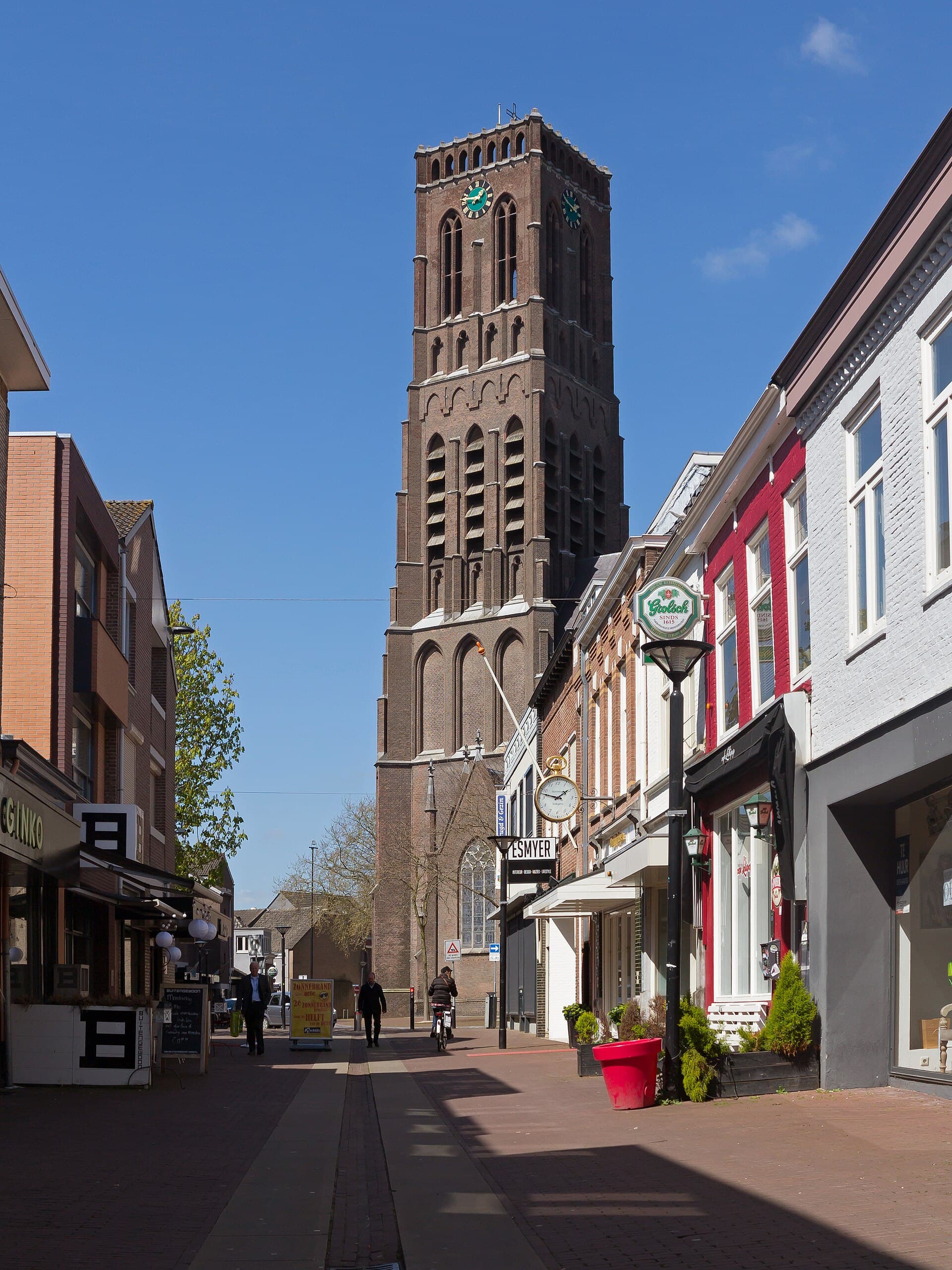
Begin your exploration at the Vorstengraf, a reconstructed 7th-century BC burial mound that offers a tangible connection to Oss's ancient past. For a deeper dive into local history and culture, visit the Museum Jan Cunen, housed in a beautiful neoclassical villa that was once a mansion for a prominent industrialist family. The museum features exhibitions of 19th-century and contemporary art. The richly decorated Neo-Gothic Grote Kerk is also worth a visit for its architectural beauty.
Oss is also home to traditional Dutch windmills. The Stellingmolen Zeldenrust, built in 1860, and the Stellingmolen Nieuw Leven, built in 1895, are open to the public on Saturday mornings. For a unique landmark, seek out the Water Tower on Watertorenstraat, often referred to as the 'cigar of Oss,' which now serves as a mosque. While the 14th-century Oss Castle is mostly ruins, its remains can still be found near the Gelderse Poort shopping center.
Beyond specific sites, take time to wander through Oss's city center, where classic buildings blend with modern architecture. The city also offers various cultural events, including pop concerts, film festivals, and plays at the Groene Engel.
The most pleasant time to visit Oss is from May through September, when the weather is generally mild and suitable for outdoor activities. June, July, and August offer warm temperatures, averaging around 24°C (75°F) in July, and are ideal for enjoying the city's parks and outdoor cafes. For those who prefer fewer crowds and potentially better value, the shoulder seasons of late spring (May) and early autumn (September-October) provide comfortable temperatures and a good balance of activities. While winters are cold and cloudy, with temperatures dropping to around 7°C (45°F) in January, the city still offers a cozy atmosphere and occasional winter events.
Oss is well-connected and easily accessible. By car, use the A50 from the north or south, or the A59 from the west. When using the A2, switch to the A59 at Knooppunt Hintham, near 's-Hertogenbosch. The city is also on the train line between 's-Hertogenbosch and Nijmegen, with two stations: Oss and Oss West. Oss station is most convenient for the city center. For getting around within Oss, walking is sufficient for the city center, and cycling is a popular and efficient option, with plenty of cycle lanes and bike rentals available. Public buses are also reliable for reaching the outskirts.
Consider purchasing an OV-chipkaart for seamless public transport use. Tap the card when boarding and alighting, and the correct fare will be deducted. While credit cards are widely accepted, it's advisable to carry some cash for smaller vendors. Tap water is safe to drink, so bring a reusable bottle. Check opening hours for museums and shops in advance, as some may close early on Sundays.
Oss in Korean, in Chinese or in Hebrew — and 29 more languages, every stop narrated by a native voice. The widest language range of any self-guided audio tour.
Available in: