Museum of Records and Curiosities
Picture a museum that celebrates the singular, the grandest, the smallest, and the most peculiar human accomplishments.
Full story unlocks in the tour
 Packare / cc0, via Wikimedia Commons
Self-guided audio walking tour of Pelhřimov — GPS route, offline playback, story-driven narration in 32 languages.
“Where extraordinary feats are chronicled, and history unfolds at every turn.”
Not the postcards. The stories even locals don't know — whispered in your ear, right where they happened.
Picture a museum that celebrates the singular, the grandest, the smallest, and the most peculiar human accomplishments.
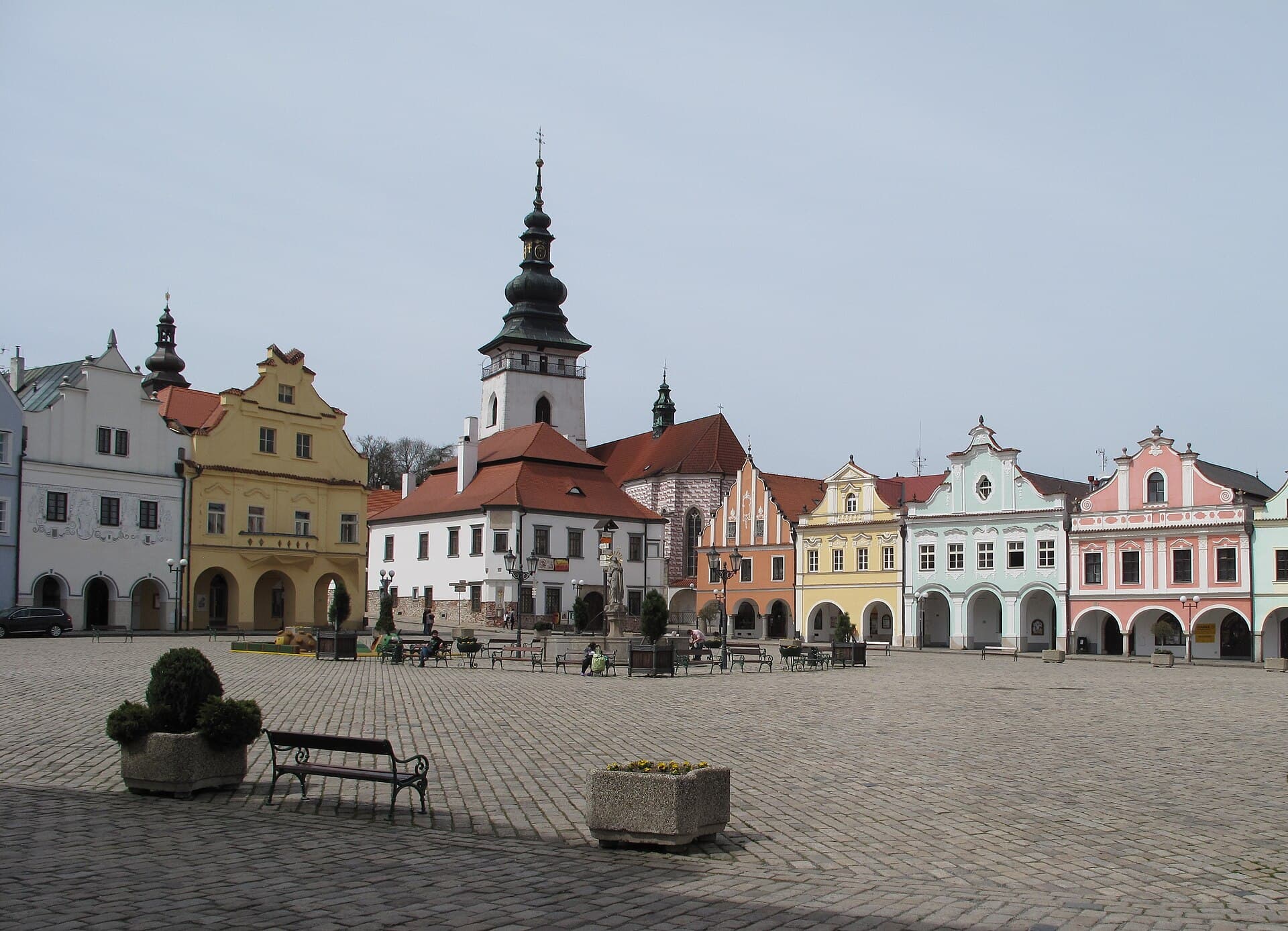
Beneath the appealing Renaissance and Baroque facades of the main square awaits a surprising and engaging experience.
The town's prominent church possesses a distinctive aesthetic detail that distinguishes it from typical sacred structures.
Discover every secret of Pelhřimov
Every address, every reveal in full — in your ear, right where it happened.
You pick your stops. You walk. The voice reveals what the others miss.
Your self-guided audio tour of Pelhřimov is ready — pick your landmarks, choose your language, and start the moment you arrive.
BuyLume has a built-in augmented-reality guide. Hold your phone up and its camera shows the street ahead of you, with a glowing arrow laid over the real view that always points to your next stop — no map to puzzle over, no wrong turns. Like everything in Lume, it works fully offline.
Pelhřimov, a town in the Vysočina Region of the Czech Republic, is often referred to as the "City of Records" due to its singular museum dedicated to unusual achievements and curiosities. Situated in the Křemešník Highlands, roughly equidistant from Prague and Brno, Pelhřimov presents a fusion of historical allure and distinctive attractions. The town's meticulously maintained historic core, with its Renaissance and Baroque buildings, is safeguarded as an urban monument reservation.
Beyond its reputation for chronicling records, Pelhřimov offers a scenic setting in the valley of the Bělá Stream, characterized by numerous small fishponds. It functions as a regional industrial hub, with a legacy of textile production, gingerbread crafting, and brewing. The town's compact center invites exploration on foot, fostering a tranquil atmosphere removed from crowded tourist paths.
Pelhřimov's particular appeal lies in its capacity to surprise and delight, inviting visitors to delve into both its enduring past and its playful contemporary character. From ascending a church tower for expansive views to encountering the largest mailbox, the town provides a distinctly Czech encounter that encourages closer observation.
## Early Beginnings and Royal Status Pelhřimov's origins can be traced to the 12th century, with its establishment frequently attributed to Bishop Pelhřim (Pelegrin) of Prague between 1225 and 1226. Legend recounts that the bishop was so captivated by the local landscape during a journey from Prague to Rome that he resolved to found a town, bestowing his name upon it. The town's emblem, featuring a bishop's silhouette, serves as a constant echo of this genesis. The earliest settlement likely formed near the Church of Saint Vitus.
The first written mention of Pelhřimov appears in 1289, when it was raided by Vítek of Hluboká. King Wenceslaus II granted Bishop Tobiáš of Bechyně the authority to restore and fortify the town in 1290. Initially settled by German colonists, Czech inhabitants gradually became the majority. The 14th century witnessed considerable growth, fueled by trades such as drapery, linen weaving, and gingerbread production, alongside silver mining near Křemešník. The town's strategic position on the boundary of the Rosenberg family and Lords of Kunštát domains proved advantageous.
Pelhřimov aligned itself with the Hussites during the Hussite Wars. From 1446 to 1450, the town hosted provincial congresses, even welcoming King George of Poděbrady. In 1550, the estate was sold to Adam Říčanský of Říčany, who constructed a castle adjacent to the town walls. The town secured its independence from the Lords of Říčany in 1572, and in 1596, Emperor Rudolf II elevated Pelhřimov to a royal town.
## Fires, Reconstructions, and Modern Growth The promising expansion of Pelhřimov was curtailed by the repressions following the Bohemian Revolt and further devastated by a significant fire in 1646, which destroyed most of its structures. Another destructive fire in 1766 led to the consistent reconstruction of burgher houses in a Renaissance-Baroque style, contributing to the town's architectural uniformity. The 19th century brought renewed cultural and industrial advancement, influenced by the Czech National Revival. Today, remnants of the town's fortifications, including two substantial Gothic gates, along with the chateau, townhouses, and churches, constitute a city monument reserve.
Since 1991, Pelhřimov has earned national recognition as the "town of records," hosting an annual international festival of records and curiosities. The Dobrý den Agency, which maintains the Czech Database of Records and publishes the Czech Book of Records, is based here. The town's industrial sector continues to thrive, focusing on food processing, engineering, and consumer goods manufacturing.
Begin your exploration in Masaryk Square (Masarykovo náměstí), the core of the historic center, bordered by Renaissance and Baroque buildings featuring arcades and decorative gables. An Empire fountain with a statue of St. Jacob stands at the square's center. The Church of St. Bartholomew, a Gothic edifice from the late 13th or early 14th century, is a prominent landmark. Ascend its 30-meter high lookout tower for sweeping views of the town and the surrounding landscape.
Be sure to visit the Museum of Records and Curiosities, housed within the historical Jihlava Gate. This distinctive museum displays an engaging collection of Czech and global records, from the grandest and smallest objects to remarkable human achievements. Nearby, the Vysočina Museum Pelhřimov, situated in the former Renaissance castle, offers insights into regional history, ethnography, and an exposition on the town's former jail and instruments of torture. The Church of St. Vitus, documented in 1325, is Pelhřimov's oldest sacred building and now serves as an exhibition and concert venue. For an unusual experience, explore the Pelhřimov Hell exposition in the cellars of a Masaryk Square building, where you can engage with a devilish theme.
The most favorable time to visit Pelhřimov for outdoor pursuits and sightseeing is from late June to late August. During these summer months, temperatures are comfortable, ranging from 65°F to 80°F, peaking in the first week of August. The weather is generally clear and dry, making it ideal for exploring the town on foot or cycling in the surrounding highlands. The annual International Festival of Records and Curiosities, a significant cultural gathering, also occurs during this period, offering extended museum hours and a lively atmosphere.
Pelhřimov is situated approximately halfway between Prague and Brno. If driving from Prague, take the D1 highway toward Brno and exit at km 90 (Humpolec), then follow the road for about 15 kilometers to reach Pelhřimov. The town is easily navigated on foot, with most attractions concentrated in its compact center. Taxis are also available and generally affordable.
For dining, Pelhřimov offers a selection of establishments serving traditional Czech cuisine, as well as international options like Chinese, Mexican, and Indian. Many places provide daily menus and outdoor seating. Accommodation choices include hotels, guesthouses, and camping sites. The local tourist information center on Masaryk Square can provide maps, brochures, and assistance with planning your visit.
Pelhřimov in Korean, in Chinese or in Hebrew — and 29 more languages, every stop narrated by a native voice. The widest language range of any self-guided audio tour.
Available in: