Vojtěch Mine
Příbram's mining history includes a world record, not for the most ore extracted, but for a pioneering engineering feat.
Full story unlocks in the tour
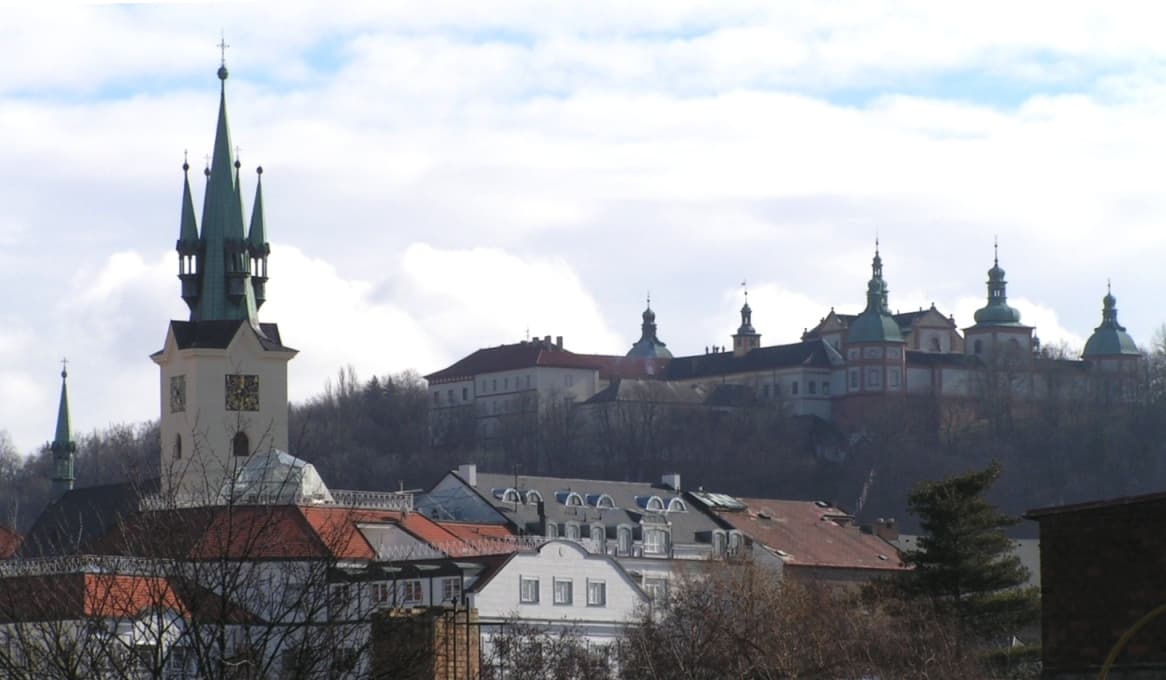 Miroslav Langer / CC BY-SA 3.0, via Wikimedia Commons
Self-guided audio walking tour of Příbram — GPS route, offline playback, story-driven narration in 32 languages.
“Where silver veins meet sacred heights.”
Not the postcards. The stories even locals don't know — whispered in your ear, right where they happened.
Příbram's mining history includes a world record, not for the most ore extracted, but for a pioneering engineering feat.
The Baroque pilgrimage site of Svatá Hora conceals a mathematical symmetry in its design that many visitors overlook.
This historic building, once an archbishop's residence, has a surprising connection to a major conflict that reshaped Europe.
Discover every secret of Příbram
Every address, every reveal in full — in your ear, right where it happened.
You pick your stops. You walk. The voice reveals what the others miss.

Your self-guided audio tour of Příbram is ready — pick your landmarks, choose your language, and start the moment you arrive.
BuyLume has a built-in augmented-reality guide. Hold your phone up and its camera shows the street ahead of you, with a glowing arrow laid over the real view that always points to your next stop — no map to puzzle over, no wrong turns. Like everything in Lume, it works fully offline.
Příbram, a city in the north-central Czech Republic, sits approximately 59 kilometers southwest of Prague on the Litavka River, within the hilly Brdy Mountains. For centuries, it served as a significant center for silver and lead mining, a legacy that shaped its identity and continues to draw visitors.
Beyond its industrial past, Příbram is also a spiritual hub, dominated by the Baroque pilgrimage site of Svatá Hora, or "Holy Mountain," which rises above the city. This blend of deep historical roots—from Celtic mining to its role as a royal town—and its serene natural surroundings in the Brdy Protected Landscape Area offers a distinctive experience for those venturing beyond the capital.
The history of Příbram is intricately linked to its mineral wealth, with archaeological findings suggesting metal mining in the region dates back over three thousand years to the Early Bronze Age. More significant silver and lead ore mining in the area, particularly around what is now Březové Hory, can be traced to the 13th century.
By the 14th century, Příbram had grown into a market town. It gained further prominence when Charles IV donated it to Arnošt of Pardubice, the first Archbishop of Prague, who frequently resided at his small castle in Příbram. The 15th century saw a predominantly Czech population, alongside German miners drawn by the silver deposits.
The town's mining industry truly flourished in the 16th century, earning Příbram the status of a royal mining city from Emperor Rudolph II in 1579. The 19th century marked the zenith of Příbram's mining activity, with its mines producing nearly all the silver and lead for the entire Austro-Hungarian Empire. This era also saw groundbreaking technological advancements, such as the world's first use of wire rope in mine shafts in 1836 and the achievement of a one-kilometer vertical depth in the Vojtěch Mine in 1875.
After World War II, Příbram's mining focus shifted to strategic uranium deposits, which were extracted until the 1960s. In 1953, the towns of Příbram and Březové Hory merged, consolidating their shared mining heritage. Today, the Mining Museum Příbram, the largest of its kind in the Czech Republic, preserves and showcases this extensive history within the original mine shafts and buildings of the Březové Hory section.
Příbram offers a blend of historical depth and spiritual tranquility. The Mining Museum Příbram is a compelling destination, housed within the historic mine shafts and buildings of the Březové Hory quarter. It stands as the largest mining museum in the Czech Republic, offering authentic rides on a mining train, descents into a shaft, and exhibitions on mining history and mineralogy.
Dominating the skyline is Svatá Hora (Holy Mountain), a significant Marian pilgrimage site in Central Europe. This Baroque complex, with its golden statue of the Virgin Mary, is an architectural marvel. Visitors can ascend to it via a covered staircase, which has 343 steps, or 365 if you count those leading to the Coronation Altar. The complex includes a basilica, cloisters adorned with art, a pilgrimage museum, a clock tower, and a treasury.
In the town center, the Church of Saint James the Great stands as Příbram's oldest monument, dating back to the 13th century with subsequent Baroque and Neo-Gothic alterations. The Zámeček-Ernestinum, originally a 14th-century castle, now serves cultural purposes and houses the Gallery of František Drtikol and the Museum of the Anti-communist Resistance. For nature enthusiasts, the surrounding Brdy Protected Landscape Area provides opportunities for hiking and cycling.
The ideal time to visit Příbram for comfortable warm-weather activities is from late June to late August. During July and August, average daytime temperatures typically reach around 24°C (75°F). July is the wettest month, with approximately 96 mm (3.8 inches) of rainfall over 15 rainy days, but it also sees the most sunshine, averaging 7.5 hours per day. For those who prefer cooler weather, the cold season lasts from mid-November to early March, with January being the coldest month, averaging a high of 3°C (37°F) and a low of -3°C (27°F).
Příbram is located about 59 kilometers (37 miles) southwest of Prague. The city is accessible by both road and rail. The D4 motorway runs east of the town, and national road I/18 passes through it. Příbram is on a supraregional railway line connecting Prague to České Budějovice, as well as a regional line from Beroun to Blatná. The bus terminal is conveniently situated next to the railway station, with local bus services operated by Arriva Střední Čechy.
The official currency in Příbram and the rest of the Czech Republic is the Czech Koruna (CZK). Currency exchange services are available in town, such as Směnárna Tourist centrum, s.r.o. and Směnárna - TATRA CAPITAL Slovakia s.r.o. It's advisable to check current exchange rates and be aware that 'zero-fee' services may offer less favorable rates. ATMs are widely available, and it's generally recommended to choose to be charged in Czech Korunas when using cards for payments or withdrawals.
Příbram in Korean, in Chinese or in Hebrew — and 29 more languages, every stop narrated by a native voice. The widest language range of any self-guided audio tour.
Available in: