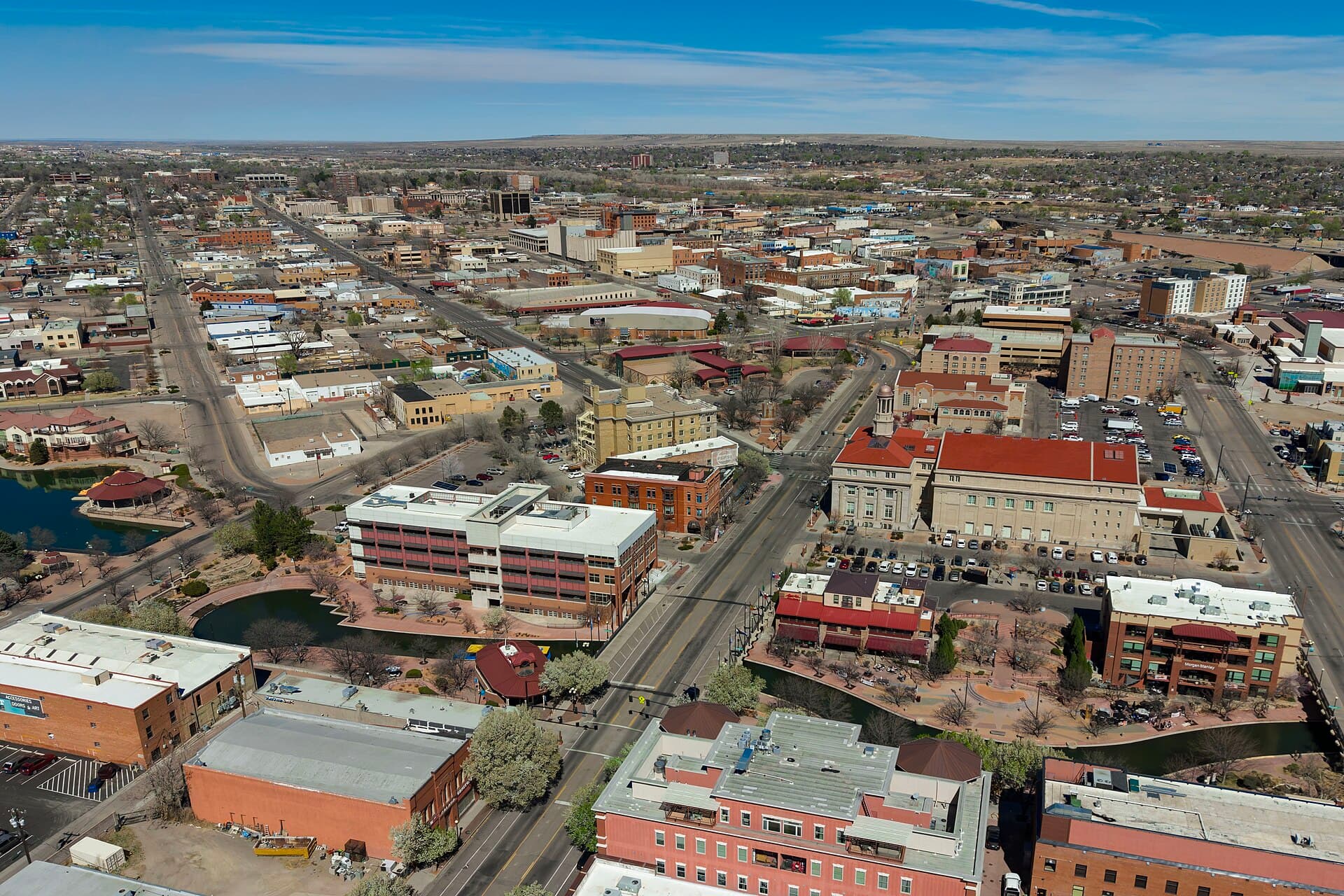
Pueblo's Riverwalk is a lively urban space today, but its existence owes to a devastating event that reshaped the city.
Quintin Soloviev / CC BY 4.0, via Wikimedia CommonsPueblo
Self-guided audio walking tour of Pueblo — GPS route, offline playback, story-driven narration in 32 languages.
“Where the Arkansas River once raged, a resilient city now thrives, seasoned with steel and a singular chile.”
Pueblo, as no one tells it.
Not the postcards. The stories even locals don't know — whispered in your ear, right where they happened.
Pueblo holds a unique distinction among American cities, recognized by Congress for an extraordinary concentration of valor.
A specific chile pepper is deeply rooted in Pueblo's identity, its unique characteristics tied to local agricultural history.
Discover every secret of Pueblo
Every address, every reveal in full — in your ear, right where it happened.
You pick your stops. You walk. The voice reveals what the others miss.


How long do you have in Pueblo?
Your self-guided audio tour of Pueblo is ready — pick your landmarks, choose your language, and start the moment you arrive.
BuyThe story of Pueblo
Pueblo, Colorado, rests at the confluence of the Arkansas River and Fountain Creek, approximately 112 miles south of Denver. Once a contender for the state capital, Pueblo has carved its own identity, shaped by its industrial past and an unyielding spirit. The city is known as the "Steel City" due to its significant steel production, a legacy that dates back to the late 19th century.
Beyond its industrial origins, Pueblo offers a blend of outdoor recreation, cultural experiences, and a culinary scene famously centered around its namesake chile. The city experiences a semi-arid climate with distinct seasons, enjoying over 300 days of sunshine annually. This abundant sunshine, coupled with low humidity, makes it an appealing destination for those seeking a mix of history and outdoor activity.
From Trading Post to Steel City
Pueblo's origins trace back to 1842 with the establishment of Fort Pueblo, a trading post that became a cultural crossroads for Anglo, French, and African-American trappers, Mexican settlers, and various Native American tribes. The area was historically claimed by France, Mexico, Texas, and Spain before becoming part of the United States in 1848 after the Mexican-American War. The Arkansas River, which flows through Pueblo, once served as the international border between the U.S. and Mexico.
The Colorado Gold Rush in 1858 sparked renewed interest in the area, leading to the platting of Pueblo in 1860. The city was formally incorporated in 1870 at the convergence of the Arkansas River and Fountain Creek. The arrival of the railroad proved instrumental in Pueblo's early economic growth, connecting southern Colorado with the Front Range.
In 1881, the Colorado Coal and Iron Company established the first integrated steel and iron mill west of St. Louis in Pueblo, solidifying its reputation as a major industrial center. This industrial prowess earned Pueblo the moniker "Steel City." The city was formed from the consolidation of four separate towns—Pueblo, South Pueblo, Central Pueblo, and Bessemer—between 1886 and 1894.
The Great Flood of 1921 and Riverwalk Revival
One of the most significant events in Pueblo's history was the Great Flood of 1921. Heavy rains caused the Arkansas River and Fountain Creek to swell, leading to a catastrophic overflow on June 3rd. The floodwaters, reaching over 24 feet in some areas, inundated the downtown business district within hours, destroying hundreds of homes and businesses and causing an estimated $25 million in damages (equivalent to about $358 million in 2019). The exact death toll remains uncertain, with estimates ranging from 150 to 1,500 people, many of whom were single immigrants working for the Colorado Fuel & Iron Company and had no family to report them missing.
In the aftermath, the Arkansas River was diverted to prevent future flooding, and the city underwent a significant reshaping. Decades later, in the 1990s, a visionary project emerged to reclaim the former river path. Inspired by San Antonio's River Walk, the Historic Arkansas Riverwalk of Pueblo (HARP) officially opened in 2000, transforming the downtown area into a lively urban waterfront. This 32-acre development now features shops, restaurants, public art, and boat tours, serving as a testament to Pueblo's resilience and commitment to revitalization.
The Historic Arkansas Riverwalk of Pueblo (HARP) is a central attraction, offering boat rides, public art, and a variety of eateries along its mile-long channel. Visitors can take narrated cruises to learn about the city's history, including the 1921 flood. Adjacent to the Riverwalk is the Creative Corridor, a three-district area with art galleries, public art displays, and events.
Lake Pueblo State Park, just a short drive from downtown, is a hub for outdoor activities, including boating, fishing, paddleboarding, and extensive trails for hiking and biking. For those interested in local agriculture, the Pueblo Chile & Frijoles Festival in September celebrates the region's famous Pueblo chiles with food, live entertainment, and vendors.
The El Pueblo History Museum chronicles the region's human events from prehistoric times through the early 20th century, highlighting the impact of railroads and commercial development. The Steelworks Center of the West preserves the history of the coal and steel industry, offering a museum in the historic mill buildings.
Pueblo also honors its military heroes at Veteran's Bridge on the Riverwalk, which features the names of over 7,000 veterans and recognizes Pueblo's four Medal of Honor recipients.
Pueblo experiences a semi-arid climate with four distinct seasons and abundant sunshine, averaging over 300 sunny days a year. Summers are warm, with July highs averaging 92°F, while winters are cool but generally mild, with January lows averaging 19°F.
The best time to visit Pueblo for warm-weather activities is from early June to mid-September. For comfortable weather with mild temperatures and low humidity, consider visiting from mid-April to May and again from mid-September to October. Fall, particularly October, is noted for its pleasant temperatures in the 70s and 40s, clear skies, and prime outdoor activity options, including the Pueblo Chile & Frijoles Festival. Spring, especially late April and May, also offers ideal temperatures for outdoor pursuits before the summer warmth.
Pueblo is accessible via Pueblo Memorial Airport (PUB) for commercial and general aviation, with Colorado Springs Airport (COS) and Denver International Airport (DIA) offering more extensive commercial flights within a 45-minute and two-hour drive, respectively. Interstate 25 runs north-south through Colorado, passing through Pueblo, and Highway 50 provides an east-west route.
Within the city, Pueblo Transit provides bus services, including a vanpool program and free rides for veterans. Pueblo City Cab offers 24/7 taxi services within Pueblo County and surrounding areas, including non-emergency medical transport. For airport transfers to Denver International Airport, Transit Van Shuttle offers private, non-stop, door-to-door service.
Accommodation options in Pueblo range from well-known hotel chains like SpringHill Suites by Marriott and Courtyard by Marriott in the downtown area, to various other hotels and motels throughout the city. Many hotels offer amenities such as free breakfast, Wi-Fi, and parking.
- What is Pueblo known for?
- Pueblo is known as the "Steel City" due to its historical steel production and as the "Home of Heroes" for having a significant number of Medal of Honor recipients. It is also celebrated for the Pueblo chile, a unique local pepper, and its annual Chile & Frijoles Festival.
- Is Pueblo, Colorado, a good place to visit?
- Yes, Pueblo offers a diverse range of attractions, from the Historic Arkansas Riverwalk and its lively arts scene to outdoor recreation at Lake Pueblo State Park. Its abundant sunshine and mild shoulder seasons make it appealing for various activities.
- What is the weather like in Pueblo, Colorado?
- Pueblo has a semi-arid climate with four distinct seasons and over 300 days of sunshine annually. Summers are warm and dry, while winters are cool but generally mild with light snowfall. Spring and fall offer comfortable, milder temperatures.
- How far is Pueblo from Denver?
- Pueblo is approximately 112 miles (180 km) south of the Colorado State Capitol in Denver.
- What is the Pueblo Riverwalk?
- The Historic Arkansas Riverwalk of Pueblo (HARP) is a 32-acre urban waterfront area in downtown Pueblo. It features a channel of the Arkansas River with boat rides, public art, restaurants, and serves as a recreational and cultural hub.
- Are there any major annual events in Pueblo?
- Yes, Pueblo hosts the **Colorado State Fair** in late August and the **Pueblo Chile & Frijoles Festival** in September. These events celebrate the region's agricultural heritage and offer a variety of entertainment.