Burg Rheinfels
Within the weathered walls of Burg Rheinfels, a peculiar tradition once dictated the fate of unwelcome visitors.
Full story unlocks in the tour
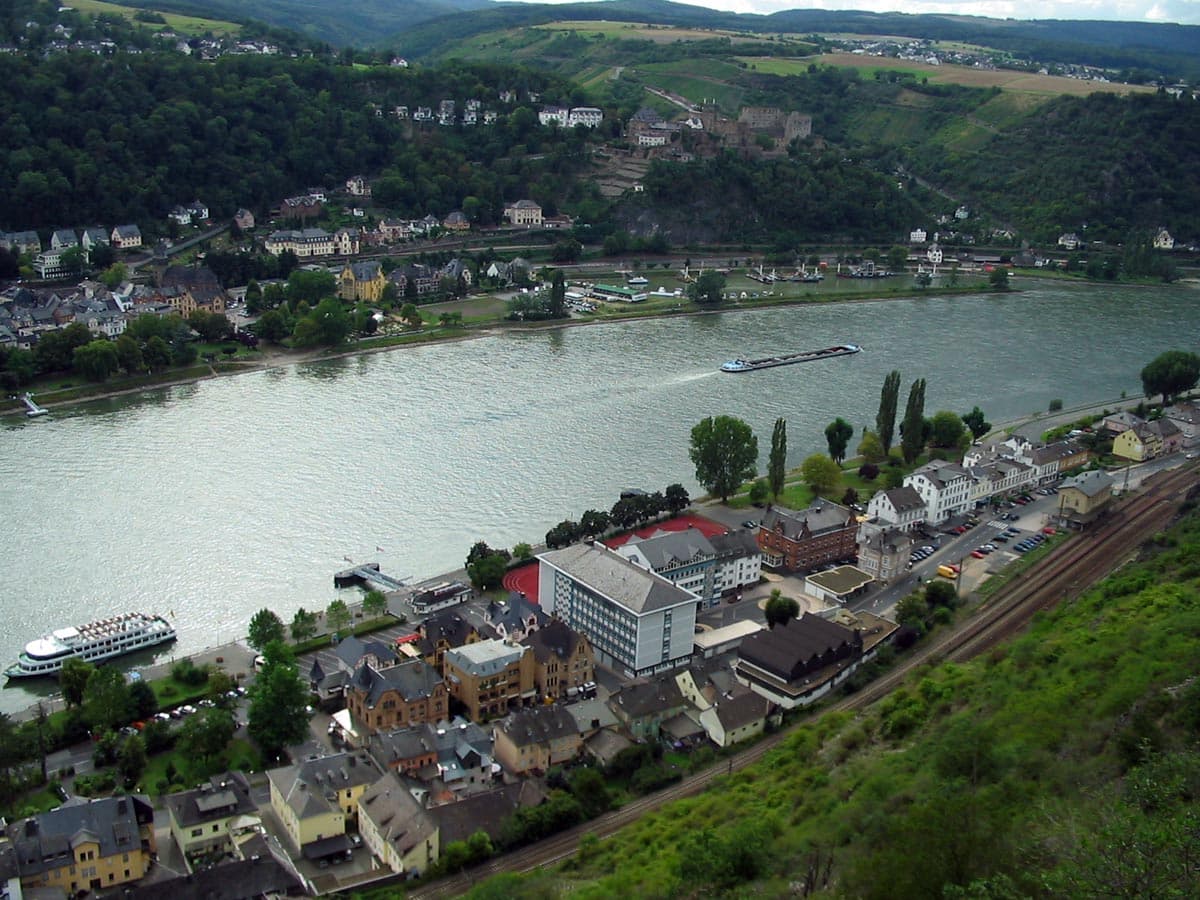 Unknown author / CC BY-SA 3.0, via Wikimedia Commons
Self-guided audio walking tour of Sankt Goar — GPS route, offline playback, story-driven narration in 32 languages.
“Where legends linger on the Rhine's most dramatic bend.”
Not the postcards. The stories even locals don't know — whispered in your ear, right where they happened.
Within the weathered walls of Burg Rheinfels, a peculiar tradition once dictated the fate of unwelcome visitors.
The Loreley, a siren of the Rhine, is more than just a myth; local sailors once swore by a specific, eerie phenomenon tied to her rock.
Beneath the unassuming floor of the Evangelische Stiftskirche lies a secret passage, rumored to connect to a place of refuge during ancient sieges.
Discover every secret of Sankt Goar
Every address, every reveal in full — in your ear, right where it happened.
You pick your stops. You walk. The voice reveals what the others miss.

Your self-guided audio tour of Sankt Goar is ready — pick your landmarks, choose your language, and start the moment you arrive.
BuyLume has a built-in augmented-reality guide. Hold your phone up and its camera shows the street ahead of you, with a glowing arrow laid over the real view that always points to your next stop — no map to puzzle over, no wrong turns. Like everything in Lume, it works fully offline.
Sankt Goar unfurls along the Rhine's most dramatic bend, a place where the river carves a deep valley through ancient slate. This small town, with its terraced vineyards and the looming presence of Burg Rheinfels, offers a tangible connection to a storied past. The air here carries the scent of damp earth and distant woodsmoke, a quiet invitation to wander.
Life in Sankt Goar unfolds at a gentle pace, dictated by the rhythm of the riverboats and the distant chimes from the church tower. It's a place where the grandeur of the landscape converges with the intimacy of a close-knit community, offering a genuine glimpse into the enduring spirit of the Middle Rhine. The town serves as a quiet sentinel to the Loreley, a legend that has captivated travelers and sailors for centuries, its influence palpable in the misty mornings and the river's deep, resonant flow.
## Medieval Origins and Strategic Importance Sankt Goar's origins trace back to the 6th century, when the hermit Goar established a hermitage and a small chapel on the Rhine's left bank. His sanctity attracted pilgrims and settlers, gradually forming the nucleus of a community. The town's strategic position along the Rhine, a vital trade route, quickly made it a point of contention among various noble houses. By the 13th century, Sankt Goar had become a significant stronghold, controlled by the Counts of Katzenelnbogen, who erected Burg Rheinfels, one of the most formidable castles on the Rhine.
## The Rise and Fall of Burg Rheinfels Burg Rheinfels, begun around 1245, was not merely a defensive structure but a symbol of power and a toll station that generated considerable wealth. Its extensive fortifications, including multiple curtain walls and towers, made it virtually impregnable for centuries. The castle withstood numerous sieges, including a major assault by French forces in 1692 during the War of the Grand Alliance. However, its eventual destruction came at the hands of French revolutionary troops in 1797, who dynamited much of the complex, leaving it in the romantic ruins seen today. The castle's enduring presence, even in its ruined state, speaks volumes about its former dominance over the river valley.
## From Toll Station to Tourist Destination With the decline of the toll system and the advent of steamships in the 19th century, Sankt Goar's economic focus shifted. The picturesque ruins of Burg Rheinfels, combined with the dramatic Loreley rock, began to draw artists, writers, and early tourists. The town became an integral part of the Rhine Romanticism movement, celebrated in poetry and paintings. Today, Sankt Goar continues to embrace its role as a gateway to the Upper Middle Rhine Valley UNESCO World Heritage site, inviting visitors to explore its layers of history, from ancient legends to the enduring beauty of its natural setting.
Begin your exploration at Burg Rheinfels, a sprawling ruin that offers panoramic views of the Rhine. Wander through its courtyards, climb its towers, and imagine the lives lived within its formidable walls. Below the castle, the Evangelische Stiftskirche, or Collegiate Church, stands as a testament to the town's spiritual origins, its quiet interior inviting contemplation. A short ferry ride across the Rhine leads to the Loreley Rock, where a statue commemorates the legendary siren. The Deutsches Puppen- und Bärenmuseum (German Doll and Bear Museum) presents a whimsical collection, offering a nostalgic journey through childhood toys. Consider a boat trip on the Rhine itself; it provides a unique perspective on the valley's castles and the dramatic landscape, allowing the river to guide your gaze through this storied region.
The most agreeable times to visit Sankt Goar are spring (April to May) and autumn (September to October). During these months, the weather is mild, ideal for exploring the castle and taking boat trips. Spring brings blooming vineyards, while autumn bathes the valley in warm, golden hues. Summer (June to August) is also pleasant, though it can be busier. Winter offers a quieter, sometimes snow-dusted, landscape, with fewer tourist services available.
Sankt Goar is readily accessible by train, with a station located directly in town, offering connections along the Rhine valley. Ferries provide convenient crossings of the Rhine, particularly to the Loreley side. Walking is the most pleasant way to navigate the town's compact center and reach Burg Rheinfels, though a shuttle service to the castle is available. Accommodations range from family-run guesthouses to small hotels. Dining options primarily feature traditional German fare, often with a focus on regional wines. Most establishments accept major credit cards, but carrying some euros for smaller purchases or tips is advisable. Basic amenities like pharmacies and grocery stores are available.
Sankt Goar in Korean, in Chinese or in Hebrew — and 29 more languages, every stop narrated by a native voice. The widest language range of any self-guided audio tour.
Available in: