Escuela Normal Juan Demóstenes Arosemena
Beyond its imposing facade and academic purpose, this historic school honors a Panamanian hero.
Full story unlocks in the tour
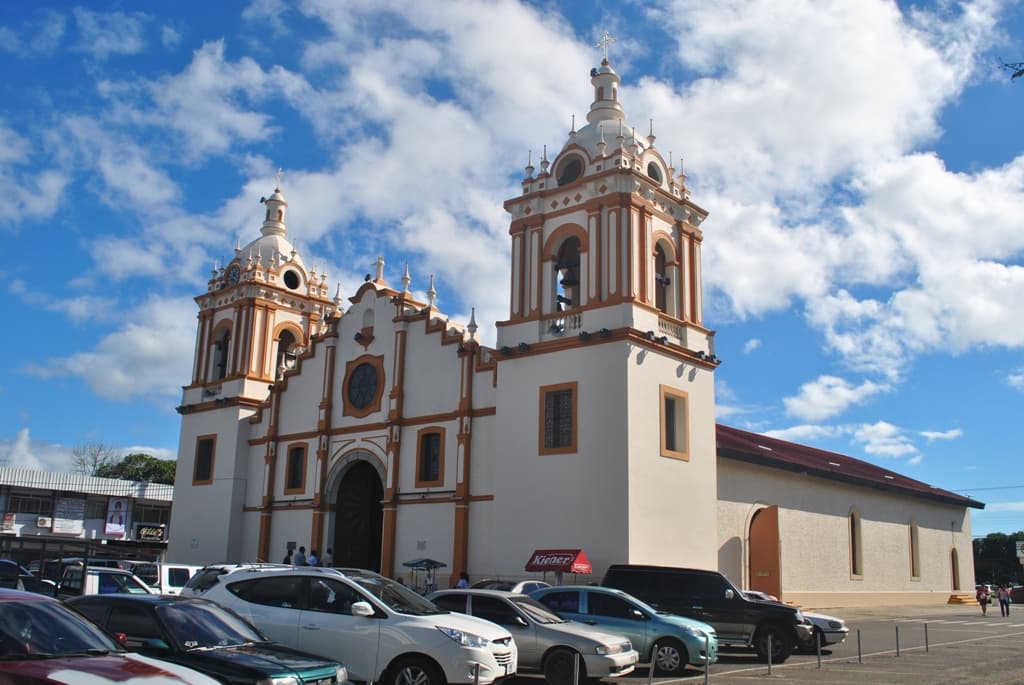 Apollo18 / public domain, via Wikimedia Commons
Self-guided audio walking tour of Santiago — GPS route, offline playback, story-driven narration in 32 languages.
“Santiago: Panama's central crossroads, where daily life unfolds.”
Not the postcards. The stories even locals don't know — whispered in your ear, right where they happened.
Beyond its imposing facade and academic purpose, this historic school honors a Panamanian hero.
The city's main cathedral holds a solemn connection to Panama's independence within its walls.
This museum, now a repository of regional history, once served a very different, more restrictive function.
Discover every secret of Santiago
Every address, every reveal in full — in your ear, right where it happened.
You pick your stops. You walk. The voice reveals what the others miss.

Your self-guided audio tour of Santiago is ready — pick your landmarks, choose your language, and start the moment you arrive.
BuyLume has a built-in augmented-reality guide. Hold your phone up and its camera shows the street ahead of you, with a glowing arrow laid over the real view that always points to your next stop — no map to puzzle over, no wrong turns. Like everything in Lume, it works fully offline.
Santiago de Veraguas, often simply called Santiago, serves as the vital crossroads of central Panama. As the capital of the Veraguas Province, it is a bustling regional hub that connects the country's eastern and western halves, positioned strategically on the Pan-American Highway. While it may not be a primary destination for ancient ruins or pristine resorts, Santiago offers an authentic glimpse into contemporary Panamanian life, acting as a crucial logistical stop for travelers exploring the country's diverse landscapes.
This working city is an active intersection where agriculture, commerce, education, and rural life converge. You will find a blend of colonial-era architecture and modern developments, particularly in its commercial centers and government offices. Santiago is a place where locals go about their daily lives, making it an excellent spot for observing daily rhythms and experiencing the genuine pulse of Panama.
Beyond its functional role, Santiago is also the gateway to some of Panama's compelling natural attractions. From here, travelers can easily access the Pacific coast beaches, the mountainous regions, and the national parks of the Azuero Peninsula, including the surfing and diving haven of Santa Catalina and Coiba National Park.
## Founding and Early Years Santiago de Veraguas was established on July 25, 1621, by people from the nearby towns of Montijo and Santa Fe. They sought to create a central location for dispatches and trade, selecting a site south of the Martín Grande river, also known as Los Chorros. Interestingly, Santiago did not appear in the 1606 account of Veraguas province by the Bishop of Panama, Don Antonio Calderon, suggesting its establishment came later than some other regional settlements like Santa Fe and Montijo.
## Colonial Era and Indigenous Heritage The province of Veraguas itself holds deep indigenous roots, with the unclassified extinct Escoria language once spoken by the native peoples around present-day Santiago. The name 'Veraguas' is thought to originate from the indigenous words 'Veracua' or 'Viragua,' meaning 'goddess' or 'strong woman.' The city's colonial influence is still evident in its architecture, particularly in landmarks like the Catedral Santiago Apóstol and the Escuela Normal Juan Demóstenes Arosemena.
## A Center for Education and Progress In the 20th century, Santiago solidified its role as an educational hub with the founding of the Escuela Normal de Santiago on June 5, 1938. This institution was established to train primary school teachers for the interior of the Republic and was later renamed Escuela Normal Juan Demóstenes Arosemena in 1941, honoring the president who championed its creation. The school's imposing architecture reflects the ambition of this educational project, designed to shape generations of teachers committed to national development.
## Modern Development and Regional Importance Santiago has grown into a significant commercial and banking center, supported by a strong agricultural sector that includes corn, rice, sugarcane, and livestock. While it has retained a more colonial feel without a skyline of high-rises, modern buildings now house shopping centers, banks, and government offices. The city's central location on the Pan-American Highway continues to make it a vital transportation hub, connecting travelers and goods across Panama and serving as a launchpad for exploring the diverse natural beauty of the Veraguas province.
Begin your exploration in the heart of Santiago at Parque de Santiago (Central Square), a leafy main square ideal for observing local life. Surrounding the park is the prominent Catedral Santiago Apóstol, a significant city landmark. This cathedral, dating back to 1868, blends Gothic and neoclassical styles and houses an historic marble tomb, an elaborately carved mahogany altar, and stained-glass windows by Dominican artist Dincón Mora. It also holds the remains of General José de Fábrega, a key figure in Panama's independence.
A short walk away, discover the Escuela Normal Juan Demóstenes Arosemena, a declared national historical monument. Its entrance features flamboyant architectural designs with large columns supporting an archway, adorned with statues and a statue of indigenous leader Urracá. Inside, a theater displays murals by Panamanian artist Roberto Lewis.
For a deeper dive into regional history, visit the Museo Regional de Veraguas, which showcases over two thousand years of the region's past, including archaeological, ecological, and ethnographical exhibits. This museum, once the city's jail, offers free admission. Experience the authentic local commerce at the Mercado Público (Public Market), a bustling hub for fresh produce, regional sweets, and traditional crafts.
While in the area, consider excursions to nearby attractions. Santiago is the primary transit point for Santa Catalina, a surfing and diving spot and the gateway to Coiba National Park, a UNESCO World Heritage Site recognized for its exceptional marine life. Also, explore the baroque San Francisco de la Montaña Church, a national treasure from 1630, located north of the city.
The ideal time to visit Santiago de Veraguas is during Panama's dry season, which extends from mid-December to mid-April. During these months, the weather is pleasant with less rainfall, making it perfect for exploring the city and accessing surrounding natural attractions like beaches and national parks. Temperatures during this period typically range from 71°F to 94°F, with clearer skies. The wet season, from May to November, brings heavier afternoon showers, though they often last only an hour or two, and the landscape becomes lush and green.
Santiago is easily accessible, located directly on the Pan-American Highway. Frequent long-distance buses connect it to Panama City (approximately 4 hours away) and David. Most travelers find one night sufficient as a stopover or logistical base before heading to more remote areas.
The official currencies are the Panamanian Balboa (PAB) and the U.S. Dollar (USD), with the Balboa pegged to the USD at 1:1. The U.S. dollar is used for all paper currency. Spanish is the official language, and while English may be understood in major hotels and bus terminals, basic Spanish phrases are helpful for navigating local transport and markets.
Panama uses plug types A and B, with a standard voltage of 120V and a frequency of 60Hz. Travelers from 220V regions will need a step-down voltage converter. Santiago is generally safe in its main commercial and central areas during the day. As in any city, exercise caution in crowded public areas and avoid unlit side streets at night. Tap water in Santiago is generally safe to drink.
Santiago in Korean, in Chinese or in Hebrew — and 29 more languages, every stop narrated by a native voice. The widest language range of any self-guided audio tour.
Available in: