Marché Central de Sarikei
Au-delà des étalages abondants de fruits tropicaux, le Marché Central de Sarikei recèle un secret qui témoigne de la surprenante richesse agricole de la ville.
L'histoire complète se débloque dans le tour
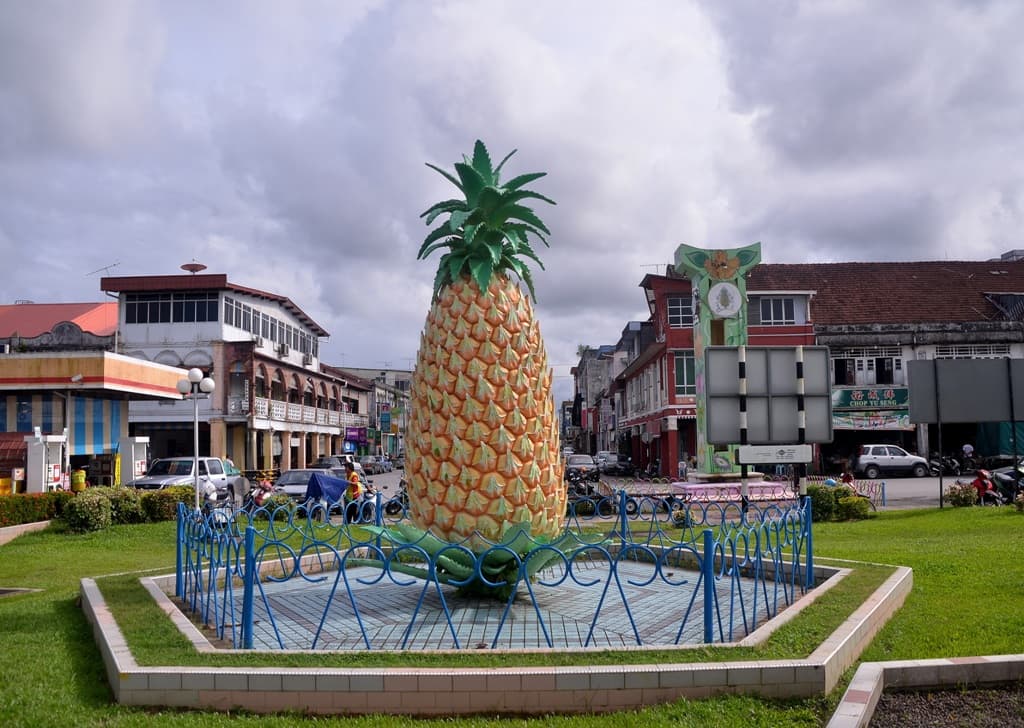 John Ragai from Petaling Jaya, Malaysia / CC BY 2.0, via Wikimedia Commons
Visite audio autoguidée de Sarikei — parcours GPS à pied, lecture hors ligne, narration en 32 langues.
“Là où le fleuve Rajang coule et les ananas fleurissent.”
Pas les cartes postales. Les histoires que même les habitants ignorent — soufflées à l'oreille, là où elles se sont passées.
Au-delà des étalages abondants de fruits tropicaux, le Marché Central de Sarikei recèle un secret qui témoigne de la surprenante richesse agricole de la ville.
Levez les yeux vers les boutiques du centre-ville de Sarikei, et vous pourriez remarquer quelque chose d'inhabituel se produisant à leurs étages supérieurs, loin du commerce au rez-de-chaussée.
Le puissant fleuve Rajang, une artère vitale pour Sarikei, a jadis joué un rôle dans l'auto-préservation de la ville pendant une période d'anarchie inattendue.
Découvrez tous les secrets de Sarikei
Chaque adresse, chaque révélation en entier — dans ton oreille, là où elle s'est passée.
Tu choisis tes lieux. Tu marches. La voix te révèle ce que les autres ignorent.


Votre visite audioguidée de Sarikei vous attend — choisissez vos lieux, votre langue, et lancez-vous dès votre arrivée.
AcheterLume intègre un guide en réalité augmentée. Levez votre téléphone : sa caméra montre la rue devant vous, avec une flèche lumineuse posée sur l'image réelle qui pointe toujours vers votre prochain arrêt — aucune carte à déchiffrer, aucun mauvais virage. Comme tout dans Lume, ça fonctionne entièrement hors-ligne.
Sarikei, souvent affectueusement surnommée la « Ville de l'Ananas » ou le « Panier alimentaire du Sarawak », est une ville fluviale située le long du puissant fleuve Rajang en Malaisie orientale. Cet emplacement stratégique, près du confluent du fleuve et de la mer de Chine méridionale, a façonné son identité en tant que centre important pour le commerce et l'agriculture. Avec une population d'environ 56 000 habitants, Sarikei offre un aperçu de la vie authentique de Bornéo, caractérisée par une communauté accueillante et un mélange de cultures Iban, Melanau et chinoises.
Bien que sa statue distinctive de l'ananas annonce fièrement ses prouesses agricoles, Sarikei est plus que son fruit célébré. La ville présente un mélange engageant de marchés locaux animés, de parcs tranquilles et d'un front de mer qui s'anime avec l'activité quotidienne. De l'exploration des boutiques traditionnelles à la dégustation de délices locaux uniques, Sarikei promet une expérience riche en nuances culturelles et en plaisirs culinaires qui surprennent souvent les visiteurs pour la première fois.
L'histoire de Sarikei remonte au XIXe siècle, avec les premiers établissements de peuples indigènes le long du fleuve Rajang. Les archives historiques indiquent que James Brooke, le premier Rajah Blanc de Sarawak, a visité Sarikei dès le 30 avril 1845. L'existence précoce de la ville a été marquée par la résistance au règne de Brooke, y compris l'incendie de Sarikei en 1856. Initialement partie de l'Empire de Brunei, Sarikei est devenue partie du Sarawak après que le bassin inférieur du Rajang ait été cédé à James Brooke en 1853.
Une période cruciale de développement a commencé au début du XXe siècle avec l'arrivée de colons chinois, en particulier de Fuzhou (Foochow). Ces immigrants industrieux ont transformé Sarikei d'un poste de traite tranquille en un centre agricole animé. L'économie de la région s'est rapidement diversifiée, les habitants et les colons cultivant le poivre noir et le caoutchouc, très appréciés dans le monde entier. Cependant, c'est l'ananas qui a véritablement valu à Sarikei son titre officieux de « Panier de fruits du Sarawak ».
Le développement urbain de Sarikei était intrinsèquement lié au fleuve Rajang, qui servait d'artère de transport principale. L'aménagement central de la ville, avec son quadrillage de rues, reflète la conception typique des établissements commerciaux coloniaux, construits pour la commodité logistique le long du front de mer. Les premières boutiques en bois ont été progressivement remplacées par des structures en brique plus permanentes dans les années 1930. Sarikei a officiellement reçu son statut de centre de la sixième division administrative du Sarawak en 1973, une décision en partie motivée par des préoccupations de sécurité pendant une période de rébellion communiste. Aujourd'hui, Sarikei continue de prospérer en tant que pôle agro-culturel, son héritage étant visible dans son architecture, ses marchés et la coexistence harmonieuse de ses diverses communautés.
Commencez votre exploration sur le front de mer de Sarikei, une esplanade animée offrant des vues panoramiques sur le fleuve Rajang. Vous y trouverez la distinctive Statue de l'Ananas, un monument de 3,6 mètres de haut symbolisant la fierté agricole de Sarikei et un endroit populaire pour les photographies. À quelques pas se trouve le Marché Central de Sarikei (Pasar Sentral Sarikei), un centre animé où vous pourrez vous immerger dans la vie locale. Parcourez les étals débordant de produits frais, y compris les ananas célébrés de la région et les fruits exotiques, ainsi que les légumes locaux, les fruits de mer et l'artisanat.
Pour une évasion tranquille, visitez le Taman Tasik Sarikei (Parc du lac de Sarikei), un espace vert magnifiquement aménagé avec un lac central, parfait pour une promenade tranquille ou un pique-nique en famille. Les passionnés d'histoire peuvent explorer l'église St. Anthony, un monument du début du XXe siècle avec une architecture distinctive, ou le Centre du patrimoine de Sarikei pour approfondir le passé de la ville. Envisagez une croisière fluviale le long du fleuve Rajang pour découvrir la beauté intacte de la forêt tropicale environnante et observer la vie locale le long du plus long fleuve de Malaisie. Pour une immersion culturelle unique, organisez un séjour chez l'habitant à la longhouse de Rumah Nyuka à Lubuk Lemba, une authentique longhouse Iban en bois de fer, offrant un aperçu de la culture indigène.
Sarikei connaît un climat de forêt tropicale humide, caractérisé par des températures constamment chaudes et une humidité élevée tout au long de l'année. Les températures moyennes quotidiennes oscillent autour de 27°C, avec des maximales diurnes atteignant environ 30°C et des nuits légèrement plus fraîches à 24°C. Bien qu'il n'y ait pas de saisons distinctes, les précipitations sont fréquentes. La période la plus humide tombe généralement en hiver et au début de l'année, en particulier en décembre et janvier, qui peuvent connaître jusqu'à 30 jours de pluie par mois. Les mois plus secs sont généralement juin et juillet, ce qui les rend idéaux pour les activités de plein air, bien qu'un parapluie ou un imperméable soit conseillé toute l'année en raison des averses tropicales imprévisibles. Le Festival annuel de l'ananas, un événement important, a lieu en novembre.
Sarikei est mieux explorée à pied, en particulier son centre-ville compact et ses marchés animés. Pour les longues distances, les taxis et les services de covoiturage comme Grab sont facilement disponibles. Sarikei sert de point de transit majeur, avec des services de bus la reliant aux principaux centres du Sarawak, y compris Sibu (à environ 1,5 heure) et Kuching (environ 5-6 heures). Le principal terminal de bus, Sarikei Express Bus Terminal, est situé à environ 1 km du centre-ville. Bien que Sarikei n'ait pas d'aéroport, l'aéroport de Tanjung Manis (TGC) est à environ une heure de route, et l'aéroport de Sibu (SBW) est à environ 1,5 heure, offrant des vols intérieurs. La monnaie officielle est le Ringgit malaisien (MYR). Les grands hôtels et supermarchés acceptent les cartes, mais il est conseillé d'avoir de l'argent liquide pour les marchés locaux et les vendeurs de nourriture de rue. Les options d'hébergement vont des hôtels économiques comme l'Hotel O Wawasan Inn et l'OYO 90102 7 Days Lodge aux séjours chez l'habitant tels que Sarikei Homestay.
Sarikei en coréen, en chinois ou en hébreu — et dans 29 autres langues, chaque étape narrée par une voix native. La plus large gamme de langues de tous les audioguides autoguidés.
Disponible en :