Gottorf Castle
Beyond the grand halls of Gottorf Castle, a curious 17th-century marvel once allowed visitors to step inside a miniature world.
Full story unlocks in the tour
 Photo: admiratio / Unsplash
Self-guided audio walking tour of Schleswig — GPS route, offline playback, story-driven narration in 32 languages.
“Where Viking echoes meet ducal grandeur on the Schlei.”
Not the postcards. The stories even locals don't know — whispered in your ear, right where they happened.
Beyond the grand halls of Gottorf Castle, a curious 17th-century marvel once allowed visitors to step inside a miniature world.
The quaint fishing village of Holm, now a charming district, was once an island with special privileges.
Observe Schleswig Cathedral closely, and you might notice a subtle architectural detail that speaks to centuries of shifting allegiances.
Discover every secret of Schleswig
Every address, every reveal in full — in your ear, right where it happened.
You pick your stops. You walk. The voice reveals what the others miss.
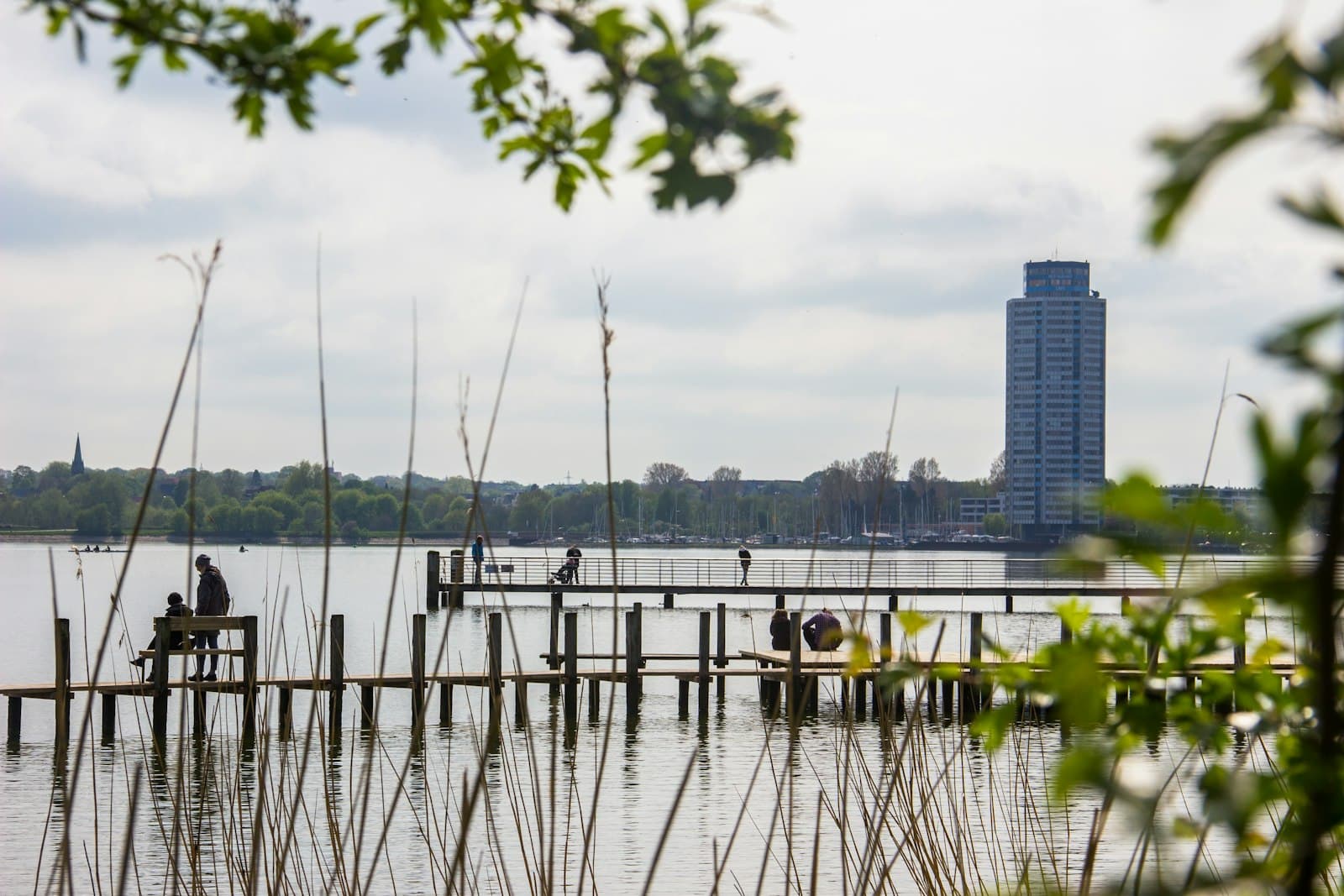
Your self-guided audio tour of Schleswig is ready — pick your landmarks, choose your language, and start the moment you arrive.
BuyLume has a built-in augmented-reality guide. Hold your phone up and its camera shows the street ahead of you, with a glowing arrow laid over the real view that always points to your next stop — no map to puzzle over, no wrong turns. Like everything in Lume, it works fully offline.
Schleswig, a city in northern Germany, sits gracefully at the end of the Schlei fjord, an inlet of the Baltic Sea. This strategic location has shaped its identity for over a millennium, making it a place where Viking history, ducal grandeur, and a unique blend of German and Danish cultures converge. With a population of approximately 25,765, Schleswig offers a tranquil yet engaging experience, far from the bustling metropolises, allowing for a deeper immersion into its profound heritage.
The city's allure lies in its diverse offerings, from the reconstructed Viking settlement of Haithabu, a UNESCO World Heritage Site, to the imposing Gottorf Castle and the quaint fishing village of Holm. The surrounding landscape of the Schlei fjord provides scenic views and opportunities for outdoor activities, making Schleswig an ideal destination for history enthusiasts, nature lovers, and those seeking a quieter, culturally rich escape.
Schleswig's story begins over 1,200 years ago, deeply intertwined with the Vikings. The village of Sliasthorp an der Schlei was first mentioned in 804. However, the Vikings initially established their primary trading center, Hedeby (Haithabu), on Haddeby Noor, a strategically advantageous location. In its heyday, Hedeby was a powerful settlement, dominating the Baltic region and home to over 1,000 people, making it one of Northern Europe's most important early medieval emporia.
Following several destructions, and with the weakening of Viking power, the population of Hedeby relocated around 1050 to the northern bank of the Schlei, giving rise to the city of Schleswig. Hedeby was finally destroyed in 1066, solidifying Schleswig's position as a regional center. The town became a bishopric in 947, and the construction of the impressive Schleswig Cathedral began in 1138.
From the 12th century, the region came under the rule of the Dukes of Gottorf, whose magnificent Gottorf Castle became their residence in 1544. For centuries, Schleswig was a Danish duchy, while Holstein was associated with the Holy Roman Empire, leading to a complex history of cultural exchange and conflict between Danish and German interests. This ongoing dispute, known as the Schleswig-Holstein Question, saw the region alternate between Danish and German rule.
The First Schleswig War (1848-1850) saw a Danish victory, but the Second Schleswig War in 1864 resulted in Prussian and Austrian triumph, leading to Schleswig's incorporation into Prussia in 1867. After Germany's defeat in World War I, the 1920 Schleswig plebiscites led to Danish-speaking North Schleswig returning to Denmark, while Southern Schleswig remained part of Germany. After World War II, when Kiel became the state capital, Schleswig received compensation by becoming the main seat of the state's highest courts, state museums, and state archives.
Begin your exploration at the Viking Museum Haithabu, a UNESCO World Heritage Site, where you can delve into the world of early medieval trade and see reconstructed Viking houses. Just a short distance away, the ancient earthworks of the Danevirke (Dannewerk) offer a glimpse into the region's strategic past as a frontier.
Dominating the landscape is Gottorf Castle, a former ducal residence now housing major state museums, including the State Museum of Art and Cultural History. Do not miss the Baroque Garden on the castle grounds. In the heart of the city, St. Peter's Cathedral stands as a testament to centuries of history, with its striking Gothic tower.
For a taste of traditional life, wander through the Holm Fishing Village, a charming settlement of small gabled houses clustered around a chapel and cemetery, offering a picturesque scene and a glimpse into Schleswig's waterside heritage. The Schleswig Old Town (Altstadt) itself, with its merchant houses and gabled façades, reflects the city's past as a ducal and ecclesiastical seat. For a relaxing stroll, the Königswiese Park and Promenade offers green spaces, a beach, and views of Seagull Island. The Stadtmuseum Schleswig provides further insights into the city's history.
The most pleasant time to visit Schleswig for warm-weather activities is from May through September. Summer, particularly June to August, offers mild and comfortable temperatures, averaging around 17-18°C, with highs reaching 21-22°C, ideal for walking tours and sightseeing. While precipitation is frequent year-round, light rain or drizzle can occur at any time, so an umbrella or raincoat is always a good idea. For fewer crowds and better value, consider the quieter months of December through March, which offer a cooler season experience.
Schleswig is easily accessible by train, with direct connections to Hamburg, Flensburg, and Kiel. The city also has a good local bus network for getting around. For those seeking more flexibility, rideshare services are available. The official currency is the Euro (EUR). While German is the primary language, many locals, especially in tourist-oriented areas, speak English, and the region has a strong Danish influence.
EU citizens, as well as citizens of EEA countries and Switzerland, do not require a visa for entry or extended stays in Germany. Other foreign nationals generally require a visa for stays longer than three months or for employment purposes. It is advisable to check the specific visa requirements with the German embassy or consulate in your home country well in advance of your trip.
Schleswig in Korean, in Chinese or in Hebrew — and 29 more languages, every stop narrated by a native voice. The widest language range of any self-guided audio tour.
Available in: