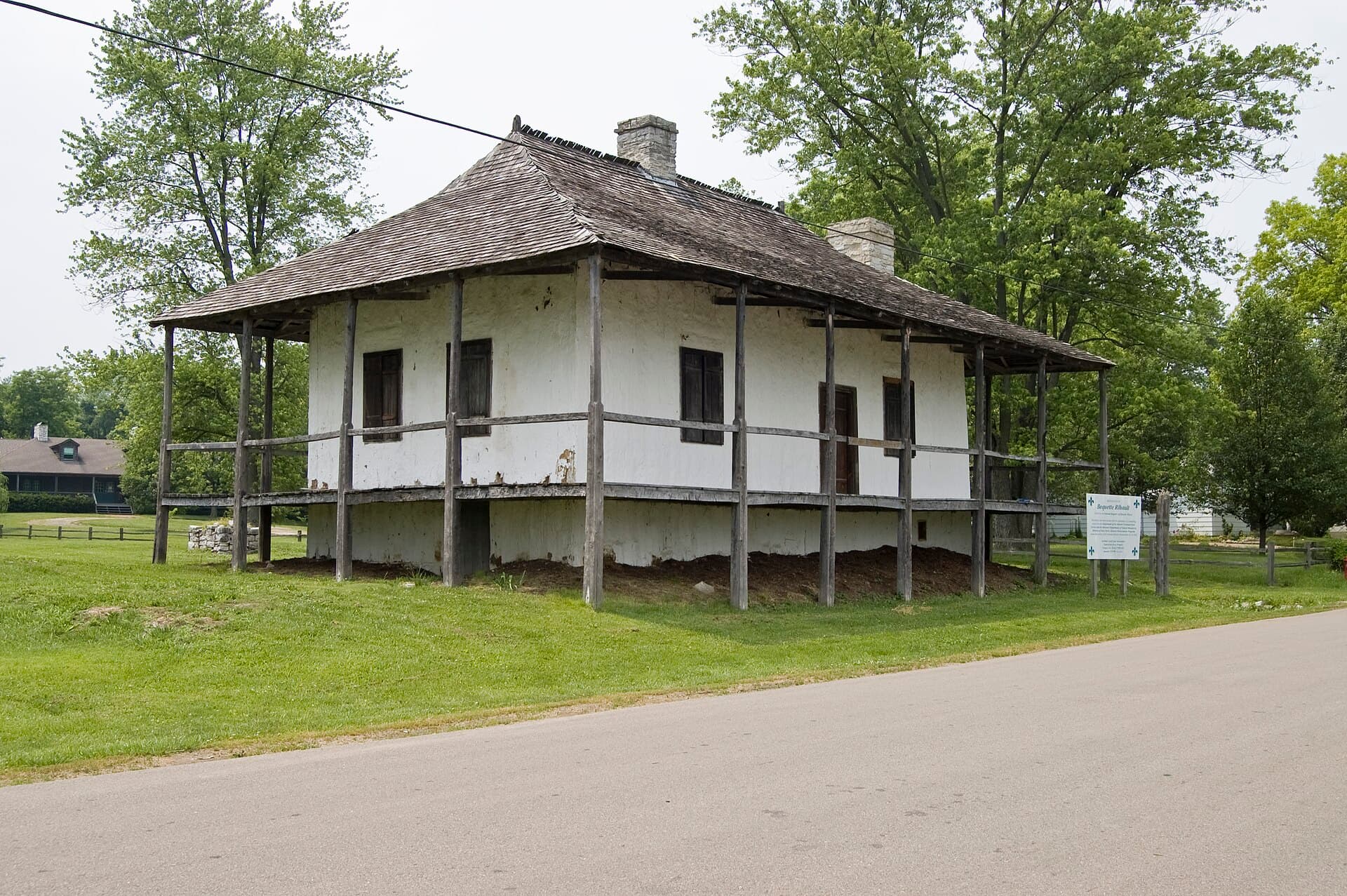
Original Ste. Genevieve settlement
Before its current location, Ste. Genevieve existed elsewhere, a testament to the unpredictable power of nature.
Full story unlocks in the tour
 Andrew Balet / CC BY 2.5, via Wikimedia Commons
Self-guided audio walking tour of Ste. Genevieve — GPS route, offline playback, story-driven narration in 32 languages.
“Where French Colonial Echoes Meet Mississippi River Lore”
Not the postcards. The stories even locals don't know — whispered in your ear, right where they happened.
Before its current location, Ste. Genevieve existed elsewhere, a testament to the unpredictable power of nature.
The distinctive homes here tell a unique story of French building techniques, unlike most colonial architecture found in the United States.
For a period, this French-speaking town held a surprising administrative role under a different European power.
Discover every secret of Ste. Genevieve
Every address, every reveal in full — in your ear, right where it happened.
You pick your stops. You walk. The voice reveals what the others miss.


Your self-guided audio tour of Ste. Genevieve is ready — pick your landmarks, choose your language, and start the moment you arrive.
BuySte. Genevieve, Missouri, is a living testament to French colonial America, a place where the echoes of 18th-century life are remarkably preserved along the banks of the Mississippi River. As the first permanent European settlement in Missouri, founded between 1735 and 1750 by French Canadian colonists, it offers a distinct window into a pivotal period of North American history.
Unlike many colonial towns on the East Coast, Ste. Genevieve's unique French vernacular architecture, characterized by vertical log construction, sets it apart. The town's narrow streets and fenced gardens evoke a sense of stepping back in time, offering a tangible connection to its French and Spanish past. Now designated a National Historical Park, Ste. Genevieve invites visitors to explore its meticulously preserved homes, delve into its complex history, and experience a community that continues to celebrate its multicultural legacy.
The story of Ste. Genevieve begins not with grand declarations, but with the practical needs of French Canadian settlers seeking fertile land. Sometime between 1735 and 1750, these early inhabitants established a community on the west bank of the Mississippi River, drawn by the fertile alluvial soil of an area they called 'Le Grand Champ' or 'The Big Field.' This initial settlement, often referred to as 'Old Ste. Genevieve,' was located about three miles south of the present-day town.
Life in this early French outpost was shaped by its unique position in the 'Illinois Country,' a vast territory under French control. The settlers developed distinctive customs, laws, and architectural styles, most notably the vertical log construction seen in homes like the Jean Baptiste Vallé House and the Bauvais-Amoureux House. These building techniques, such as poteaux-en-terre (posts-in-ground) and poteaux-sur-sole (posts-on-sill), are rare examples of French Colonial vernacular architecture in North America.
In 1762, a significant shift occurred when France ceded its territories west of the Mississippi to Spain following the French and Indian War. Despite coming under Spanish rule, Ste. Genevieve largely retained its French character and language, even serving as the capital of Spanish Louisiana for a period. However, the Mississippi River, which had given life to the settlement, also posed its greatest threat. A devastating flood in 1785 compelled the community to relocate to higher ground, establishing the Ste. Genevieve we know today.
The Louisiana Purchase in 1803 ushered in a new era, as Ste. Genevieve transitioned into American hands. While its French-speaking residents navigated this change, American settlers began to arrive, followed by German immigrants after 1830, each leaving their mark on the town's architecture and culture. This blend of influences created a unique cultural fabric that continues to define Ste. Genevieve. In a more somber chapter, the town experienced a race riot in 1930, which led to the forced departure of most of its African American population.
Today, Ste. Genevieve's enduring historical significance has been formally recognized with its designation as a National Historical Park in October 2020. This status ensures the preservation of its irreplaceable French colonial heritage and invites visitors to explore the intricate layers of its past.
Begin your exploration at the Ste. Genevieve National Historical Park Visitor Center, located within the town's Welcome Center at 66 S. Main Street. Here, you can watch an introductory film, pick up maps, and sign up for ranger-led programs to tour historic structures like the Jean Baptiste Vallé House, the Bauvais-Amoureux House, and the Green Tree Tavern.
Wander through the Ste. Genevieve Historic District, a National Historic Landmark District featuring narrow streets and well-preserved 18th-century French colonial homes. Many of these unique vertical log structures are open for tours, offering a direct glimpse into early frontier life.
Beyond the National Historical Park, visit the Felix Valle State Historic Site, another significant example of early American architecture. Explore the Ste. Genevieve Museum Learning Center to delve deeper into the region's prehistoric past, Indigenous inhabitants, and the stories of French and German settlers.
For outdoor enthusiasts, the nearby Pickle Springs Natural Area offers hiking trails with waterfalls, canyons, and unique rock formations. You can also honor veterans at Missouri's National Veterans Memorial in nearby Perryville, which features a full-scale replica of the Vietnam Veterans Memorial. Experience the local craft beer and wine scene at various wineries in the region.
The best times to visit Ste. Genevieve for warm-weather activities are from late May to late June and from late July to late September, when temperatures are comfortable and humidity is lower. The clearer skies of August also make it a pleasant time to explore. For those who appreciate fall foliage and harvest festivals, autumn offers a beautiful backdrop. Winter brings a different charm, with the possibility of snow-covered historic streets and opportunities for cozy winery visits and winter hikes. Be aware that July can be particularly muggy.
Ste. Genevieve is approximately an hour's drive south of St. Louis, Missouri. The Ste. Genevieve National Historical Park Visitor Center, located at 66 S. Main Street, serves as a central hub for information, maps, and tour sign-ups. The park is generally open daily from 9 AM to 5 PM, with exceptions for major holidays. While many outdoor areas of the National Historical Park do not have an entrance fee, some tours or special programs may.
The town offers a variety of lodging options, including inns, many in refurbished historic structures, as well as camping areas. You'll find diverse dining choices, from casual bites to fine dining, often featuring locally sourced ingredients. Consider checking the status of the Ste. Gen. Modoc Ferry if you plan to cross the Mississippi River. The city also hosts numerous festivals and events throughout the year, so check the local calendar to align your visit with a special celebration.
Ste. Genevieve in Korean, in Chinese or in Hebrew — and 29 more languages, every stop narrated by a native voice. The widest language range of any self-guided audio tour.
Available in: