Casa de la Libertad
The very room where Bolivia declared its independence holds a surprising detail that hints at its earlier, quieter purpose.
Full story unlocks in the tour
 Parallelepiped09 / CC BY-SA 4.0, via Wikimedia Commons
Self-guided audio walking tour of Sucre — GPS route, offline playback, story-driven narration in 32 languages.
“Where history unfolds from whitewashed walls and ancient footsteps pave the way.”
Not the postcards. The stories even locals don't know — whispered in your ear, right where they happened.
The very room where Bolivia declared its independence holds a surprising detail that hints at its earlier, quieter purpose.
Thousands of dinosaur footprints climb a sheer rock face outside Sucre, but the most astonishing part isn't just their quantity or age.
Beyond the lively stalls of produce and local goods, the Central Market offers a unique opportunity for language learners.
Discover every secret of Sucre
Every address, every reveal in full — in your ear, right where it happened.
You pick your stops. You walk. The voice reveals what the others miss.


Your self-guided audio tour of Sucre is ready — pick your landmarks, choose your language, and start the moment you arrive.
BuyLume has a built-in augmented-reality guide. Hold your phone up and its camera shows the street ahead of you, with a glowing arrow laid over the real view that always points to your next stop — no map to puzzle over, no wrong turns. Like everything in Lume, it works fully offline.
Sucre, Bolivia, often called "La Ciudad Blanca" or "The White City," is a UNESCO World Heritage site recognized for its impeccably preserved colonial architecture. Situated in a scenic valley at an elevation of approximately 2,800 meters (9,150 feet), it offers a milder climate than many other Bolivian cities, making it a comfortable place to explore. As the constitutional capital of Bolivia, Sucre holds significant historical and cultural importance, serving as the seat of the judiciary, while La Paz functions as the administrative capital.
The city's relaxed pace and elegant atmosphere draw visitors who appreciate its blend of history, lively local life, and educational opportunities. From its grand churches and leafy plazas to its bustling markets and historic university, Sucre invites a deeper look into Bolivia's past and present. It's a place where every whitewashed building and stone-paved street seems to tell a story, reflecting centuries of Spanish influence and the enduring spirit of Bolivia.
## The City of Four Names Sucre has been known by various names throughout its existence, each reflecting a different chapter in its extensive history: Charcas, La Plata, Chuquisaca, and finally, Sucre. Originally an Inca town called Chuquisaca, the area was conquered by Topa Inka Yupanqui, who imposed the Quechua language. The Spanish conquistadors founded the city in 1538, initially naming it Ciudad de la Plata de la Nueva Toledo, or simply La Plata. This name, meaning "The Silver," highlighted the city's importance and wealth, particularly due to its proximity to the incredibly rich silver mines of Potosí.
In 1559, La Plata became the seat of the Audiencia de Charcas, a significant administrative body established by King Philip II of Spain, which governed a vast region encompassing parts of present-day Paraguay, Peru, Chile, Argentina, and most of Bolivia. During the colonial era, Sucre's temperate climate made it a preferred residence for Spanish royalty and wealthy families involved in the silver trade from Potosí. The city flourished as a judicial, religious, and cultural center, with the founding of the St. Francis Xavier University of Chuquisaca in 1624, one of the oldest universities in the Americas.
The independence movement against Spain began in Sucre in 1809, with what locals call the "first cry for liberty." After years of struggle, Bolivia declared its independence on August 6, 1825, in the Casa de la Libertad. The new nation was named Bolivia in honor of Simón Bolívar, and the city of Chuquisaca was renamed Sucre in 1839, in honor of revolutionary leader Antonio José de Sucre, who became Bolivia's first president. While Sucre retained its title as the constitutional capital, the seat of government moved to La Paz in 1898 after the economic decline of Potosí's silver industry, a decision that still causes some regional tension.
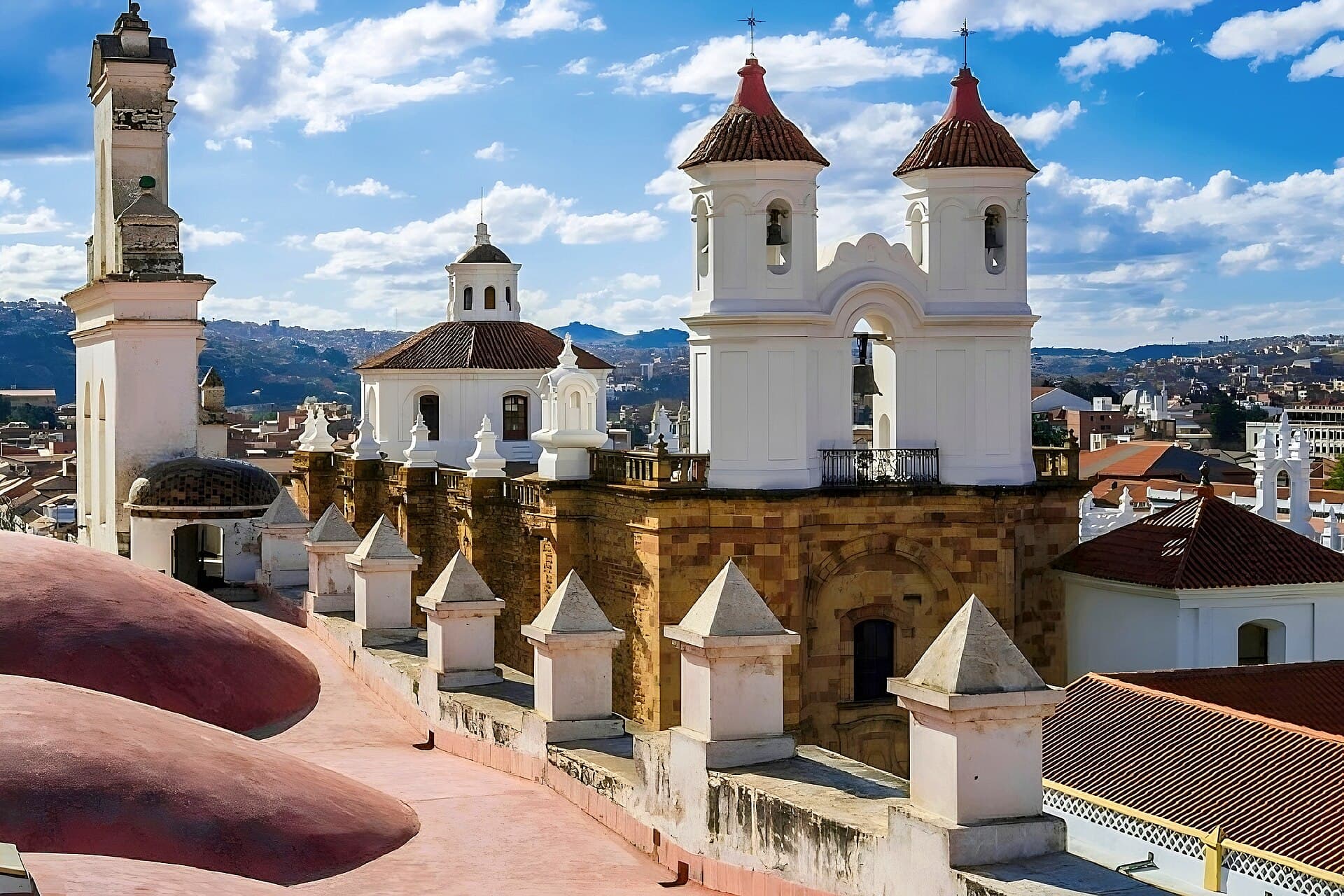
Begin your exploration at Plaza 25 de Mayo, Sucre's central square, a lively hub surrounded by important historical buildings. Here, you'll find the Casa de la Libertad, where Bolivia's Declaration of Independence was signed in 1825; it now functions as a museum offering guided tours. Just a short walk from the main plaza is the Convento de San Felipe Neri, a beautiful colonial building where you can climb to the red-tiled rooftops for expansive views of the "White City."
For a different perspective, head uphill to La Recoleta, an area with a monastery and a plaza offering some of the city's finest views, especially at sunset. Delve into prehistory at Parque Cretácico (Dinosaur Park), a short bus ride from the city center, where you can see the Cal Orck'o cliff, home to the world's largest collection of dinosaur footprints. Back in the city, immerse yourself in local life at the Central Market, a bustling place to sample local foods and observe daily routines. Do not miss the General Cemetery, a peaceful and beautifully maintained garden-like space with intricate tombs.
The dry season, from April to November, is generally considered the best time to visit Sucre. During these months, you can expect clear blue skies, abundant sunshine, and pleasant daytime temperatures ranging from 18-22°C (64-72°F). Nights can be cool, especially from May to August, so layering is advisable. This period is ideal for exploring the city's historic center on foot, visiting museums, and enjoying outdoor activities like hiking. The wet season, from November to March, brings more frequent afternoon thunderstorms, though the city remains open and enjoyable for visitors who do not mind some rain.
Sucre's Alcantarí International Airport (SRE) is about 30 km from the city, with daily flights from La Paz, Santa Cruz, and Cochabamba. Shared taxis or minibuses connect the airport to the city center. Long-distance buses also connect Sucre to other major Bolivian cities like Potosí (3-4 hours), La Paz (12-14 hours), and Santa Cruz (16-18 hours); booking "cama" or "semi-cama" seats is recommended for comfort on longer journeys.
Within Sucre, the city center is very walkable. Taxis are inexpensive, but it's best to agree on a fare before starting your journey as they are usually not metered. Small local buses, known as "micros," run set routes; simply flag them down and tell the driver your destination. Sucre is considered one of Bolivia's safer cities, but it's always wise to secure valuables, especially in crowded areas like markets. While Spanish is widely spoken, learning a few Quechua phrases can also be helpful.
Sucre in Korean, in Chinese or in Hebrew — and 29 more languages, every stop narrated by a native voice. The widest language range of any self-guided audio tour.
Available in: