The intriguing Talsi coat of arms features a green hillock and a hand holding an oak wreath. While some jokingly interpret it as a zombie's hand with a tombstone wreath, its true meaning is far less macabre.
Chmee2 / CC BY-SA 3.0, via Wikimedia CommonsTalsi
Self-guided audio walking tour of Talsi — GPS route, offline playback, story-driven narration in 32 languages.
“Where nine hills meet two lakes, Talsi recounts stories of old Courland.”
Talsi, as no one tells it.
Not the postcards. The stories even locals don't know — whispered in your ear, right where they happened.
The stately white Talsi Evangelical Lutheran Church, an enduring landmark, holds a unique detail atop its tower that speaks to a broader spiritual message.
Talsi is known as the 'Town of Nine Hills,' each with its own name and character. One of these hills holds a poignant memorial to a significant historical event.
Discover every secret of Talsi
Every address, every reveal in full — in your ear, right where it happened.
You pick your stops. You walk. The voice reveals what the others miss.
How long do you have in Talsi?
Your self-guided audio tour of Talsi is ready — pick your landmarks, choose your language, and start the moment you arrive.
BuyThe story of Talsi
Talsi, often referred to as the 'green pearl of Courland,' is a picturesque town in western Latvia, recognized for its distinctive landscape of nine hills and two serene lakes. This appealing town offers a blend of natural beauty and historical depth, inviting visitors to explore its paved streets, colorful wooden houses, and ancient parks. The historic center, situated between Lake Talsi and Lake Vilkmuiža, is recognized as an urban construction monument, displaying architecture from the 16th to 19th centuries.
With a population of around 9,000, Talsi maintains a relaxed atmosphere, making it an ideal destination for those seeking an authentic Latvian experience away from the busier cities. It serves as a calm base for exploring the surrounding Kurzeme region, offering a balance between convenience and charm. From leisurely walks along the lakeside promenade to discovering local crafts and regional history, Talsi provides a captivating glimpse into Latvian life.
Early Beginnings and German Influence
The history of Talsi stretches back to at least the 10th century, when a hill fort was established by the Curonians, an ancient Baltic tribe. The settlement was first documented in written sources in 1231, in an agreement between a Curonian tribe and a papal envoy. During the Northern Crusades in the late 13th century, the area came under German rule, and a castle was built in Talsi. The town expanded in the 15th century as German-speaking traders and artisans settled in the area.
Plagues, Fires, and Russian Rule
The main church, still visible today, was inaugurated in 1567. Talsi, like many European towns, faced hardship, enduring two severe plague outbreaks in 1657 and 1710, and a devastating fire in 1733. In 1795, Talsi became part of the Russian Empire, along with the rest of Courland. At this time, Baltic Germans comprised a significant portion of the population. The late 18th century also marked the first time Jews were permitted to settle in Talsi, with many arriving from Lithuania and eventually forming a substantial community.
20th Century Challenges and Independence
The early 20th century brought further challenges. During the Revolution of 1905, half of Talsi was destroyed by fire when Russian troops opened fire on the town. World War I caused a drastic population decline, from approximately 5,000 to just 1,100, with many Jewish residents forced to leave. Peace returned in 1920 with the end of the Latvian War of Independence, and Talsi became part of the newly independent Latvia, quickly regaining its population. By 1935, the town had 4,116 inhabitants, predominantly ethnic Latvians, with significant Jewish and German minorities.
German occupation during World War II, from 1941 to 1945, led to the tragic murder of Talsi's entire Jewish population. Following the war, Talsi was part of the Latvian Soviet Socialist Republic. The town experienced growth in the 1950s and 60s, including the opening of a metalworking plant in 1965. After the dissolution of the Soviet Union and Latvia's renewed independence, a sculpture called 'Koklētājs,' dedicated to Latvian freedom fighters, was finally inaugurated, having been started in the 1930s.
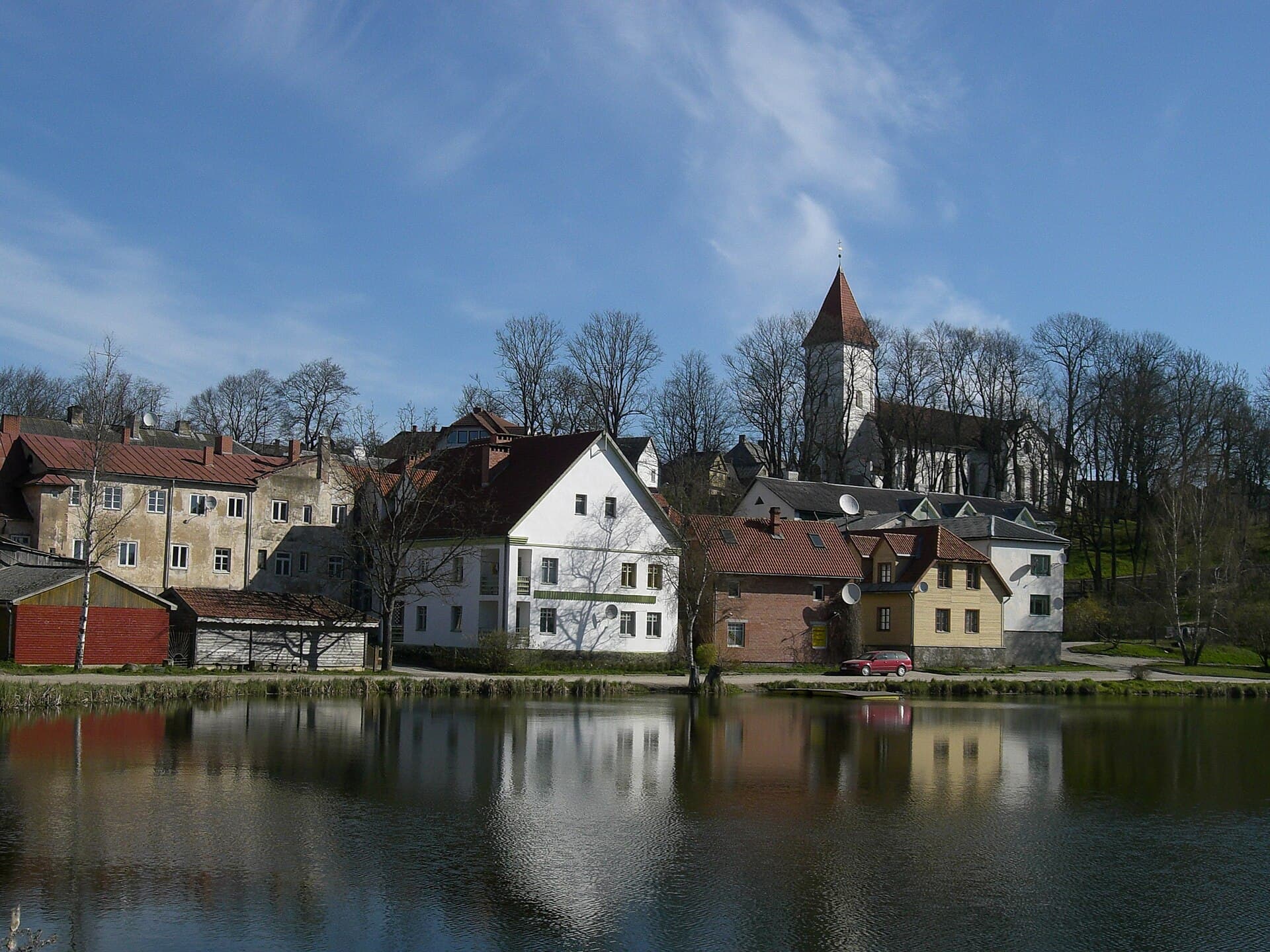
Talsi's landscape, shaped by its nine hills and two lakes, provides a natural itinerary. Begin at Talsu pilskalns, the Castle Mound, which offers wide views of the town and its surrounding lakes. This 32-meter-high hill, once the site of an ancient Curonian hill fort, is central to Talsi's identity. Stroll along the Talsi Lake promenade, a pleasant loop with benches and views, popular with locals for walking and fishing. You'll also find a fountain in the lake during summer.
For a deeper dive into local history and culture, visit the Talsi Regional Museum, housed in the beautifully restored 19th-century manor house of Baron von Fircks on Tiguļu kalns, the tallest of Talsi's hills. Tiguļu kalns also features an arboretum, a park with diverse tree species. The Talsi Evangelical Lutheran Church, an oldest stone building in Talsi, stands prominently on Baznīckalns (Church Hill). Do not miss the Talsi Creative Yard, a center for local artists, photographers, musicians, actors, and weavers, which evolved from the town's first cultural center established in the early 1900s. For a distinctive photo opportunity, seek out the 'Giant Buttons' on the wall of the Talsi Tourism and Active Leisure Center.
The best time to visit Talsi is during the warmer months, from late May to early September. This period offers comfortable temperatures, longer daylight hours, and the most pleasant conditions for outdoor activities like hiking, cycling, and exploring the lakes. July and August are the warmest months, with average daily high temperatures above 62°F (17°C), making them ideal for enjoying the lakeside and town festivals. While summer can see more local tourists, the shoulder months of late May-early June and September offer milder weather and fewer crowds, providing a more intimate experience.
Talsi is easily accessible by bus from Riga, with the journey taking approximately two hours, making it a convenient day trip or overnight stop. Renting a car offers more flexibility for exploring the wider Kurzeme region. Once in Talsi, the town is very walkable, with most attractions within easy reach on foot. The local currency is the Euro (EUR), and credit cards are widely accepted in supermarkets and many cafes, though carrying some cash for smaller establishments and markets is advisable.
Accommodation options include guesthouses and holiday homes, with booking in advance recommended, especially during peak season. Talsi is generally considered safe for tourists, but standard safety precautions should always be observed. Tap water is safe to drink. For local information and assistance, the Talsi Regional Tourist Information Center is located at Lielā iela 19/21.
- What is Talsi known for?
- Talsi is known as the 'Town of Nine Hills' and two lakes, offering a unique picturesque landscape. It is recognized for its 19th-century wooden architecture, appealing Old Town, and as a calm base for exploring the Kurzeme region.
- How do I get to Talsi?
- The most convenient way to reach Talsi from Riga is by bus, with the journey lasting about two hours. Renting a car also provides flexibility for exploring the area.
- What are the main attractions in Talsi?
- Key attractions include Talsu pilskalns (Castle Mound) for wide views, the Talsi Lake promenade, the Talsi Regional Museum in Baron von Firck's manor, and the Talsi Evangelical Lutheran Church. Do not miss the Talsi Creative Yard and the distinctive 'Giant Buttons' art installation.
- When is the best time to visit Talsi?
- The best time to visit Talsi is from late May to early September, when the weather is warm and pleasant, ideal for outdoor activities and experiencing local festivals.
- Is Talsi suitable for a day trip?
- Yes, Talsi is a popular and worthwhile day trip from Riga, easily accessible by a two-hour bus ride. Its compact size and central attractions make it manageable for a single day's exploration.
- What currency is used in Talsi?
- As in the rest of Latvia, the Euro (EUR) is the currency used in Talsi. Credit cards are widely accepted, but it's good to carry some cash for smaller purchases.