The Toledo Strip
Before Toledo was firmly in Ohio, it was the prize in a bloodless conflict with Michigan. But one incident did involve a weapon, and a surprising outcome.
Full story unlocks in the tour
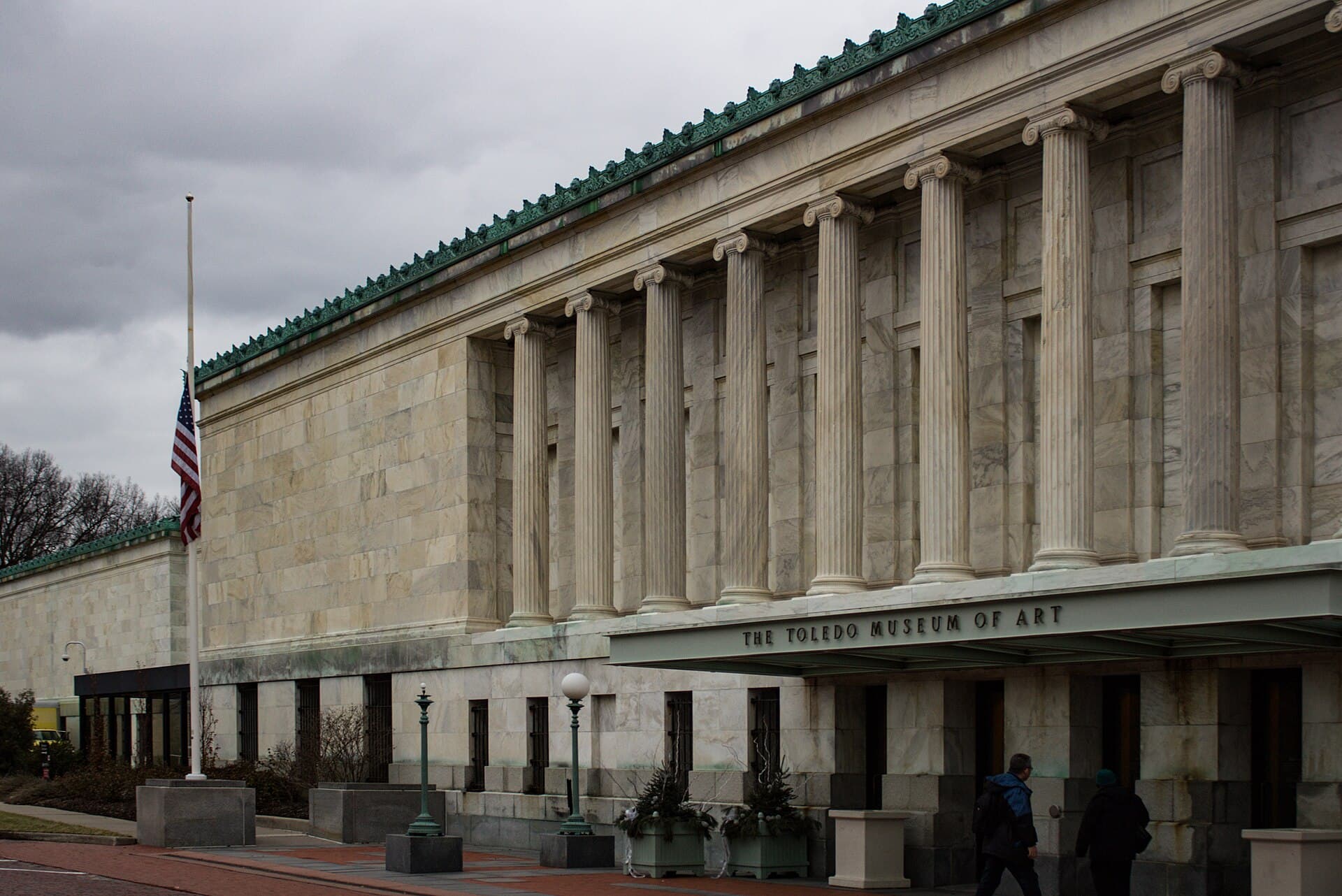 Jason Zhang / CC BY-SA 3.0, via Wikimedia Commons
Self-guided audio walking tour of Toledo — GPS route, offline playback, story-driven narration in 32 languages.
“Where industry forged art, and a border war was won with a penknife.”
Not the postcards. The stories even locals don't know — whispered in your ear, right where they happened.
Before Toledo was firmly in Ohio, it was the prize in a bloodless conflict with Michigan. But one incident did involve a weapon, and a surprising outcome.
This Toledo institution, famous for its Hungarian hot dogs, has a wall filled with signed buns from celebrities. But the very first signature wasn't from a president or a rock star.
Toledo's beloved minor league baseball team has a rather unusual name. It's not just a quirky choice; it's rooted in the city's unique landscape and a historical workaround.
Discover every secret of Toledo
Every address, every reveal in full — in your ear, right where it happened.
You pick your stops. You walk. The voice reveals what the others miss.


Your self-guided audio tour of Toledo is ready — pick your landmarks, choose your language, and start the moment you arrive.
BuyToledo, Ohio, rests at the western tip of Lake Erie, a city shaped by its strategic location and a history of industrial innovation. Known as "The Glass City," it's a place where manufacturing prowess met artistic expression, and where the echoes of a quirky border dispute still resonate. From its early days as a challenging wetland to its ascent as a powerhouse in glass and automotive production, Toledo offers a compelling narrative of American ingenuity and resilience.
Beyond its industrial backbone, Toledo is a city with a lively cultural scene, home to a world-renowned art museum, a beloved minor league baseball team, and a culinary landmark that has captured national attention. It's a place where history isn't just in textbooks but alive in its architecture, its neighborhoods, and the stories passed down through generations.
Toledo's very existence as an Ohio city is a testament to a peculiar conflict known as the Toledo War, or the Michigan-Ohio War, in 1835-1836. The dispute arose from inaccurate maps used by Congress in 1787 to define the border between Ohio and the Michigan Territory. Both laid claim to the 468-square-mile "Toledo Strip," a valuable area that included the mouth of the Maumee River, crucial for inland shipping and access to Lake Erie.
The "war" was primarily a legislative standoff, characterized by dueling laws, heated rhetoric, and political maneuvering rather than actual combat. Both Ohio's Governor Robert Lucas and Michigan's young Territorial Governor Stevens T. Mason deployed militias to the disputed border, but direct interaction was largely limited to taunting. The most significant act of violence involved a Michigan deputy sheriff attempting to arrest an Ohio partisan, resulting in the deputy being non-fatally stabbed with a penknife. Ultimately, Congress intervened, awarding the Toledo Strip to Ohio in exchange for Michigan receiving a larger portion of the Upper Peninsula when it achieved statehood in 1837.
Prior to its industrial boom, the Toledo area was largely defined by the Great Black Swamp, a vast, glacially-fed wetland that made early settlement challenging. This natural barrier delayed development, making the region Ohio's "final frontier." Early settlements like Port Lawrence and Vistula eventually merged in 1833, adopting the name Toledo. The completion of the Miami and Erie Canal in 1845 and the arrival of railroads transformed Toledo into a vital transportation hub, connecting Lake Erie with the Ohio River and positioning it between major rail lines to Chicago and New York.
The late 19th century marked Toledo's ascent as "The Glass City." The discovery of abundant natural gas in the region, coupled with silica-rich sandstone, attracted glass manufacturers. Edward Drummond Libbey relocated his New England Glass Company to Toledo in 1888, laying the groundwork for other major glass companies like Owens-Illinois and Owens-Corning to follow. This innovation extended beyond industrial glass, with Toledo becoming the birthplace of the Studio Glass Movement in the 1960s.
Toledo's industrial prowess diversified beyond glass. By the late 1800s, it was the second-largest railroad center in the U.S. after Chicago, fostering industries from carriage makers to breweries. The early 20th century saw the city become a major automotive manufacturing center, particularly with John Willys moving his Overland automobile factory to Toledo in 1909, making it synonymous with Jeep production. The city's economy faced challenges during the Great Depression, with over 50% unemployment by 1931, but recovered with wartime production during WWII.
Toledo's growth also brought a diverse influx of immigrants from Central and Eastern Europe, including Polish, Hungarian, German, Irish, and Syrian communities, each contributing to the city's unique cultural fabric and establishing distinct neighborhoods. This rich heritage is still evident today, making Toledo a city with a deep and varied story.
Begin your exploration at the Toledo Museum of Art, a world-class institution renowned for its extensive glass collection housed in the striking Glass Pavilion, where you can often witness live glassblowing demonstrations. For a taste of local flavor and history, visit Tony Packo's Cafe, famous for its Hungarian hot dogs and walls adorned with celebrity-signed buns. Sports enthusiasts can catch a Toledo Mud Hens baseball game at Fifth Third Field, cheering on the Triple-A affiliate of the Detroit Tigers.
Delve into Toledo's industrial past at the Jeep Experience, celebrating the city's long-standing connection to the iconic vehicle. Explore the Maumee River waterfront, a focal point for recreation and development, and reflect on its historical significance as a transportation artery and a final stop on the Underground Railroad. Discover the city's diverse ethnic heritage by exploring neighborhoods like the historic Hungarian district around Tony Packo's or the areas once settled by Polish and German immigrants. Keep an eye out for the whimsical fiberglass frog statues scattered downtown, a nod to Toledo's early "Frogtown" nickname.
Toledo experiences all four seasons. Summer (June to August) offers warm weather, perfect for enjoying outdoor activities along the Maumee River, attending Mud Hens games, and exploring parks. Spring (April to May) and Fall (September to October) bring milder temperatures and beautiful foliage, ideal for walking tours and museum visits without the peak summer crowds. Winters (November to March) can be cold with snow, but offer opportunities for indoor attractions and a quieter experience.
Toledo is easily accessible by car, situated at the crossroads of major interstates I-80/90 and I-75. The city also has a central rail hub for freight and passenger rail. While downtown Toledo is increasingly walkable, particularly around the entertainment district and waterfront, a car is recommended for exploring wider areas and specific attractions. Public transportation, provided by the Toledo Area Regional Transit Authority (TARTA), offers bus services throughout the city. Accommodation options range from downtown hotels to those in outlying areas. Dining in Toledo offers a diverse culinary scene, from local favorites like Tony Packo's to a variety of ethnic restaurants reflecting the city's immigrant history.
Toledo in Korean, in Chinese or in Hebrew — and 29 more languages, every stop narrated by a native voice. The widest language range of any self-guided audio tour.
Available in: