Tomb of Seti I (KV17)
The tomb of Seti I is known for its vivid, well-preserved artwork, yet one feature within its deepest chambers represented an architectural innovation.
Full story unlocks in the tour
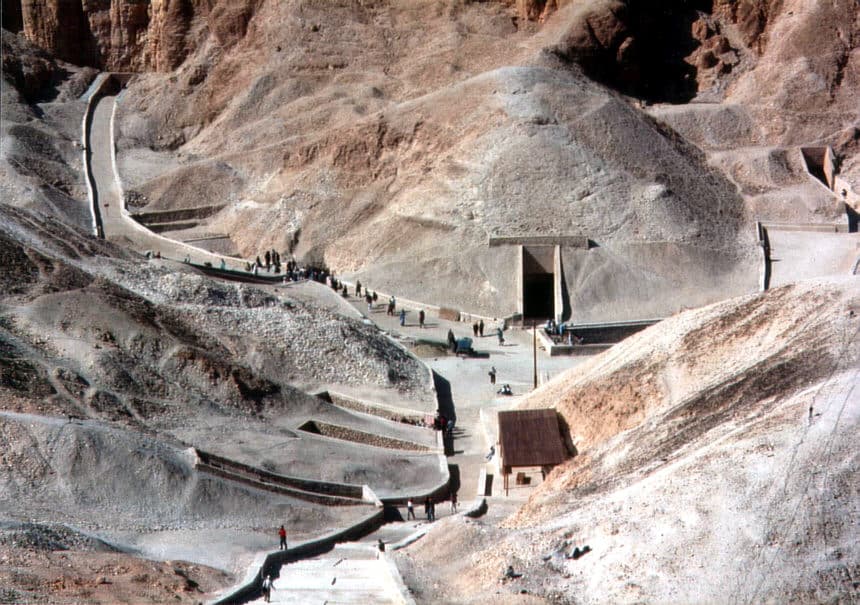 Fotograf/Photographer: Peter J. Bubenik (1995) / CC BY-SA 2.0, via Wikimedia Commons
Self-guided audio walking tour of Valley of the Kings — GPS route, offline playback, story-driven narration in 32 languages.
“Where pharaohs sought eternity, and secrets still speak from the stone.”
Not the postcards. The stories even locals don't know — whispered in your ear, right where they happened.
The tomb of Seti I is known for its vivid, well-preserved artwork, yet one feature within its deepest chambers represented an architectural innovation.
For decades, explorers dismissed KV5 as a minor, insignificant pit, even using its entrance as a dumping ground.
The pharaohs abandoned the monumental pyramids for this remote valley, seeking a more secure resting place.
Discover every secret of Valley of the Kings
Every address, every reveal in full — in your ear, right where it happened.
You pick your stops. You walk. The voice reveals what the others miss.
Your self-guided audio tour of Valley of the Kings is ready — pick your landmarks, choose your language, and start the moment you arrive.
BuyLume has a built-in augmented-reality guide. Hold your phone up and its camera shows the street ahead of you, with a glowing arrow laid over the real view that always points to your next stop — no map to puzzle over, no wrong turns. Like everything in Lume, it works fully offline.
The Valley of the Kings, situated on the west bank of the Nile River near Luxor, served as the primary burial ground for the pharaohs and influential nobles of the New Kingdom (approximately 1539–1075 BCE). This arid, sun-baked gorge, also known as the Valley of the Gates of the Kings, contains the rock-cut tombs of 63 known pharaohs and other elite individuals, including the celebrated Tutankhamun, Seti I, and Ramesses II.
Designated a UNESCO World Heritage Site in 1979, the Valley of the Kings offers a profound window into ancient Egyptian beliefs about the afterlife. The elaborate tombs, carved deep into the limestone hills, were meant to safeguard the pharaohs' mummies and treasures for their journey into the next world, a stark contrast to the easily plundered pyramids of earlier dynasties. Today, it remains an active archaeological site, with new discoveries still emerging, continuously reshaping our understanding of this ancient royal cemetery.
## From Pyramids to Subterranean Tombs For centuries, the monumental pyramids served as the final resting places for Egypt's pharaohs. However, their sheer visibility made them prime targets for tomb robbers. With the advent of the New Kingdom (c. 1539–1075 BCE), a new strategy for royal burial emerged: the rock-cut tombs of the Valley of the Kings. This shift was a direct response to the need for greater security, aiming to preserve the pharaohs' bodies and their extensive treasures for the afterlife.
The site itself, a desolate wadi on the west bank of the Nile, was chosen with deliberate intention. Its remote location offered a degree of concealment, and the natural pyramid-like shape of the peak of al-Qurn, which overlooks the valley, was seen as a divine sign, symbolizing rebirth and eternal life. Furthermore, the west bank of the Nile held funerary associations, as it was where the sun god set, to be reborn in the east.
Construction of these elaborate subterranean complexes began with Thutmose I, believed to be the first pharaoh interred here. Over nearly 500 years, successive pharaohs of the 18th, 19th, and 20th dynasties, including renowned rulers like Seti I, Ramesses II, and Tutankhamun, commissioned their eternal homes within these cliffs. The tombs varied in design, but generally featured descending corridors, deep shafts to deter robbers, pillared chambers, vestibules, and a burial chamber housing a stone sarcophagus. The walls were intricately decorated with religious texts and scenes depicting the pharaoh's journey through the underworld, intended as spiritual maps to guide them to the afterlife.
Despite the efforts at concealment, most tombs were eventually plundered in antiquity. However, the Valley's dry climate helped preserve many of the intricate wall paintings and hieroglyphs, offering invaluable insights into ancient Egyptian beliefs and artistry. The most famous discovery in modern times was that of Tutankhamun's tomb (KV62) in 1922 by Howard Carter, notable for being found largely intact with its dazzling array of treasures. More recently, the excavation of KV5, the tomb of the sons of Ramesses II, in 1995, dramatically expanded our understanding of the Valley's scale and purpose, revealing it to be the largest tomb ever found in Egypt.
The Valley of the Kings offers a singular opportunity to step into the ancient Egyptian afterlife. While not all 63 known tombs are open to the public simultaneously due to conservation efforts, a rotating selection ensures there are always impressive sites to explore. A standard admission ticket typically grants access to three tombs. Special tickets are required for some of the most elaborate tombs, such as those of Tutankhamun (KV62) and Seti I (KV17).
Among the most recommended tombs are the Tomb of Seti I (KV17), often considered one of the most beautifully decorated and deepest in the valley, with exquisite painted reliefs and a unique vaulted burial chamber ceiling depicting astronomical scenes. The tomb of Ramesses VI (KV9) is also highly regarded for its vivid artwork and detailed funerary texts. While Tutankhamun's tomb (KV62) is smaller and less elaborately decorated, it holds the unique distinction of being the only major royal tomb found mostly intact, and you can still see his mummy within. Other notable tombs that may be open include those of Ramesses III (KV11) and Ramesses IV (KV2). Remember to purchase tickets at the West Bank ticket office before arriving at the Valley of the Kings, as tickets cannot be bought at the tomb sites themselves.
The ideal time to visit the Valley of the Kings is during the cooler months, from October to April, when temperatures are more moderate, typically ranging between 20–30°C (68–86°F). Early mornings are generally recommended to avoid the midday heat and larger crowds. Arriving before 7:00 a.m., when the valley opens at 6:00 a.m., offers cooler temperatures and better light for viewing the intricate wall paintings. While some advice suggests avoiding early mornings due to crowds, the heat is a more significant factor, especially from June to August when temperatures can exceed 40°C (104°F). Sundays, Tuesdays, and Wednesdays tend to be busier due to Nile cruise schedules.
Accessing the Valley of the Kings usually involves a journey to Luxor's West Bank. Many visitors arrange a car and driver or a taxi, which can be hired for the day, often through hotels or from the West Bank ferry terminal. A small electric train, known as a 'tuf-tuf,' ferries visitors from the visitor center to the tombs themselves. The general admission ticket allows entry to three tombs, with additional tickets required for premium tombs like Tutankhamun's and Seti I's. These special tickets can be purchased at the visitor center.
It is crucial to bring water and sun protection, including sunscreen, sunglasses, and a hat, as the valley can be intensely hot. Comfortable shoes are also essential for navigating the site. Photography rules have become more lenient; generally, you can take photos inside most tombs with a phone or camera without an extra permit, though flash photography, tripods, and gimbals are usually prohibited. However, some guides may still allow phone photography for a tip. There are toilets available at the visitor center.
Valley of the Kings in Korean, in Chinese or in Hebrew — and 29 more languages, every stop narrated by a native voice. The widest language range of any self-guided audio tour.
Available in: