This architectural wonder, requiring five architects and 32 years to finish, holds an unexpected secret within its walls, a construction timeline that dwarfs that of a world-renowned skyscraper.
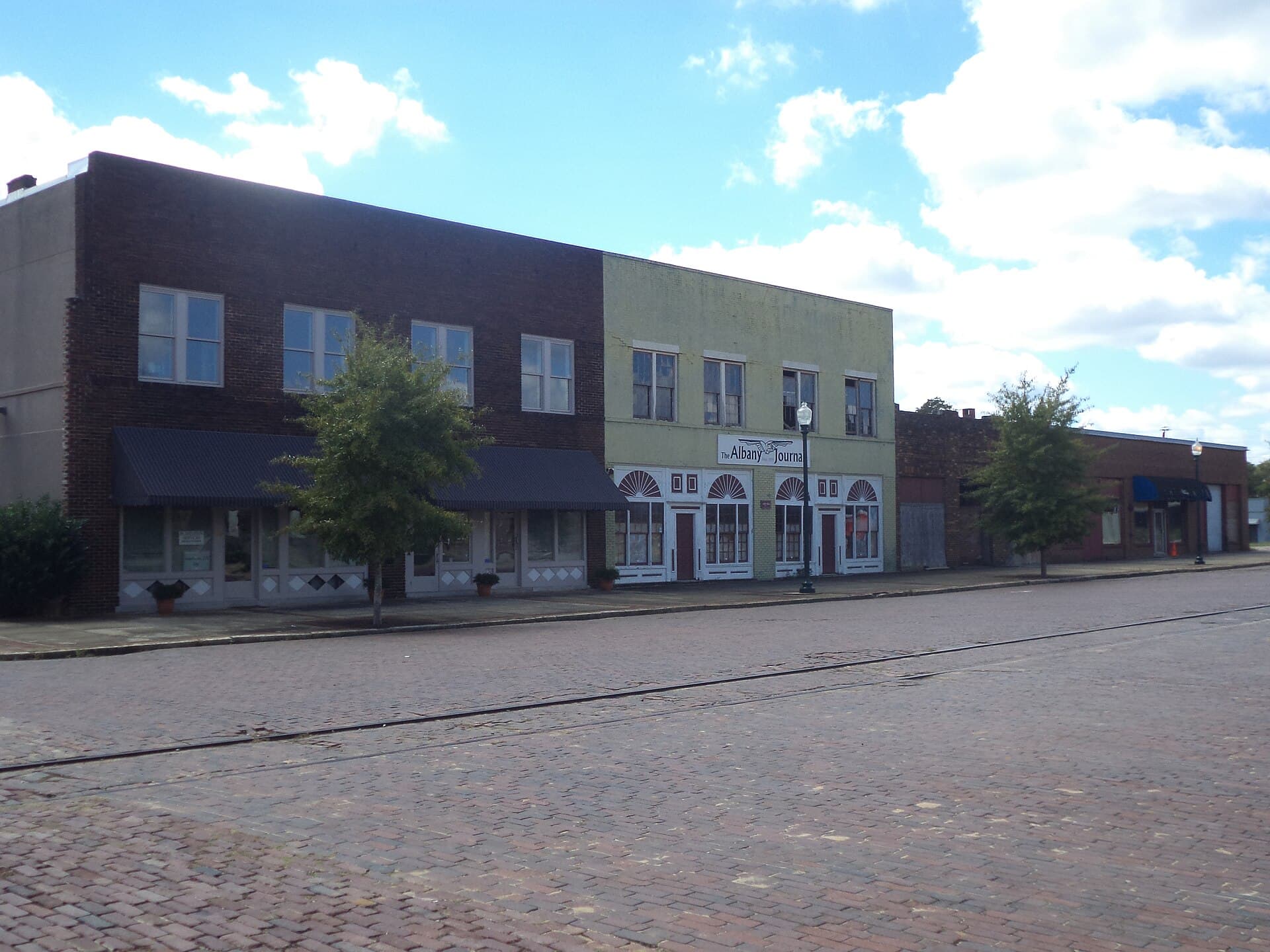
Michael Rivera / CC BY-SA 3.0, via Wikimedia CommonsAlbany
Self-guided audio walking tour of Albany — GPS route, offline playback, story-driven narration in 32 languages.
“Where centuries of careful craft shape every brick, and quiet stories emerge from grand halls and secluded passages.”
Albany, as no one tells it.
Not the postcards. The stories even locals don't know — whispered in your ear, right where they happened.
This seemingly ordinary historic residence offers a singular window into five generations of a prominent Albany family, preserving an unbroken narrative unlike many other historical locations.
One of Albany's most welcoming pubs is more than just a place for a drink; it is a living fragment of the city's Dutch heritage, dating back to a time long before American independence.
Discover every secret of Albany
Every address, every reveal in full — in your ear, right where it happened.
You pick your stops. You walk. The voice reveals what the others miss.
How long do you have in Albany?
Your self-guided audio tour of Albany is ready — pick your landmarks, choose your language, and start the moment you arrive.
BuyPoint your phone, follow the arrow, never get lost
Lume has a built-in augmented-reality guide. Hold your phone up and its camera shows the street ahead of you, with a glowing arrow laid over the real view that always points to your next stop — no map to puzzle over, no wrong turns. Like everything in Lume, it works fully offline.
The story of Albany
Albany, the capital of New York State, offers a compelling fusion of deep-rooted history, distinctive architecture, and a quietly evolving cultural landscape. Situated on the west bank of the Hudson River, approximately ten miles south of its confluence with the Mohawk River, this city stands as one of the oldest continuously settled and chartered cities in the United States. Its narrative began long before New York became a state, with a legacy that predates both New York City and Boston.
Beyond its function as a political center, Albany reveals itself as a destination rich in unexpected discoveries. From its Dutch colonial origins to its crucial role in American transportation and industry, the city has consistently reimagined itself while preserving the echoes of its past. Visitors can explore grand governmental structures, wander through historic districts, and uncover a lively local character that often surprises first-time guests.
## From Fur Trade to State Capital Albany's story begins with the Algonquian-speaking Mohican people who originally inhabited the area. In 1609, Henry Hudson, searching for a trade route to the Far East, sailed up the river that now bears his name, claiming the area for the Dutch. French and Dutch fur traders soon followed, establishing Fort Nassau in 1614 and then Fort Orange in 1624, marking the first permanent European settlement in what would become New York.
The settlement around Fort Orange grew into a village called Beverwyck, a name reflecting the lucrative beaver fur trade. In 1664, the English took control of New Netherland, renaming the town "Albany" in honor of Prince James, Duke of Albany (who later became King James II of England and James VII of Scotland). On July 22, 1686, Albany received its official charter, known as the Dongan Charter, which remains the oldest continuously effective city charter in the United States.
Throughout the 18th century, Albany's strategic location along the Hudson River made it a military hotspot during conflicts like the French and Indian War and the Revolutionary War. In 1797, Albany was officially designated the capital of New York State, a role it has maintained ever since. The 19th century saw Albany flourish as a major center of trade and transportation. It served as the original eastern terminus of the Erie Canal and was a pioneering hub for some of the earliest railroads in the world. This era saw the city's main exports include beer, lumber, published works, and ironworks, and from 1810 to the 1860s, Albany was consistently among the ten most populous cities in the nation.
## Modern Developments and Enduring Legacy While Albany's population saw a decline in the latter half of the 20th century due to urban sprawl and suburbanization, the city has been actively working to revitalize its economy. Today, it remains a significant governmental center and is increasingly focused on high technology and research, bolstered by institutions like the University at Albany. The city's commitment to preserving its historical significance is evident in its numerous landmarks and cultural institutions, which continue to tell the story of this enduring American city.
Begin your exploration at the Empire State Plaza, an impressive modernist complex that houses government buildings, cultural facilities, and a significant collection of public art. Within the Plaza, the New York State Museum offers extensive exhibits on the state's natural and cultural history. Adjacent to the Plaza is the New York State Capitol Building, an architectural marvel with its intricate design and the famous Million Dollar Staircase. For a deeper dive into local art and history, visit the Albany Institute of History & Art, one of the oldest museums in the country, showcasing Hudson River School paintings and regional artifacts.
Step back in time at the Schuyler Mansion State Historic Site, the 1762 home of Revolutionary War General Philip Schuyler. Another architectural delight is the Ten Broeck Mansion, built in 1798, which offers insight into Albany's Dutch heritage and Gilded Age elegance. For a moment of quiet, stroll through Washington Park, an 81-acre Victorian-era park known for its picturesque landscapes and the annual Tulip Festival. The Cathedral of the Immaculate Conception, a striking Gothic Revival structure completed in 1852, is a prominent landmark in downtown Albany. Finally, for a distinct perspective of the city, take a walk or bike ride along the Corning Preserve which stretches along the Hudson River.
The ideal time to visit Albany is during the summer months, from late May to mid-September. During this period, the weather is warm and comfortable, with average temperatures around 22°C (72°F) and highs reaching 28°C (82°F). This timeframe is perfect for enjoying outdoor activities, river cruises, and the city's numerous festivals. Early July to mid-August offers the warmest weather for water-related activities. While autumn brings vivid foliage, and winter offers nearby skiing, the summer months provide the most pleasant conditions for general sightseeing and outdoor exploration in Albany.
Albany is well-connected and accessible by various transportation methods. The Albany International Airport (ALB) serves the region with commercial flights. For ground transportation, major expressways lead into the city, and Amtrak provides rail service. Within the city and surrounding Capital Region, the Capital District Transportation Authority (CDTA) offers extensive bus services, including regular routes, shuttle systems, and paratransit. Downtown Albany is quite walkable, allowing easy access to many major attractions. For those preferring private transportation, several companies like Royale Transportation and Premiere Transportation offer chauffeured services, including airport transfers, executive cars, and charter buses. Parking is available, with metered parking and several garages and lots operated by Park Albany. The cost of living in Albany is considered affordable compared to other major New York cities, with lower expenses for housing, utilities, groceries, and healthcare.
- Is Albany a walkable city?
- Yes, downtown Albany is quite walkable, with many of the city's key attractions, including the Capitol and Empire State Plaza, within easy walking distance.
- What is Albany known for?
- Albany is known for being the capital of New York State, its long and continuous history as one of the oldest chartered cities in the U.S., its distinctive architecture, and its role as a historical transportation hub.
- What are some free things to do in Albany?
- Many attractions in Albany are free, including exploring the New York State Museum, visiting the Capitol Building, strolling through Washington Park, and attending free outdoor concerts like Alive at 5 during the summer.
- What is the best time of year to visit Albany?
- The best time to visit Albany for general outdoor tourist activities is from mid-June to mid-September, when the weather is warm and comfortable.
- How do I get around Albany without a car?
- The Capital District Transportation Authority (CDTA) provides extensive regional bus services. Downtown Albany is also very walkable, making it easy to explore many sights on foot.
- Is Albany an expensive city to visit or live in?
- Compared to cities like New York City or Boston, Albany is considered an affordable place to visit and live, with lower costs for housing, utilities, groceries, and transportation.
Albany in your own language — all 32· 32
Albany in Korean, in Chinese or in Hebrew — and 29 more languages, every stop narrated by a native voice. The widest language range of any self-guided audio tour.
Available in:
- English
- FrenchFrançais
- SpanishEspañol
- GermanDeutsch
- ItalianItaliano
- PortuguesePortuguês
- DutchNederlands
- PolishPolski
- SwedishSvenska
- DanishDansk
- NorwegianNorsk
- FinnishSuomi
- RussianРусский
- UkrainianУкраїнська
- TurkishTürkçe
- CzechČeština
- HungarianMagyar
- RomanianRomână
- BulgarianБългарски
- GreekΕλληνικά
- Japanese日本語
- Korean한국어
- Chinese中文
- Arabicالعربية
- Hebrewעברית
- Hindiहिन्दी
- Thaiไทย
- VietnameseTiếng Việt
- IndonesianBahasa Indonesia
- MalayBahasa Melayu
- CatalanCatalà
- BasqueEuskara