The Landmark Theatre
The grand Landmark Theatre, an architectural marvel, is said to host a permanent resident who never left the stage.
Full story unlocks in the tour
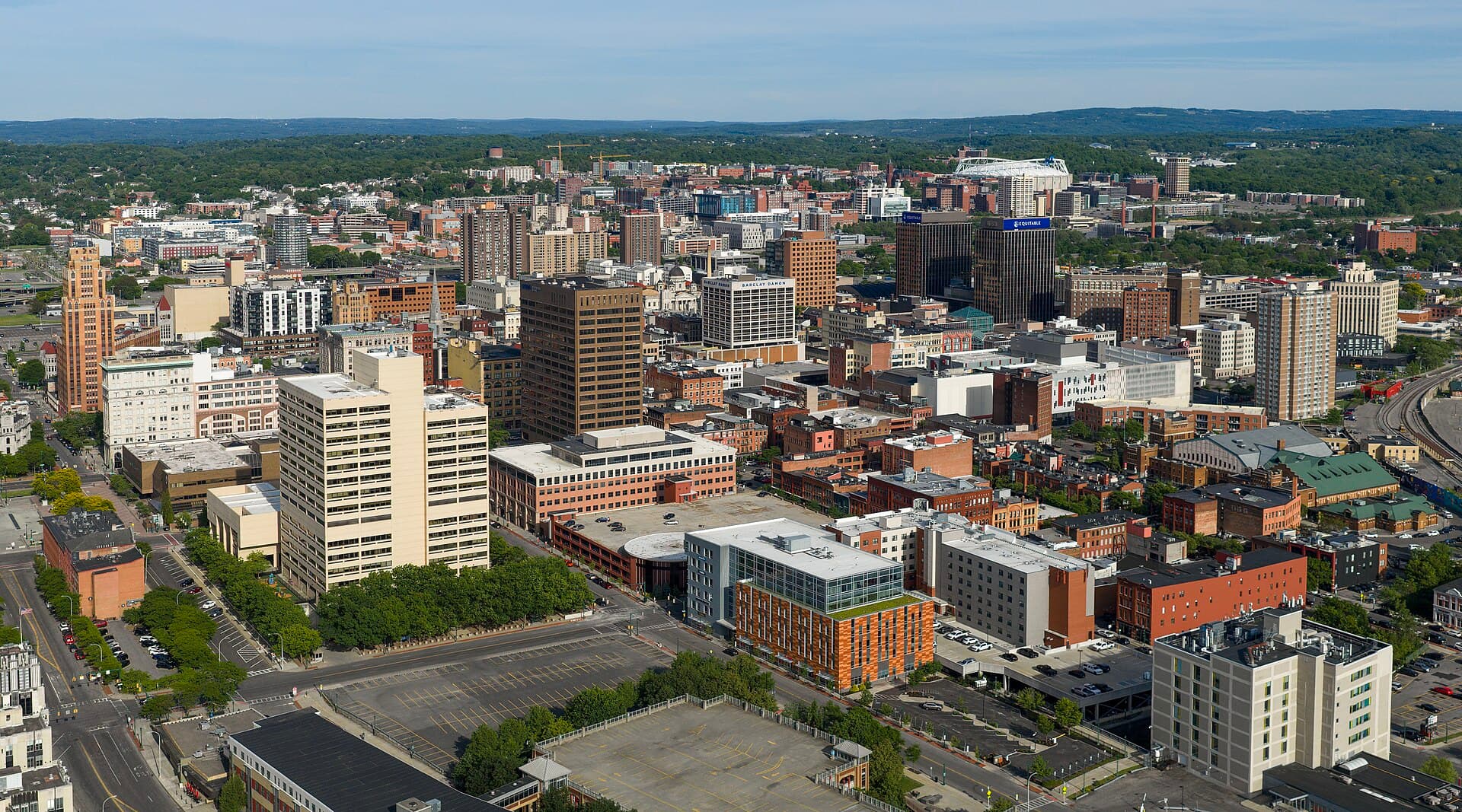 Quintin Soloviev / CC BY 4.0, via Wikimedia Commons
Self-guided audio walking tour of Syracuse — GPS route, offline playback, story-driven narration in 32 languages.
“Beyond the Salt City: Unearthing Syracuse's surprising past and present.”
Not the postcards. The stories even locals don't know — whispered in your ear, right where they happened.
The grand Landmark Theatre, an architectural marvel, is said to host a permanent resident who never left the stage.
Along a winding stretch of road outside Syracuse, a spectral bride is said to eternally search for her lost love.
This museum, housed in the last remaining weighlock building in the U.S., is not only a repository of history but also a hub of unexplained activity.
Discover every secret of Syracuse
Every address, every reveal in full — in your ear, right where it happened.
You pick your stops. You walk. The voice reveals what the others miss.
Your self-guided audio tour of Syracuse is ready — pick your landmarks, choose your language, and start the moment you arrive.
BuyLume has a built-in augmented-reality guide. Hold your phone up and its camera shows the street ahead of you, with a glowing arrow laid over the real view that always points to your next stop — no map to puzzle over, no wrong turns. Like everything in Lume, it works fully offline.
Syracuse, a city in Central New York, rests on the ancestral lands of the Onondaga Nation. Officially incorporated as a village in 1825, it has long served as a crucial crossroads, first with the Erie Canal and later with the railway network. Today, it remains a significant transportation hub at the interchange of I-81 and I-90, with its airport serving over a million people in the Central New York area.
Known colloquially as 'The Salt City,' Syracuse’s early prosperity was built upon its abundant salt springs, which fueled a thriving industry for nearly 150 years. Beyond its industrial past, Syracuse has evolved into an intellectual and cultural center, home to Syracuse University and Upstate Medical University. The city's commitment to history is evident in its ten districts listed on the National Register of Historic Places, and its designation as one of New York's 19 heritage areas.
From groundbreaking architectural marvels like the Everson Museum of Art to its surprising contributions to everyday inventions, Syracuse offers a compelling blend of history, innovation, and local lore. It’s a city that embraces its past while continually looking towards the future, inviting visitors to discover its many layers.
The history of Syracuse is inextricably linked to its natural brine springs, first noted by Jesuit missionary Father Simon Le Moyne in 1654. These salty waters, used by the Haudenosaunee (Iroquois Confederacy) for medicinal and culinary purposes, became the foundation of a booming industry. In 1797, the New York State Legislature established the Onondaga Salt Springs Reservation, paving the way for commercial salt production. By the mid-1800s, Syracuse was producing over 12 million bushels of salt annually, becoming the largest salt-producing region in the United States and earning its enduring nickname, 'The Salt City.'
The completion of the Erie Canal through Syracuse in 1825 was a pivotal moment, amplifying the salt industry and transforming the nascent village into a major transportation hub. The canal facilitated the shipment of Syracuse salt across the country, influencing everything from dinner tables to the building blocks of other cities. The city's strategic location at this crossroads, later enhanced by the railway network in the mid-19th century, spurred significant growth and diversification.
As the salt industry declined after 1870 due to competition and the depletion of concentrated brine, Syracuse transitioned into a major industrial center. The late 1800s and early 1900s saw the establishment of numerous businesses, including the Franklin Automobile Company, which produced the world's first air-cooled engine, and the Smith Corona company. World War II further fueled industrial expansion in specialty steel, fasteners, and custom machining. Post-war, General Motors and Chrysler had significant operations in the area, and Syracuse was headquarters for Carrier Corporation, which invented air conditioning. The city's population peaked at 221,000 in 1950.
Syracuse University, founded in 1870, played a crucial role in the city's evolution, becoming one of the first coeducational universities. The establishment of the New York State College of Forestry (now SUNY-ESF) in 1911 and Le Moyne College in 1946 further solidified Syracuse's reputation as an educational hub. Today, the city continues to thrive as an economic and educational center, with a focus on higher education, research, and services, while actively preserving its historical and cultural heritage.
Begin your exploration in Clinton Square, a historic public park that once saw the Erie Canal flow directly through its heart. Today, it’s a lively space with fountains in summer and an ice-skating rink in winter, surrounded by 19th-century architecture like the Gridley Building and Syracuse Savings Bank.
Delve into the city’s pivotal past at the Erie Canal Museum, housed in the last remaining Weighlock Building in the United States. Here, interactive displays and original artifacts tell the story of the canal and Syracuse’s salt industry.
For art enthusiasts, the Everson Museum of Art is a compelling stop. Designed by I. M. Pei, the building itself is a sculptural masterpiece, housing a remarkable collection of American art, including one of the largest holdings of American ceramics and a pioneering video art collection.
Experience the grandeur of a bygone era at the Landmark Theatre, a 1928 movie palace renowned for its elaborate architecture and, some say, its resident ghost. For a breath of fresh air, Green Lakes State Park, a short drive away, offers two glacial lakes with unique blue-green hues, including the National Natural Landmark, Round Lake.
The best times to visit Syracuse for pleasant weather and a balance of activities are late spring (May-early June) and fall (mid-September-October). These shoulder seasons offer comfortable temperatures ideal for exploring. Summer (June-August) brings warm, sunny days, though it can be humid with occasional thunderstorms. Fall is particularly beautiful with spectacular foliage. Winters (December-March) are cold and snowy, with Syracuse being the snowiest major city in the U.S., which might appeal to winter sports enthusiasts or budget travelers seeking lower prices.
Syracuse Hancock International Airport (SYR) is the primary airport serving the region, offering connections for visitors. The city is well-connected by major highways, I-81 and I-90. Within the city, public transportation is available, and many attractions in downtown and surrounding neighborhoods are walkable. Consider checking local event calendars before your visit, as major university events or festivals can influence crowd levels and accommodation availability. Average hotel prices can range from $100-$200 per night during peak season, dropping to an estimated $80-$150 in the off-season. Syracuse experiences four distinct seasons, so pack accordingly, especially for winter, which brings significant snowfall.
Syracuse in Korean, in Chinese or in Hebrew — and 29 more languages, every stop narrated by a native voice. The widest language range of any self-guided audio tour.
Available in: