Andlau Abbey Crypt
A stone bear in the crypt isn't just a quirky decoration.
Full story unlocks in the tour
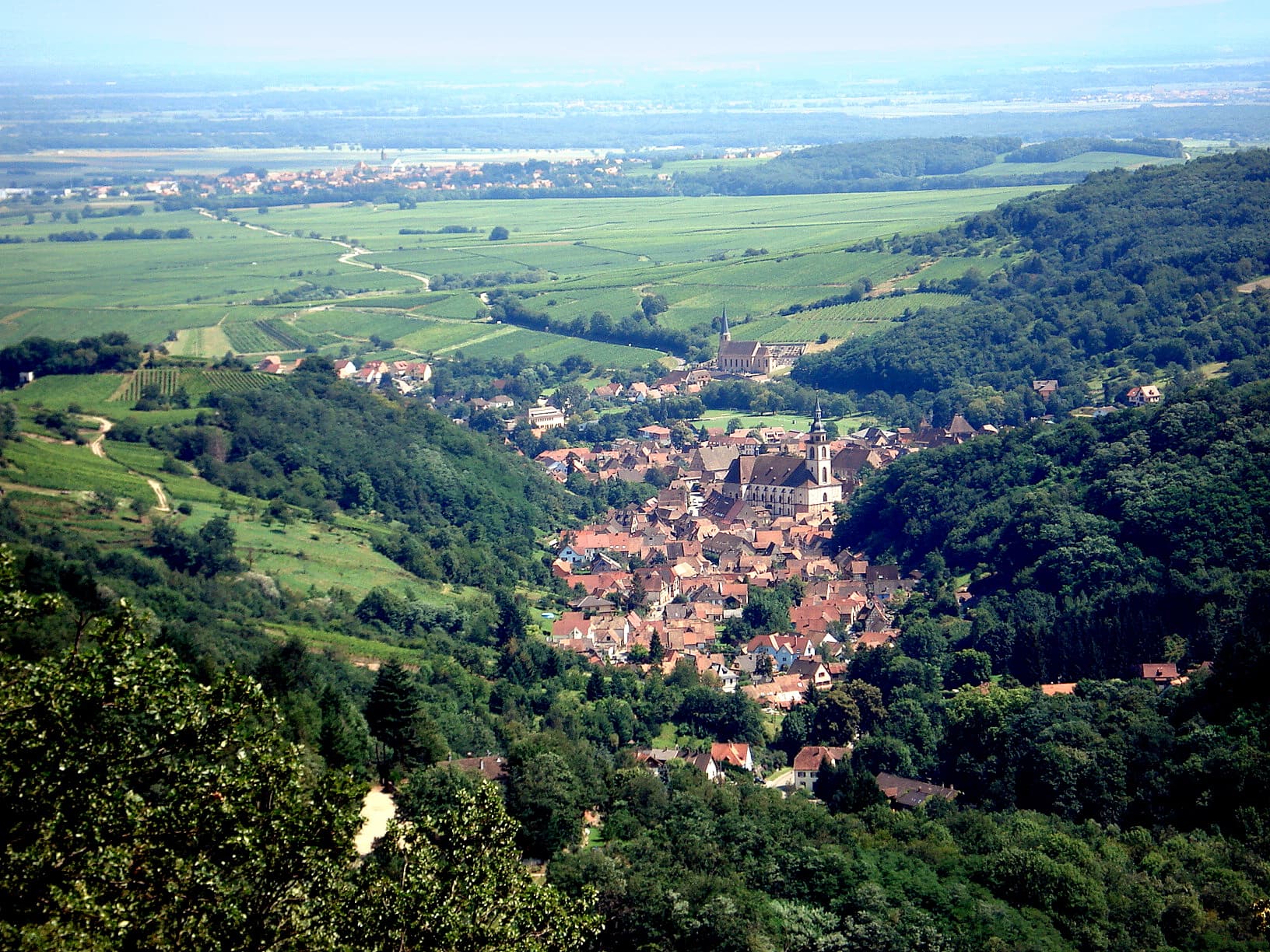 Torsade de Pointes / Public domain, via Wikimedia Commons
Self-guided audio walking tour of Andlau — GPS route, offline playback, story-driven narration in 32 languages.
“Where ancient legends intertwine with Grand Cru vineyards.”
Not the postcards. The stories even locals don't know — whispered in your ear, right where they happened.
A stone bear in the crypt isn't just a quirky decoration.
The detailed carvings on the church facade tell a surprisingly varied story.
This medieval castle, now a ruin, was once dismantled piece by piece by a private owner.
Discover every secret of Andlau
Every address, every reveal in full — in your ear, right where it happened.
You pick your stops. You walk. The voice reveals what the others miss.


Your self-guided audio tour of Andlau is ready — pick your landmarks, choose your language, and start the moment you arrive.
BuyLume has a built-in augmented-reality guide. Hold your phone up and its camera shows the street ahead of you, with a glowing arrow laid over the real view that always points to your next stop — no map to puzzle over, no wrong turns. Like everything in Lume, it works fully offline.
Andlau, a village in Alsace, France, rests along the Alsace Wine Route, set between Strasbourg and Colmar. It is celebrated for its enduring historical architecture, particularly the Romanesque Abbey Church of Saints-Pierre-et-Paul, and the surrounding vineyards that yield esteemed Grand Cru wines. In 2014, a television program recognized this village as the second most cherished in France.
The village's character is deeply shaped by its winemaking heritage and its location at the base of the Vosges Mountains. Andlau offers a blend of cultural legacy, evocative streets, and opportunities for outdoor pursuits, such as hiking through vineyards and to medieval castles.
Andlau’s structures frequently display the traditional half-timbered design characteristic of the Alsace region, with facades painted in cheerful colors. The town's atmosphere is often described as serene and appealing, providing a more tranquil experience compared to some of the more frequently visited Alsatian villages.
Andlau's origins are deeply intertwined with Empress Richarde, wife of Charles the Fat, a great-grandson of Charlemagne. Around 880, Richarde established a Benedictine abbey in Andlau. Legend recounts that an angel appeared to Richarde, instructing her to construct a monastery at a location indicated by a bear. She discovered a bear scratching the earth at the entrance of the Val d'Eleon, and there the abbey was founded. This event led to the bear becoming a symbol of Andlau and Saint Richarde, earning Andlau the appellation 'le village aux ours' (the village of bears).
Richarde herself experienced a tumultuous life. In 887, her husband, Emperor Charles the Fat, accused her of adultery. To affirm her innocence, she underwent an ordeal by fire, walking barefoot through flames while clad in a wax-coated shirt, emerging unharmed. Despite her vindication, she departed the imperial court and retired to Andlau, where she was later elected Abbess and passed away around 895-897. In 1049, Pope Leo IX canonized Richarde and consecrated the altar of the abbey church to her.
The original abbey structures from around 880 have not endured. The abbey was entirely reconstructed in the first half of the 11th century. The crypt, a significant Romanesque element with groin vaults supported by monolithic columns, dates from this 11th-century period. The apse and the first two levels of the westwork were built in the 12th century. The abbey church underwent several modifications in the 12th, 15th, 17th, and 18th centuries, including a substantial rebuilding in the 12th century following a fire. The nave was completely rebuilt in the late 17th century. After the French Revolution, the former abbey church of Sainte-Richarde became the parish church of Saints-Pierre-et-Paul.
The Château d'Andlau, also known as Haut-Andlau, is a medieval ruined castle built upon a granite outcrop at an altitude of 451 meters. Eberhard d'Andlau constructed it between 1246 and 1264. The castle comprises a long residential building flanked by two circular towers. In 1678, troops pillaged it during Louis XIV's reintegration of Alsace into France. The castle remained with the Counts of Andlau until the French Revolution, after which it was confiscated as a national asset and sold in 1796. Subsequently, a merchant dismantled and sold it off piece by piece. In 1818, Antoine-Henri d'Andlau purchased the ruin, preventing its complete destruction, and restoration efforts commenced. It was classified as a historical monument in 1926.
The primary attraction in Andlau is the Abbey Church of Saints-Pierre-et-Paul, a Romanesque masterpiece. Explore its 11th-century double crypt, which houses a 16th-century stone bear sculpture, a nod to the founding legend. The church's west facade, constructed between 1130 and 1140, features a richly sculpted portal depicting scenes from Genesis and a notable 30-meter-long historiated frieze. This frieze offers a glimpse into medieval life with its detailed carvings of animals, mythical creatures, and daily activities.
Beyond the abbey, visit the ruins of Château d'Andlau (Haut-Andlau) and Château de Spesbourg, both accessible via walking paths and offering views of the surrounding valleys. The village itself invites exploration with its traditional half-timbered houses and appealing streets. The Sainte Richarde Fountain in Place de la Mairie, with its sandstone statue of Saint Richarde and the bear, is another notable landmark.
For those interested in local heritage, Les Ateliers de la Seigneurie is a heritage interpretation center located in a 16th-century Renaissance mansion. It offers interactive exhibits on Alsatian architectural, religious, and winegrowing heritage.
The best time to visit Andlau for warm-weather activities is from mid-June to early September, when temperatures are comfortable, ranging from 20°C to 26°C (68°F to 79°F). July is typically the warmest month, with an average high of 76°F (24°C). The clearer part of the year in Andlau begins around early June and lasts for about 3.7 months, with July being the clearest month. Autumn also offers pleasant weather with colorful landscapes and wine harvesting celebrations. For those interested in Christmas markets, visiting in winter provides a central location for exploring the famous Alsatian markets.
Andlau is situated on the Alsace Wine Route, making it accessible by car. Parking is generally available, with some hotels offering free parking. For public transport, the closest train station without TGV service is in Eichhoffen, about 2 km away, while a TGV station is in Sélestat, 14 km away. Bus services are also available from Sélestat. Taxis are available in Andlau, and ride-sharing services like Uber operate in the area.
Accommodation options in Andlau include charming hotels, guesthouses, and vacation rentals such as houses, apartments, and cottages. Many local establishments offer traditional Alsatian cuisine and a selection of local wines.
The local currency is the Euro. It is advisable to have some cash for smaller purchases, though credit cards are widely accepted. The official language is French, but English is often spoken in tourist-oriented establishments.
Andlau in Korean, in Chinese or in Hebrew — and 29 more languages, every stop narrated by a native voice. The widest language range of any self-guided audio tour.
Available in: