Bario Salt Spring
Bario is known for its distinctive salt, but the traditional method of production demands a round-the-clock commitment that extends beyond simple boiling.
Full story unlocks in the tour
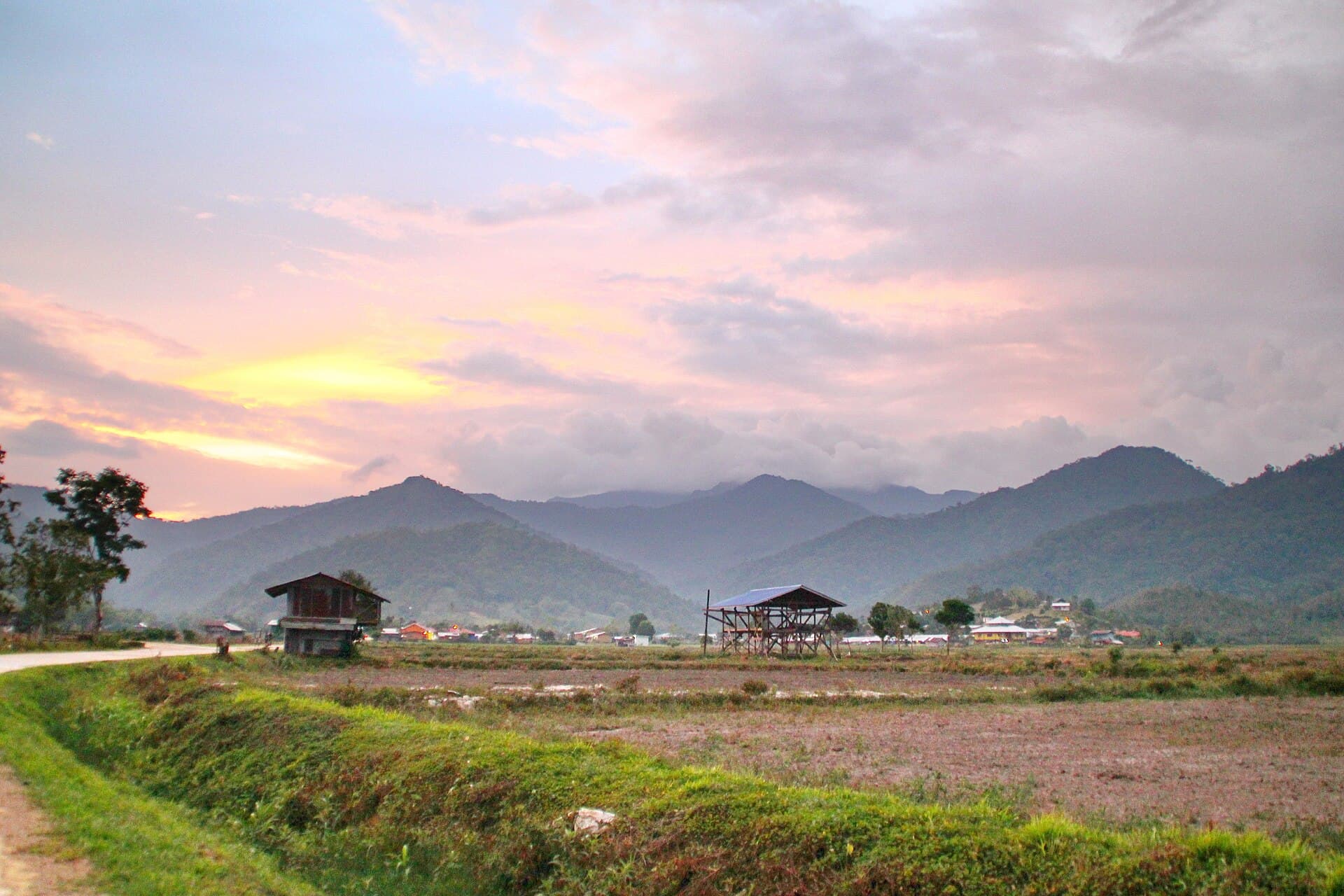 Intrepid Navigator / CC0, via Wikimedia Commons
Self-guided audio walking tour of Bario — GPS route, offline playback, story-driven narration in 32 languages.
“Where mountain breezes carry ancient stories and the landscape holds sweet, quiet wonders.”
Not the postcards. The stories even locals don't know — whispered in your ear, right where they happened.
Bario is known for its distinctive salt, but the traditional method of production demands a round-the-clock commitment that extends beyond simple boiling.
The Bario Asal Longhouse is considered the oldest and longest longhouse in the region, yet its distinctive layout reveals a subtle division between communal and private life.
Some older Kelabit residents in Bario display a striking physical characteristic that hints at a long-departed tradition of adornment.
Discover every secret of Bario
Every address, every reveal in full — in your ear, right where it happened.
You pick your stops. You walk. The voice reveals what the others miss.

Your self-guided audio tour of Bario is ready — pick your landmarks, choose your language, and start the moment you arrive.
BuyLume has a built-in augmented-reality guide. Hold your phone up and its camera shows the street ahead of you, with a glowing arrow laid over the real view that always points to your next stop — no map to puzzle over, no wrong turns. Like everything in Lume, it works fully offline.
Bario, often called the 'Valley of the Wind' in the Kelabit language, is a serene highland settlement situated at approximately 1,000 meters above sea level in the Kelabit Highlands of Sarawak, Malaysia. Distant from the commotion of urban existence, this remote destination offers a singular window into the authentic culture of the indigenous Kelabit people, one of Malaysia's smallest ethnic groups. With a population of around 800 to 1,200 residents across its 13 to 16 longhouses and surrounding villages, Bario is recognized for its cool climate, untouched natural expanses, and the exceptional warmth of its inhabitants, earning it the endearing name 'Land of a Hundred Handshakes'.
Life in Bario unfolds at a measured pace, profoundly linked to the earth and its enduring traditions. Visitors arrive here to disconnect from the digital realm and immerse themselves in a community where farming, particularly of the celebrated Bario rice and sweet Bario pineapples, remains the core of daily existence. The region is a sanctuary for nature enthusiasts and cultural explorers, providing opportunities for jungle trekking, exploring traditional longhouses, and savoring the unique culinary delights of the Kelabit Highlands. The journey to Bario itself, often by small propeller plane, is an adventure, revealing sweeping vistas of endless rainforests and a feeling of arriving in a truly special, unblemished corner of Borneo.
Bario's allure resides in its simplicity and the genuine hospitality of its people. It is a destination that encourages meaningful travel, cultural connection, and a restorative escape into the embrace of nature.
## Early Origins and Isolation Bario's history is not marked by a conventional founding date but rather by centuries of gradual formation as a cluster of villages, serving as the cultural heart of the Kelabit people. For a long time, the Kelabit lived in relative isolation amidst the dense jungles of Borneo, their way of life shaped by their geographic location at an altitude of about 1,000 meters above sea level, which provided natural protection. Unlike many other Borneo tribes who practiced nomadic slash-and-burn farming, the Kelabit of Bario developed advanced stationary wet paddy rice cultivation, a method that sustained them for generations and led to the renowned Bario rice. The presence of natural salt springs also played a crucial role in the region's early economy, with Bario salt serving as a valuable trade commodity, sometimes even a form of currency, with neighboring lowland tribes. The early cultural landscape was also marked by a significant megalithic tradition, with over 35 megaliths and stone monuments identified in the area.
## External Contact and Transformation The 20th century brought significant changes to Bario. In 1939, missionaries from the Borneo Evangelical Mission (BEM) arrived, leading to the widespread adoption of Christianity among the Kelabit people, who transitioned from animistic beliefs. A pivotal moment occurred in March 1945 during the closing months of World War II, when Bario became a base for Operation Semut, an anti-Japanese military operation. A small force under Tom Harrisson parachuted into the area, and the Kelabit people actively participated in sabotaging Japanese operations in Sarawak. In recognition of their wartime service, many Kelabit warriors were awarded medals. The airstrip built to support this war effort became, and remains, a vital gateway into Kelabit territory.
## Modernization and Development The first school in Bario was established in 1946. The initial airstrip, built by the BEM in 1953, was later acquired by the Sarawak colonial government in 1961, and a new concrete airstrip was completed in 1996, allowing for more reliable aircraft. During the Indonesia-Malaysia Confrontation (1963-1966), Bario's strategic location and airstrip made it an operational center for British forces. Many Kelabit villages near the border were relocated to the Bario plains for safety, leading to the establishment of new longhouses and expanded padi fields. In 1967, the first government secondary school opened, providing local education opportunities. A significant cultural and technological milestone was the launch of the e-Bario project in 1999, which brought internet access to the isolated community, earning Bario international recognition. Since 2006, Bario has hosted the annual Pesta Nukenen (Food and Culture Festival), celebrating Kelabit cuisine and traditions.
Bario offers a blend of cultural immersion and natural exploration. Begin your journey at the Bario Asal Longhouse, one of the oldest and longest traditional Kelabit longhouses, providing an authentic glimpse into communal living with its unique layout and smoke-darkened timbers. Nearby, you can embark on a hike up Prayer Mountain for expansive views of the entire Bario valley, a rewarding trek that takes about 45-60 minutes. For a unique cultural and geological experience, visit the Bario Salt Spring to witness the age-old tradition of salt making, where locals extract brine and boil it over wood fires.
Explore the surrounding paddy fields, where the celebrated Bario rice is cultivated, and observe traditional farming methods. You can also visit local pineapple farms to taste the exceptionally sweet Bario pineapples. For a touch of history, seek out the Twin Pioneer Plane Wreckage, a preserved aircraft from a 1964 landing incident, now resting amidst the rice paddies. The Bario Museum offers insights into Kelabit culture and heritage. Do not miss the opportunity to simply walk through town, enjoying the peaceful atmosphere and the renowned hospitality of the Kelabit people, who are known for their friendly greetings.
Bario enjoys a refreshingly cool climate year-round, with average temperatures hovering between 21°C and 22°C, and nights dropping to around 17°C. The best time to visit is generally during the drier months, from March to October. This period offers better chances for clear skies, making flights more reliable and trekking trails firmer underfoot. While rain is frequent in this lush region regardless of the month, the middle of the year provides a better opportunity for outdoor activities. Consider timing your visit for late July to early August to experience the Pesta Nukenen (Bario Food and Culture Festival), a lively three-day event celebrating Kelabit cuisine and traditions.
Access to Bario is primarily by air, with AirBorneo operating daily flights from Miri, a journey of approximately 50 minutes in a small Twin Otter turboprop aircraft. It's advisable to book flights well in advance due to limited seating and potential weather-related delays; building in a buffer day at each end of your trip is recommended. Luggage is strictly weight-restricted (typically 10kg checked, 5kg carry-on), and passengers are weighed with their luggage. An arduous overland route via logging roads from Miri exists, taking 10-13 hours by 4WD, but it is generally only suitable for seasoned adventurers.
Accommodation in Bario is predominantly in local homestays, offering a chance to experience Kelabit hospitality and home-cooked meals. Cash is essential as there are no ATMs, and credit cards are rarely accepted. Mobile phone reception is limited, with only Celcom typically having coverage, so be prepared for a digital detox. Pack light, bringing a light jacket or fleece for cool evenings, a durable raincoat, waterproof trekking shoes, and insect repellent. Meals are often communal and feature fresh, organic, locally sourced ingredients like Bario rice, wild boar, river fish, and jungle ferns.
Bario in Korean, in Chinese or in Hebrew — and 29 more languages, every stop narrated by a native voice. The widest language range of any self-guided audio tour.
Available in: