Będzin Castle
This formidable medieval castle, a symbol of Będzin, once confined a most unexpected individual.
Full story unlocks in the tour
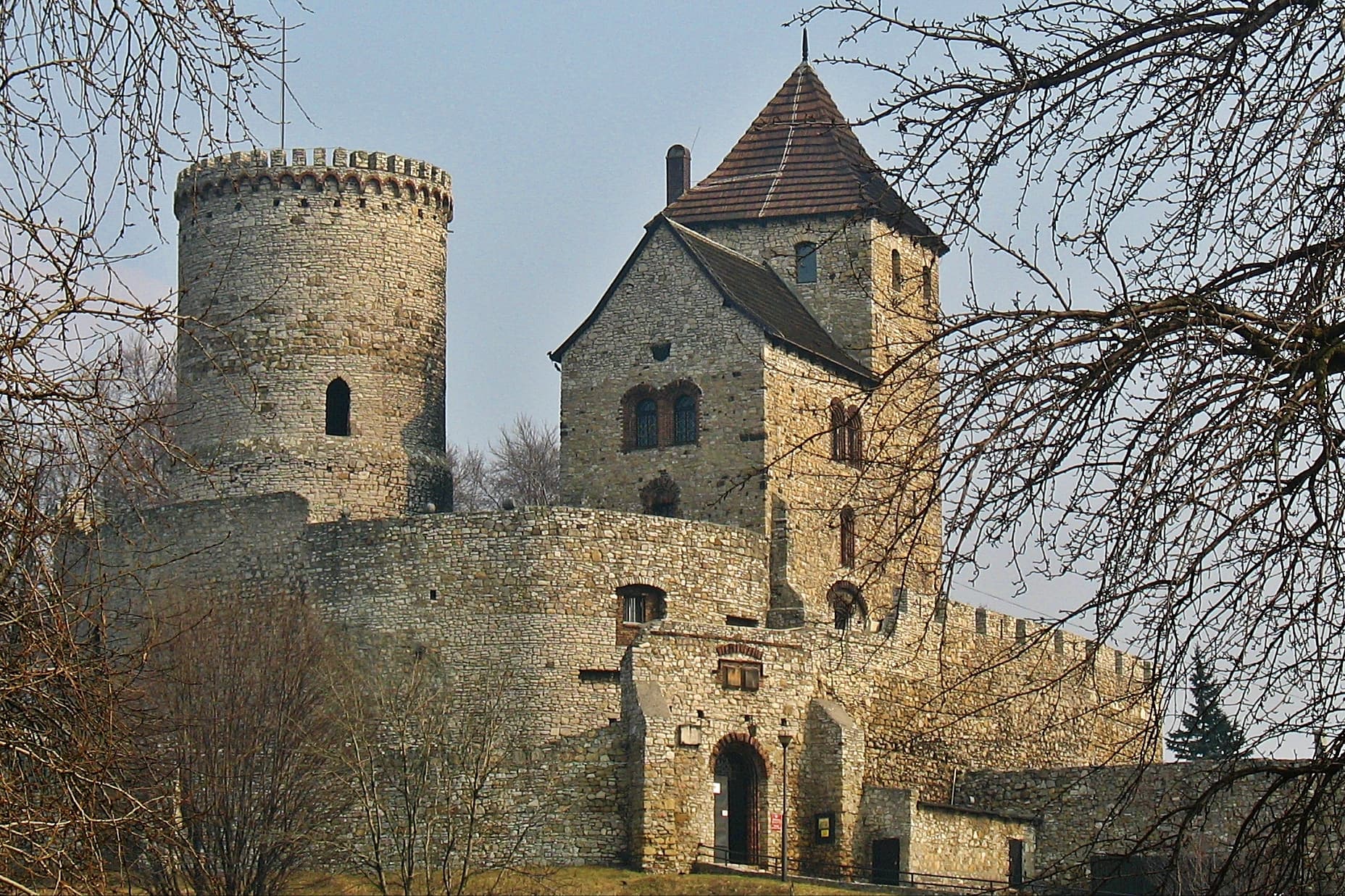 Ludan / CC BY-SA 3.0 pl, via Wikimedia Commons
Self-guided audio walking tour of Będzin — GPS route, offline playback, story-driven narration in 32 languages.
“Where ancient fortresses stand sentinel over narratives of endurance.”
Not the postcards. The stories even locals don't know — whispered in your ear, right where they happened.
This formidable medieval castle, a symbol of Będzin, once confined a most unexpected individual.
During the Second World War, a priest in Będzin performed an act of extraordinary courage, utilizing his church to defy the Nazi regime.
Archaeologists recently uncovered a secret passage and sanctuary beneath a seemingly ordinary house in the former Jewish Ghetto.
Discover every secret of Będzin
Every address, every reveal in full — in your ear, right where it happened.
You pick your stops. You walk. The voice reveals what the others miss.


Your self-guided audio tour of Będzin is ready — pick your landmarks, choose your language, and start the moment you arrive.
BuyLume has a built-in augmented-reality guide. Hold your phone up and its camera shows the street ahead of you, with a glowing arrow laid over the real view that always points to your next stop — no map to puzzle over, no wrong turns. Like everything in Lume, it works fully offline.
Będzin, a city in southern Poland, rests along the Czarna Przemsza River within the Silesian Highlands. Though now part of the Silesian Voivodeship, Będzin historically belongs to Lesser Poland and is recognized as one of the region's most ancient towns. It functions as a significant trade, economic, and administrative center for the Dąbrowa Basin, an industrialized and densely populated area.
The city's landscape weaves together ancient landmarks and natural beauty, featuring medieval fortresses, historical underground passages, and sweeping viewpoints. From the commanding presence of Będzin Castle to the tranquil flow of the Czarna Przemsza River, the city extends a diverse array of experiences for those who wander its paths.
## From Medieval Stronghold to Industrial Hub Będzin's origins trace back to the 9th century as a settlement guarding an ancient trade route from Kyiv to Western Europe. The first recorded mention of a wooden fort here dates to the 11th century, which was destroyed during the Tatar invasion in 1241 and subsequently rebuilt. In the 14th century, during the reign of Casimir III the Great, this wooden fortification was upgraded to a stone castle, operational by 1348. Będzin was officially incorporated as a town on August 5, 1358, becoming a royal city of Poland.
The castle served as a crucial military outpost on the southwestern border of the Kingdom of Poland, defending against invasions from Bohemian or Silesian lands. Its strategic location on the trade route between Wrocław and Kraków also fostered its development as a center of trade. In the 17th century, Będzin gained recognition for its excellent cloth and crafts. The 19th century brought further economic stability with the rise of zinc extraction, refining, and coal mining, cementing its role as an industrial center within the Upper Silesia coal-mining region.
## A Flourishing Jewish Heritage and the Shadows of War Będzin cultivated a significant Jewish community, with records of Jewish settlement dating back to the late 13th century. By the second half of the 18th century, Jews constituted the majority of Będzin's inhabitants, engaging in trade, money lending, and owning most market stalls and slaughterhouses. In 1583, King Stefan Batory granted a charter to Będzin's Jews, allowing them rights to prayer houses, a cemetery, and unrestricted trade, a privilege confirmed by subsequent rulers. This flourishing Jewish life led to Będzin being known as "Yerushalayim de Zagłębie" (Jerusalem of Zagłębie). By 1931, the Jewish population numbered 21,625, comprising 45.4 percent of the total population.
The tranquility was shattered with the German invasion on September 4, 1939. The Great Synagogue was burned down by the SS, with 200 Jews murdered inside. A ghetto was established in July 1940, eventually housing approximately 27,000 Jews from Będzin and surrounding communities. Despite the horrific conditions, a Jewish underground resistance became active. The Będzin Ghetto was liquidated in August 1943, with most inhabitants deported to Auschwitz-Birkenau. After the war, a small number of Jewish survivors returned, but by the 1970s, Jewish life in Będzin had largely ceased.
Dominating the city skyline is the Będzin Castle, a restored 14th-century Gothic fortress that houses the Zagłębie Museum. Here, you can explore exhibitions on weaponry and the city's history, and ascend the round tower for expansive views of the surrounding region. Beneath the castle, delve into the Będzin Underground Facilities, an unfinished World War II air-raid shelter now transformed into an exhibition space.
For a glimpse into Będzin's once-flourishing Jewish community, visit the Jewish Cemetery on the western slope of Castle Hill, one of three Jewish cemeteries that existed before WWII and the only one preserved. The Mizrachi Prayer House is another significant site, featuring remarkably preserved wall paintings with Judaic iconography.
Beyond historical sites, Będzin offers natural attractions. St. Dorothy's Mountain, the highest point in Będzin, provides excellent panoramic views of the Zagłębie and Silesia regions. The city also sits on the Czarna Przemsza River, contributing to its scenic landscape and offering green spaces for relaxation. For active recreation, consider visiting Trzy Stawy, a popular lake for cycling and unwinding.
The most pleasant times to visit Będzin are during late spring to early autumn, specifically May, June, August, and September. During these months, temperatures are mild, and local parks and gardens are in bloom, creating a delightful atmosphere for outdoor activities and sightseeing. Summer often features various outdoor events and festivals, including the annual Będzin Cultural Festival in June. Autumn brings picturesque fall foliage, ideal for photography and leisurely walks. Winters are colder, but the city transforms into a festive wonderland during the holiday season with decorations and Christmas markets.
Będzin is well-connected, situated at the intersection of two important expressways: state road no. 94 (Wrocław to Kraków) and state road no. 86 (Katowice to Warsaw). The closest airport is Katowice Airport. The city also has direct train connections to many cities in the Silesian Voivodeship, as well as Opole, Wrocław, Łódź, Warsaw, and others. Most of the main attractions in Będzin are accessible on foot.
While generally safe, it's advisable to be cautious in the city center after dusk, especially on side streets. Some settlements like Syberka and Ksawera are best avoided after dark, particularly if traveling alone. Pickpockets can be an issue at the Będzin Market. Wild boars are common in the city's forests and parks, so avoid walking alone in these areas after dusk.
Będzin in Korean, in Chinese or in Hebrew — and 29 more languages, every stop narrated by a native voice. The widest language range of any self-guided audio tour.
Available in: