Main Square (Plaza Principal)
Observe the statue of Juan Rulfo in the main square; it shares a story beyond merely honoring the author.
Full story unlocks in the tour
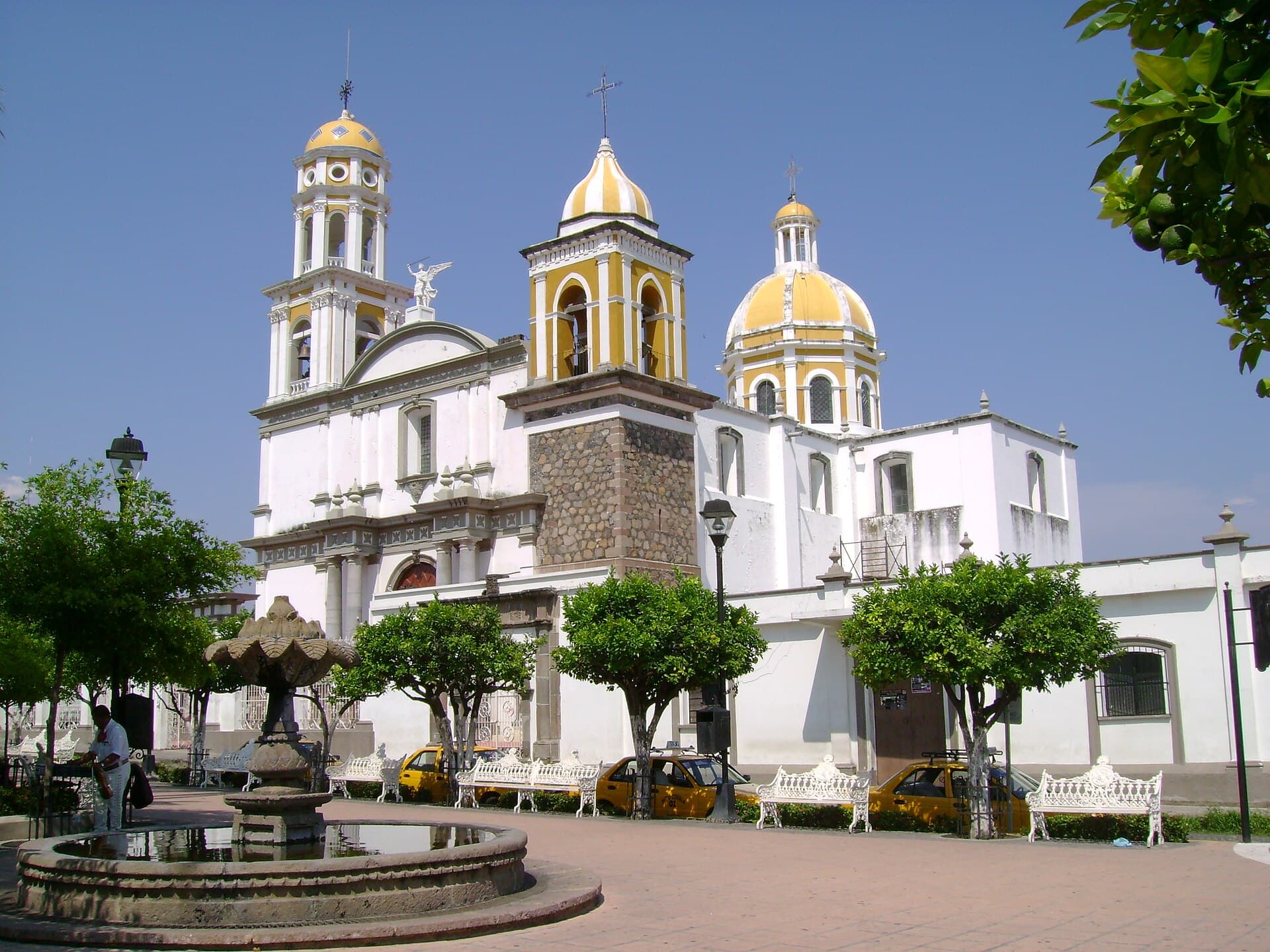 Yaomautzin Ohtokani Olvera Lara / CC BY-SA 3.0, via Wikimedia Commons
Self-guided audio walking tour of Comala — GPS route, offline playback, story-driven narration in 32 languages.
“Where the echoes of a literary landscape meet the pulse of Mexican life.”
Not the postcards. The stories even locals don't know — whispered in your ear, right where they happened.
Observe the statue of Juan Rulfo in the main square; it shares a story beyond merely honoring the author.
The pristine white facades of Comala's buildings are not an ancient tradition. Their uniform color has a surprisingly practical origin.
Comala is celebrated for its 'ponche,' but it is not the warm, spiced Christmas drink many Mexicans anticipate.
Discover every secret of Comala
Every address, every reveal in full — in your ear, right where it happened.
You pick your stops. You walk. The voice reveals what the others miss.


Your self-guided audio tour of Comala is ready — pick your landmarks, choose your language, and start the moment you arrive.
BuyLume has a built-in augmented-reality guide. Hold your phone up and its camera shows the street ahead of you, with a glowing arrow laid over the real view that always points to your next stop — no map to puzzle over, no wrong turns. Like everything in Lume, it works fully offline.
Comala, a Pueblo Mágico in the Mexican state of Colima, lives in two worlds: the tangible and the literary. Known as the 'White Town of America' for its uniformly whitewashed buildings and red-tiled roofs, Comala offers a serene escape at the foot of the active Volcán de Colima. Its well-worn streets and neoclassical architecture evoke a timeless charm, inviting visitors to slow down and absorb the tranquil atmosphere.
Beyond its picturesque appearance, Comala holds a deep connection to Mexican literary history as the setting for Juan Rulfo's seminal novel, Pedro Páramo. While the fictional Comala is a spectral, desolate place, the real town pulses with life, music, and a distinctive culinary scene. Here, the aroma of organic coffee and artisan bread mingles with the sounds of mariachi, creating a sensory experience that is both authentic and captivating.
Comala is more than just a beautiful town; it is a cultural weave with pre-Hispanic roots, colonial influences, and a lively contemporary spirit. It is a place where tradition is celebrated in festivals, creativity flourishes in artisan workshops, and the warmth of its people is as inviting as the year-round pleasant climate.
The history of Comala stretches back over 3,000 years, with its name originating from the Nahuatl word for 'place of comales' (griddles), indicating its ancient significance as a center for producing these essential cooking tools for cultures like the Olmecs, Toltecs, Chichimecas, and Tarascos. The pre-Hispanic settlement was occupied by the Spanish in 1527, though it was not officially constituted as a town until 1820.
Comala's urban plan developed with a grid of perpendicular streets, adapting to the topography and radiating from the main square, where the most emblematic buildings are situated. The town's distinctive white adobe houses with tile roofs, which earned it the moniker 'the white town of America,' became a defining characteristic, particularly after a town-wide decision in the 1960s to paint all buildings white.
In 1988, Comala's historic center was declared a Zone of Historical Monuments, encompassing 51 blocks and buildings constructed between the 16th and 19th centuries. Key historical structures include the neoclassical Parish Church of San Miguel del Espíritu Santo, whose first stone was laid in 1883, and the Municipal Presidency, inaugurated in 1903. The Main Square, or Plaza de Armas, features a metal bandstand of German origin, a testament to the influence of figures like Arnoldo Vogel, a German businessman who established a major coffee plantation in the area in 1883.
Comala gained international renown as the setting for Juan Rulfo's influential 1955 novel Pedro Páramo, a work that profoundly impacted Latin American literature and inspired authors like Gabriel García Márquez. While Rulfo's Comala is a spectral, desolate place, the real town embraces its literary connection, with a statue of the author in the main square. In 2002, Comala was designated a Pueblo Mágico, or 'Magical Town,' by the Mexican government, recognizing its natural beauty, cultural richness, and historical importance. This designation has further cemented its place as a significant cultural and tourist destination in Mexico.
Begin your exploration in the Plaza Principal, the heart of Comala. Here, you will find the neoclassical Parish Church of San Miguel del Espíritu Santo, dating back to the late 19th century, and the striking white wrought-iron bandstand. Take a moment to observe the bronze sculpture of Juan Rulfo, seated on a bench, seemingly sharing stories with a child. Surrounding the plaza are Los Portales de Comala, arcades filled with traditional 'botanero' restaurants where you can enjoy complimentary snacks with your drinks and often live music.
Just outside the town, visit the Ex Hacienda de Nogueras, a restored 18th-century hacienda that was once a renowned sugar company. It now houses the Museo Universitario Alejandro Rangel Hidalgo, dedicated to the works of the acclaimed artist, whose former home this was. Nature lovers can explore the nearby Laguna La María for birdwatching, hiking, and kayaking, or venture to the Carrizalillo Lagoon Ecotourism Center. For a unique local experience, consider a Coffee Route tour to learn about the region's organic coffee production. The imposing Volcán de Colima can be seen from various points around Comala, offering a dramatic backdrop to the town.
The best time to visit Comala for warm-weather activities is from early November to late May, during the dry season. During these months, rainfall is at its lowest, making it ideal for sightseeing and exploring. Comala enjoys a consistently warm climate year-round, with average daytime temperatures typically around 31°C (88°F). May is the warmest month, reaching about 33°C (91°F), while January is the coolest at around 29°C (84°F). The rainy season usually occurs from June to September, with September being the wettest month.
Comala is located near Colima City, the state capital. You can reach Comala by taking State Highway No. 16 after connecting from the Guadalajara-Colima highway. The drive from Colima City to Comala is less than 15 minutes, with frequent combis and buses available. If flying, the Miguel de la Madrid National Airport (CLQ) near Colima City is the closest option, about 22 kilometers away. Taxis from the airport to Comala take approximately 30 minutes.
Once in Comala, the town center is easily walkable, with its well-worn streets. Light clothing, sandals, and a hat are recommended for walking tours. For ecotourism activities, bring sports shoes, long pants, and insect repellent. While Comala is generally a peaceful environment, it is always wise to practice general travel safety.
Comala in Korean, in Chinese or in Hebrew — and 29 more languages, every stop narrated by a native voice. The widest language range of any self-guided audio tour.
Available in: