La Pila Neighborhood
A grand fountain featuring a lion stands in the La Pila neighborhood, but its origin story extends beyond mere decoration.
Full story unlocks in the tour
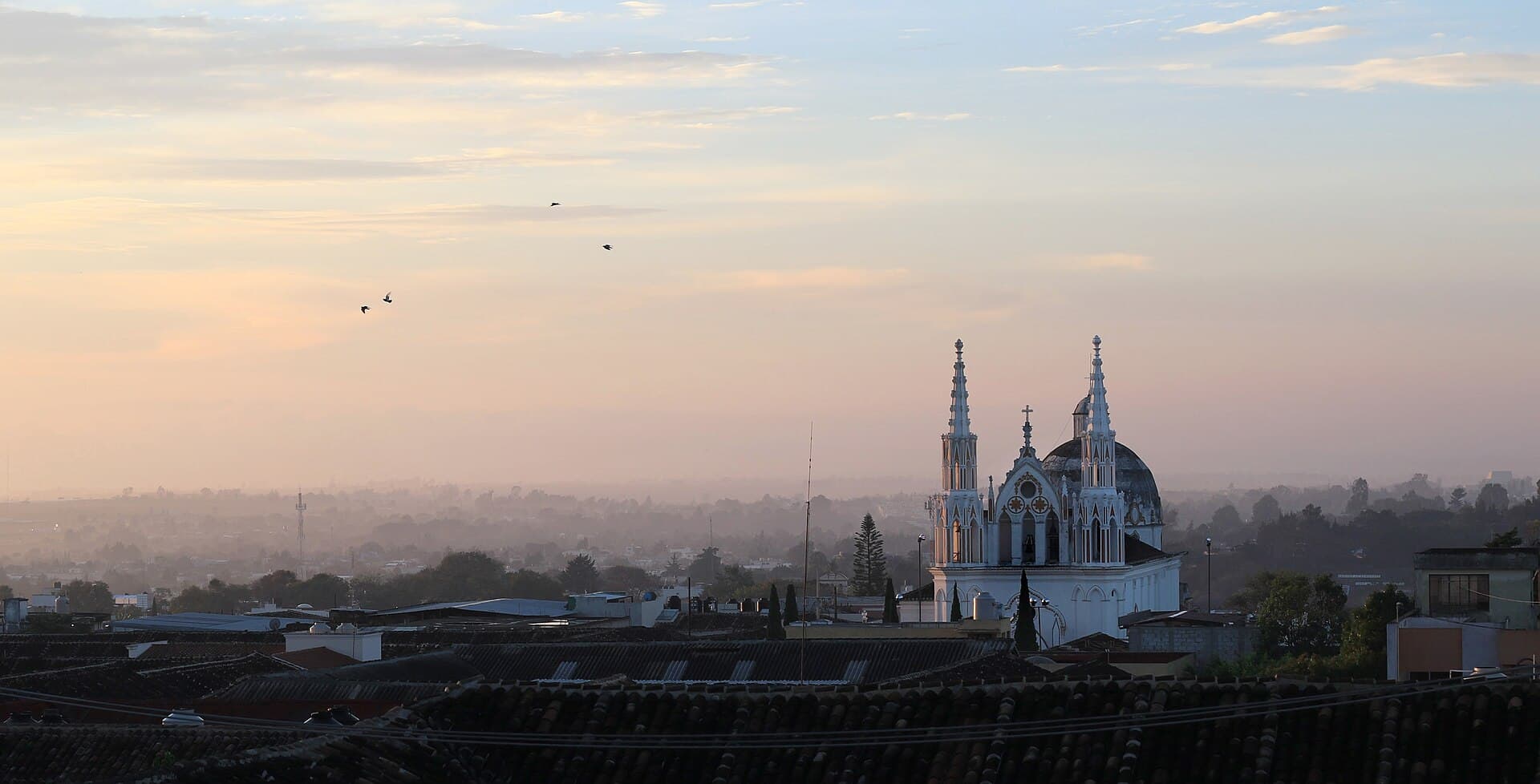 Jaimalalatete / CC BY-SA 4.0, via Wikimedia Commons
Self-guided audio walking tour of Comitán — GPS route, offline playback, story-driven narration in 32 languages.
“Where the echoes of ancient Maya meet the grace of colonial design.”
Not the postcards. The stories even locals don't know — whispered in your ear, right where they happened.
A grand fountain featuring a lion stands in the La Pila neighborhood, but its origin story extends beyond mere decoration.
The strikingly varied colors of the more than 50 lakes in this national park, ranging from emerald to deep purple, are attributed to forces beyond geology.
The city's official name, Comitán de Domínguez, pays tribute to a national hero, but its older names recount a story of both nature and indigenous culture.
Discover every secret of Comitán
Every address, every reveal in full — in your ear, right where it happened.
You pick your stops. You walk. The voice reveals what the others miss.


Your self-guided audio tour of Comitán is ready — pick your landmarks, choose your language, and start the moment you arrive.
BuyLume has a built-in augmented-reality guide. Hold your phone up and its camera shows the street ahead of you, with a glowing arrow laid over the real view that always points to your next stop — no map to puzzle over, no wrong turns. Like everything in Lume, it works fully offline.
Comitán de Domínguez, often simply called Comitán, is a city in the highlands of Chiapas, Mexico, that captivates with its colonial architecture, distinctive culture, and a surprisingly mild climate. Recognized as a 'Pueblo Mágico' since 2012, it offers a blend of historical depth and natural allure, serving as a gateway to some of Mexico's most striking landscapes.
Rooted in indigenous heritage and colonial influences, Comitán presents a distinct character from other Mexican destinations. Its inviting streets, flowery patios, and neoclassical buildings beckon exploration, while the warmth of its people and singular gastronomy promise an authentic experience. At an elevation of nearly 1,670 meters (5,500 feet), the city enjoys clean mountain air and temperate weather year-round.
The history of Comitán stretches back to the pre-Hispanic era, when it was a Maya-Tzeltal settlement known as Balún Canán, meaning 'Place of the Nine Stars' or 'Nine Guardians'. This ancient settlement was established in a swamp by a group of Tzeltal indigenous people. In 1486, the Aztecs conquered the area, renaming it Comitlán, a Nahuatl word often translated as 'Place of Potters' or 'Land of Jars,' or even 'Place of Fevers.'
The formal colonization of Comitán began in 1556 when Dominican friars, led by missionary Diego Tinoco, relocated the population, including a large group of Tojolabal indigenous people, to its current site. The Dominicans played a crucial role in the city's planning and establishment, making it a center for evangelization and influencing its urbanization with a classic 'checkerboard' layout around the main square. The construction of the Santo Domingo de Guzmán monastery, the city's patron, took place between the 16th and 17th centuries, showcasing Mudejar architectural influences.
Comitán's strategic location on a plateau, acting as a natural passage between the Chiapas highlands and tropical lowlands, contributed significantly to its development as an important transit point on the commercial route to Guatemala. From 1542 to 1821, Comitán belonged to the Audiencia de los Confines, based in Guatemala City, which included Honduras, Nicaragua, Costa Rica, Guatemala, and Chiapas, thus distinguishing Chiapas from the Audiencia de Mexico.
The city was a crucial site for independence, serving as the birthplace of the independence of Chiapas and Central America from the Spanish Crown, declared on August 28, 1821. Over the centuries, its name evolved, from San Pablo de Comitán to Santo Domingo de Comitán in 1625, and then Ciudad de Santa María de Comitán in 1813. In 1915, it was officially renamed Comitán de Domínguez in honor of Dr. Belisario Domínguez Palencia, a humanitarian doctor and politician who bravely spoke out against the usurping government during the Mexican Revolution and was subsequently murdered for his stance on freedom of speech. Comitán is also the childhood home of renowned writer and poet Rosario Castellanos, considered one of Mexico's most important 20th-century writers.
Comitán's central plaza, Benito Juárez Square, is a lively heart of the city, featuring benches, trees, art sculptures, and a fountain. It is surrounded by historic buildings, shops, and eateries. The Iglesia de Santo Domingo, built between the 16th and 17th centuries, stands on the main plaza with its neoclassical facade and Mudejar-influenced block tower.
Just three blocks northwest of the main plaza, the picturesque San Caralampio neighborhood is a delight to explore, featuring the Temple of San Caralampio and La Pila square. For those interested in history and culture, the Casa de la Cultura (House of Culture) on the southeast corner of the main plaza offers local history exhibitions and connects to the Museo Arqueológico de Comitán, which houses regional artifacts. Art enthusiasts can visit the Museo de Arte Hermila Domínguez Castellanos, two blocks southeast of the main plaza, to see works by leading Mexican artists, including Rufino Tamayo.
Beyond the city center, Comitán serves as an excellent base for exploring natural wonders. The Lagos de Montebello National Park, an hour's drive away, offers over 50 lakes with turquoise, green, and even purple hues. The El Chiflón waterfalls, a series of five cascades amidst lush forests with turquoise pools, are under 40 km away and a popular day trip. For ancient history, the Tenam Puente Archaeological Zone, a Mayan site on a hilltop with expansive views, is just 20 minutes outside of town.
Comitán de Domínguez enjoys a mild and temperate climate year-round, often described as having "eternal spring" due to its elevation. The best time to visit for general outdoor activities and minimal rain is during the dry season, from November to mid-May. During these months, daytime temperatures are pleasantly warm, averaging around 23-28°C (73-82°F), with cooler evenings. The warmest months are typically April and May, while December and January are the coolest, though still mild. The rainy season occurs from May to October, with frequent afternoon and evening showers, especially from June to September.
The closest airport to Comitán is in Tuxtla Gutiérrez (TGZ), the state capital. From there, you can take a bus to Comitán; the journey from Tuxtla Gutiérrez to Comitán takes approximately 3.5 hours, and from San Cristóbal de las Casas, it's about 2 hours. Major bus lines like ADO and Omnibus Cristóbal Colón (OCC) offer daily departures to Comitán. While exploring the city center is easily done on foot, renting a car can be beneficial for visiting nearby attractions like the Lagos de Montebello and El Chiflón waterfalls.
Comitán is generally considered safe, but it's always wise to be aware of your surroundings. When photographing locals, especially indigenous people in traditional dress, always ask for permission, as taking photos without consent is considered impolite. Avoid consuming alcohol in public places outside of bars and restaurants, as this is prohibited. The local currency is the Mexican Peso (MXN). While English isn't as widely spoken as in more popular tourist destinations, locals are generally hospitable.
Comitán in Korean, in Chinese or in Hebrew — and 29 more languages, every stop narrated by a native voice. The widest language range of any self-guided audio tour.
Available in: