Hvoll Museum
A museum in Dalvík tells the story of an event that reshaped the town, an event so powerful it is still discussed today.
Full story unlocks in the tour
 Steinninn / CC BY 4.0, via Wikimedia Commons
Self-guided audio walking tour of Dalvík — GPS route, offline playback, story-driven narration in 32 languages.
“Where the mountains meet the Arctic Circle, and the ocean recounts sagas of colossal creatures and shimmering herring.”
Not the postcards. The stories even locals don't know — whispered in your ear, right where they happened.
A museum in Dalvík tells the story of an event that reshaped the town, an event so powerful it is still discussed today.
Among the local artifacts and natural history exhibits, you will find an unexpected resident that once drifted ashore from a distant, icy land.
Beyond local history, the Hvoll Museum also celebrates two remarkable individuals with local ties, one of whom stood head and shoulders above the rest, quite literally.
Discover every secret of Dalvík
Every address, every reveal in full — in your ear, right where it happened.
You pick your stops. You walk. The voice reveals what the others miss.

Your self-guided audio tour of Dalvík is ready — pick your landmarks, choose your language, and start the moment you arrive.
BuyLume has a built-in augmented-reality guide. Hold your phone up and its camera shows the street ahead of you, with a glowing arrow laid over the real view that always points to your next stop — no map to puzzle over, no wrong turns. Like everything in Lume, it works fully offline.
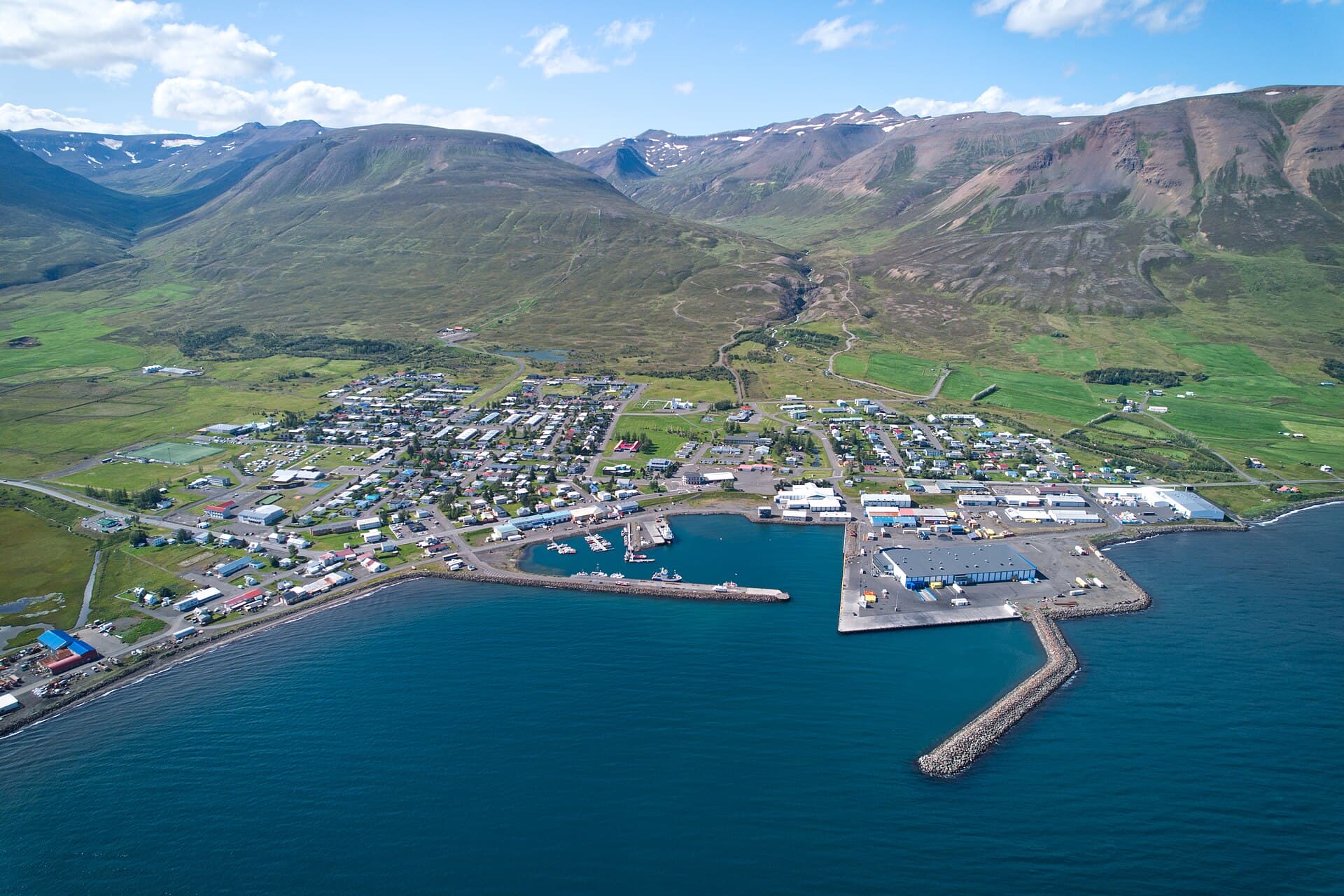
Dalvík, a captivating fishing village on the Tröllaskagi peninsula in North Iceland, offers a compelling blend of dramatic landscapes and authentic local life. Situated on the western shores of Eyjafjörður, Iceland's longest fjord, the town is framed by commanding mountains and affords expansive views of the island of Hrísey. With a population ranging from approximately 1,400 to 2,000 people, Dalvík maintains a welcoming, intimate atmosphere, making it a cherished stop for those seeking a genuine Icelandic experience away from the busiest routes.
Known as a significant fishing and commercial port, Dalvík also serves as a gateway to the Arctic Circle via the ferry to Grímsey Island. Beyond its maritime connections, the village is a center for outdoor activities, from exceptional whale watching opportunities in the abundant Eyjafjörður to some of Iceland's finest skiing slopes. Whether you are drawn to its enduring character, lively cultural events like the annual Great Fish Day, or the serene beauty of its surroundings, Dalvík invites you to slow down and immerse yourself in the unique rhythm of North Iceland.
Before the turn of the 20th century, the area where Dalvík now stands was primarily an agricultural landscape of scattered farmsteads. Fishing was a supplementary activity for farmers, who used simple wooden piers that were frequently damaged by ice and harsh weather.
The true genesis of Dalvík as a village began in the early 1900s with the arrival of Norwegian fishers, drawn by the plentiful herring in the fjords. This 'herring golden-age' spurred rapid growth, transforming the area into one of the country's largest herring ports. Unlike many other Icelandic villages, Dalvík's early development was driven by fishing and fish processing rather than trade, with the first stores only appearing after the fishing sector prospered.
In 1934, Dalvík experienced a devastating setback when it was struck by the most powerful earthquake ever recorded in the region. The quake, known as Dalvíkurskjálftinn, destroyed or severely damaged a significant portion of the village, leaving approximately 200 people homeless. The resilience of the community is evident in the subsequent rebuilding efforts, culminating in the construction of a more robust harbor in 1939, which replaced the vulnerable wooden piers.
Today, fishing and fish processing remain central to Dalvík's economy, with the village maintaining its status as an important port. The town celebrates this heritage annually with Fiskidagurinn Mikli, or 'The Great Fish Day,' a festival where local producers offer free seafood dishes to all attendees. The cooperative society also played an active role in Dalvík's development, contributing to its infrastructure and services.
Dalvík offers a variety of attractions that highlight its natural beauty, history, and local culture. Begin your exploration at the Hvoll Folk Museum, where you can delve into the region's past, learn about the devastating 1934 earthquake, and encounter quirky exhibits like a taxidermied polar bear that once drifted from Greenland. The museum also pays tribute to notable local figures, including Jóhann K. Pétursson, 'The Icelandic Giant,' and former President Dr. Kristján Eldjárn.
For outdoor enthusiasts, Dalvík is a prime destination for whale watching in Eyjafjörður, considered one of the best places in Iceland to spot up to nine species, including humpback whales. Many tours offer the added bonus of sea angling, with the day's catch often barbecued on shore. In winter, the Dalvík Ski Area on Böggvisstaðafjall mountain provides excellent slopes, including a floodlit run, and is well-regarded for heli-skiing. The surrounding Tröllaskagi peninsula is a hiker's paradise, with numerous trails offering unparalleled views of the fjord and mountains.
Take a scenic ferry trip from Dalvík harbor to Grímsey Island, Iceland's northernmost inhabited area, which lies directly on the Arctic Circle. Alternatively, explore the nearby Svarfaðardalur Nature Reserve, a wetland haven for diverse bird species. Do not miss the charming Dalvík Church, a picturesque white structure that stands out against the dramatic backdrop. For relaxation, visit the local swimming pool with its hot tubs, or venture to the nearby Beer Spa (Bjórböðin) in Árskógssandur.
The best time to visit Dalvík largely depends on your desired activities. For general outdoor tourism and warm-weather pursuits like hiking and whale watching, mid-July to mid-August offers the most favorable conditions, with average daily high temperatures above 51°F and longer daylight hours. Whale watching tours often run well into winter, sometimes year-round.
If your primary goal is to experience winter sports like skiing or snowboarding, the colder months from November to April are ideal, with excellent snow conditions. For a chance to witness the Northern Lights, consider visiting between September and March, when the nights are long and dark. Spring (April-May) and autumn (September-October) offer fewer crowds and unique transitional beauty, though weather can be more unpredictable.
Dalvík is easily accessible, located about an hour's drive north of Akureyri, often considered the capital of North Iceland. The town's postal code is simply 620. While exploring Dalvík, consider renting a car to discover the wider Tröllaskagi peninsula and its lesser-known locales. Always check local road and weather conditions, especially outside of summer, as they can be unpredictable.
Accommodation options in Dalvík include guesthouses, a hostel, and an excellent camping site. Dining choices range from local cafes, such as Gísli, Eiríkur, Helgi, known for its fish soup, to restaurants offering diverse fare. The town provides essential services, including a swimming pool, a library within the Cultural House Berg, and a tourist information office.
For excursions, the ferry Sæfari departs from Dalvík to Grímsey Island. Booking popular whale watching tours in advance, especially during summer, is highly recommended. Remember to dress in warm layers and waterproof clothing, even in summer, as conditions on the water can be chilly.
Dalvík in Korean, in Chinese or in Hebrew — and 29 more languages, every stop narrated by a native voice. The widest language range of any self-guided audio tour.
Available in: