Port of Echuca Discovery Centre
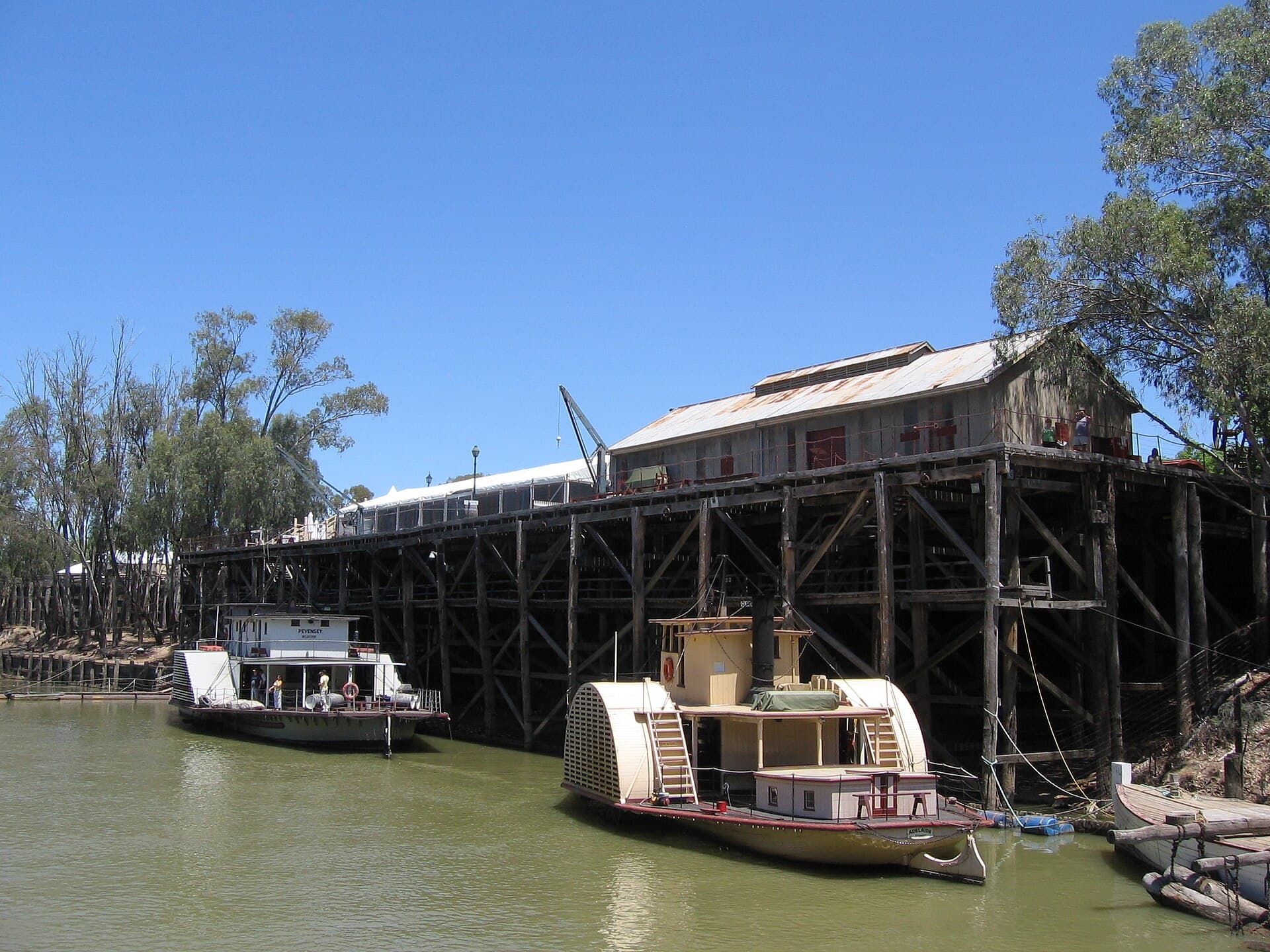
Beyond the restored wharf and the rhythmic chug of paddle steamers, a lesser-known reason explains Echuca's rise as Australia's largest inland port.
Full story unlocks in the tour
 Mattinbgn / CC BY-SA 4.0, via Wikimedia Commons
Self-guided audio walking tour of Echuca — GPS route, offline playback, story-driven narration in 32 languages.
“Where the Murray's paddle steamers narrate stories of a departed era.”
Not the postcards. The stories even locals don't know — whispered in your ear, right where they happened.
Beyond the restored wharf and the rhythmic chug of paddle steamers, a lesser-known reason explains Echuca's rise as Australia's largest inland port.
Many visitors find charm in the vintage films, yet few grasp the true scarcity of the arcade games housed within.
While its age commands respect, the PS Adelaide holds a singular distinction among active paddle steamers.
Discover every secret of Echuca
Every address, every reveal in full — in your ear, right where it happened.
You pick your stops. You walk. The voice reveals what the others miss.


Your self-guided audio tour of Echuca is ready — pick your landmarks, choose your language, and start the moment you arrive.
BuyLume has a built-in augmented-reality guide. Hold your phone up and its camera shows the street ahead of you, with a glowing arrow laid over the real view that always points to your next stop — no map to puzzle over, no wrong turns. Like everything in Lume, it works fully offline.
Echuca, a resonant name derived from the Aboriginal Yorta Yorta word for 'meeting of the waters,' rests at the convergence of the Murray and Campaspe Rivers in Victoria, Australia. This historic town, twinned with Moama across the Murray in New South Wales, offers a tangible connection to Australia's pioneering past. Once a bustling inland port, Echuca's identity remains profoundly interwoven with the formidable Murray, where the steady thrum of paddle steamers echoes its golden age.
Travelers are drawn to Echuca for its distinctive blend of historical character and natural splendor. The town acts as a gateway to river explorations, from relaxed cruises on authentic paddle steamers to water sports upon the Murray. Beyond the river, Echuca provides a tranquil atmosphere with its preserved port precinct, local wineries, and a flourishing food scene. It is a place where history is not merely presented in museums, but actively experienced upon the water and along its venerable streets.
Echuca's genesis traces back to Henry Hopwood, an ex-convict who established 'Hopwood's Ferry' in the mid-19th century, providing a crucial crossing point for people and goods over the Murray River. As the settlement expanded, its name transformed to Echuca, reflecting its geographical significance as the 'meeting of the waters' where the Murray and Campaspe Rivers converge.
By the 1870s, Echuca had evolved into Australia's largest inland port. Its strategic placement offered the shortest distance between the Murray River and Melbourne, establishing it as an indispensable nexus for river and rail transport. A 332-meter long redgum wharf became the central point, where paddle steamers unloaded commodities such as wool, wheat, other grains, livestock, and timber. These goods were then efficiently transferred by hydraulic crane to waiting trains bound for Melbourne, cementing Echuca's role in the burgeoning colonial economy.
The town's prosperity during this period remains evident in the preserved Port of Echuca, which is recognized as a Heritage Place on the Australian National Heritage List. The port precinct, with its historic structures and the largest collection of operating paddle steamers globally, offers a concrete link to this significant chapter of Australian history. The narratives of river trade and the lives of those who worked on the Murray are vividly recounted, allowing visitors to journey back in time and appreciate Echuca's pivotal contribution to shaping inland Australia.
The golden age of river travel introduced a distinctive culture to Echuca. The paddle steamers served not only as cargo carriers but also as vital connections for communities along the river, fostering trade and communication. The town's economy flourished due to the river and the surrounding agricultural lands, with dairy, wheat, sheep, pig, and cattle farms all contributing to the region's prosperity. While the dominance of river transport eventually diminished with the expansion of road and rail networks, Echuca has carefully safeguarded its heritage. Today, tourism and agriculture remain the primary industries, with visitors drawn to the town's historical character, the allure of the Murray River, and its iconic paddle steamers. Festivals and cultural events throughout the year further commemorate Echuca's enduring past and lively present.
Begin your exploration at the Port of Echuca Discovery Centre, the core of the town's historical precinct. Here, interactive displays and artifacts detail Australia's inland navigation and the crucial role paddle steamers played in the 19th century. Stroll along the historic Echuca Wharf, a 332-meter redgum structure, and envision the lively trade of a former era.
A paddle steamer journey on the Murray River is an essential Echuca experience. Vessels like the PS Pevensey, PS Adelaide (the world's oldest operating wooden-hulled paddle steamer), and PS Alexander Arbuthnot provide one-hour voyages, complete with narration on river life and the operational steam engines. For a singular step back in time, visit Sharp's Movie House + Penny Arcade on Murray Esplanade, where you can view old black and white films and engage with rare 1930s penny machines.
Beyond the port, explore the National Holden Motor Museum for a glimpse into Australian automotive history, or satisfy your sweet cravings at the Echuca Chocolate Company. Wine enthusiasts can visit St Anne's Vineyard or explore the broader Perricoota wine region. For an unusual experience, the Great Aussie Beer Shed and Heritage Farm Museum offers a distinctive collection. Those who appreciate nature can enjoy walking or biking along the Murray River, or venture to nearby Barmah National Park to observe wildlife amidst towering river red gums.
Echuca experiences warm, dry summers and cool winters. The most agreeable period for warm-weather activities extends from late December to early March, with January being the warmest month, averaging 88°F (31°C). For milder weather, consider visiting in spring (September to November) or autumn (March to May), when temperatures are comfortable for exploring the town and enjoying outdoor activities without extreme heat or cold. Winter (June to August) is cooler, with average lows of 40°F (4°C), offering a tranquil atmosphere and opportunities for indoor activities like museums and cafes.
Echuca is approximately a two-and-a-half-hour drive north of Melbourne, making a car rental a convenient option for travel. Once in Echuca, many attractions within the historic port precinct are accessible by foot. Accommodation options cater to various budgets, from economical motels to upscale hotels and holiday parks. Popular choices include The Georgian Motor Lodge, Mercure Port of Echuca, and Campaspe Lodge.
The town offers diverse dining experiences, from Italian at Roma Restaurant to modern Greek at Opa Echuca, and plant-based options at The Sweet Meadow. For a historic pub experience, consider 1895 The Royal. The Echuca Moama Official Visitor Guide provides comprehensive information, and the Visitor Information Centre is located in the historic port area.
Echuca in Korean, in Chinese or in Hebrew — and 29 more languages, every stop narrated by a native voice. The widest language range of any self-guided audio tour.
Available in: