Beyond the more tourist-centric Witches' Market in La Paz, El Alto offers a more authentic, less-advertised hub for traditional Andean healing.
Parallelepiped09 / CC BY-SA 4.0, via Wikimedia CommonsEl Alto
Self-guided audio walking tour of El Alto — GPS route, offline playback, story-driven narration in 32 languages.
“Where the sky meets the market and tradition builds the future.”
El Alto, as no one tells it.
Not the postcards. The stories even locals don't know — whispered in your ear, right where they happened.
The world's highest urban cable car system offers more than just a ride between cities; it reveals a unique social geography.
This sprawling market stands as one of South America's largest, and it is where one can find almost anything imaginable, including items one might not expect to see for sale in the open.
Discover every secret of El Alto
Every address, every reveal in full — in your ear, right where it happened.
You pick your stops. You walk. The voice reveals what the others miss.
How long do you have in El Alto?
Your self-guided audio tour of El Alto is ready — pick your landmarks, choose your language, and start the moment you arrive.
BuyThe story of El Alto
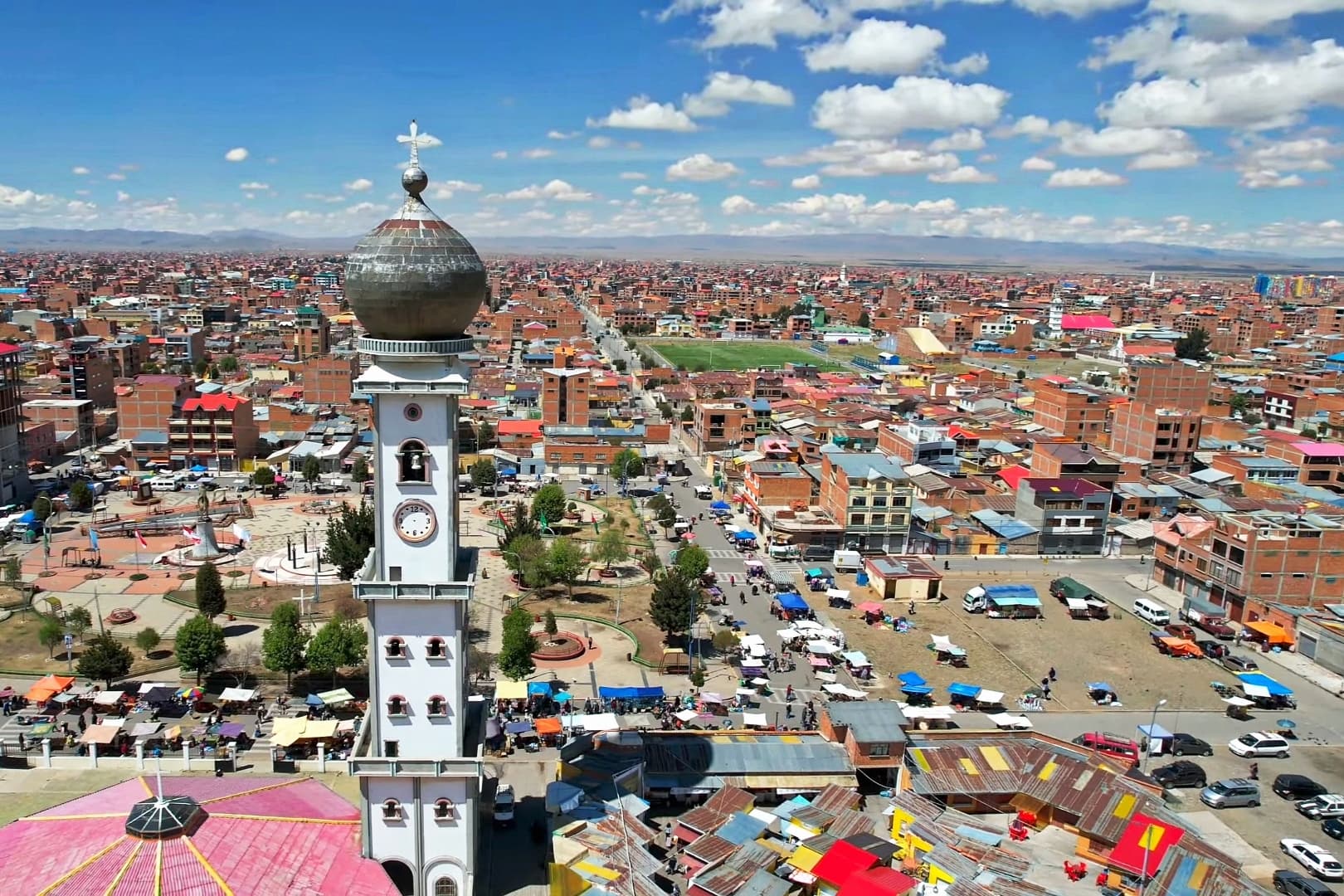
El Alto, Spanish for "The High One," is a city that lives up to its name. Situated on the Altiplano plateau at an average elevation of 4,000 meters (13,123 feet), it holds the distinction of being the highest major city in the world. This dynamic metropolis, adjacent to La Paz, is one of Bolivia's fastest-growing urban centers, with an estimated population of over 943,000 residents in 2020. El Alto's unique atmosphere is a blend of high-altitude living, a youthful demographic—with more than half its residents under 19 years old—and a strong indigenous Aymara identity, which accounts for about 74% of its population.
Often seen as a crucial economic and transport hub, El Alto offers panoramic views of the snow-capped Andes peaks and the city of La Paz in the canyon below. While it might initially appear as a dense collection of unpainted brick houses and bustling streets, El Alto is a city of immense cultural significance and a powerful political force in Bolivia. It is a place where traditional Aymara culture flourishes, expressed through its lively markets, distinctive architecture, and the resilience of its people.
From Railway Settlement to Rebel City
El Alto's origins trace back to 1903, when railway lines from Lake Titicaca and Arica reached the rim of the canyon above La Paz. A settlement of railway workers, along with the La Paz terminus, railyards, and depots, began to form on this dry, previously uninhabited plain. The establishment of an airfield in 1925 for the new air force further attracted people to the area. For decades, El Alto was largely considered a satellite of La Paz, with limited investment in infrastructure.
The city's expansion accelerated significantly in the 1950s when it was connected to La Paz's water supply, and building land in the canyon became scarce and expensive. This period saw an influx of indigenous Aymara people from rural areas, seeking better opportunities. El Alto's population steadily grew, reaching 30,000 by the mid-1960s and topping 100,000 by the mid-1970s, fueled by a construction boom and later by economic depression and drought in agricultural communities.
In 1985, El Alto and its surroundings were politically separated from La Paz, a date now celebrated as the city's founding day, and it was formally incorporated as a city in 1987. This independence marked a turning point, as El Alto developed a distinct Aymara identity and political consciousness. The city became a central actor in Bolivian politics, notably playing a key role in the 2003 "Gas War," where protests essentially cut off La Paz and contributed to the resignation of the neoliberal president. This event laid the groundwork for the rise of Evo Morales, Bolivia's first indigenous president. Today, El Alto continues to be a powerful force, with its residents demanding respect and asserting their cultural and political influence.
El Alto offers a raw and authentic Bolivian experience. A primary draw is the 16 de Julio Market (Feria 16 de Julio), one of the largest open-air markets in South America, held every Thursday and Sunday. Here, one can find everything from traditional textiles and crafts to electronics, car parts, and an array of street food. For a deeper dive into Andean spirituality, explore El Alto's Witches Street, located near the 16 de Julio Market, where yatiri (traditional Aymara healers) offer herbs, amulets, and ritual items.
Another distinctive feature of El Alto is its Neo-Andean architecture, particularly the lively and often flamboyant buildings known as cholets. These multi-story structures, designed by architects like Freddy Mamani, blend Andean cultural motifs with modern design, symbolizing the economic prosperity and cultural pride of the Aymara people. For sweeping panoramic views of La Paz and the majestic Mount Illimani, seek out one of El Alto's many viewpoints. The Mi Teleférico cable car system not only provides efficient transport but also offers unparalleled aerial perspectives of both cities and the surrounding Andean landscape.
For a unique cultural spectacle, look for Cholitas Wrestling matches, where indigenous Aymara women in traditional attire engage in theatrical lucha libre.
The optimal time to visit El Alto is during the dry season, which spans from May to October. During these months, one can anticipate clear skies and cooler, more pleasant daytime temperatures, making it ideal for exploring the outdoor markets and city. While nights can be cold, often dropping to 0°C or below, the dry weather generally makes for a more comfortable experience. The 16 de Julio Market is most active on Thursdays and Sundays.
El Alto is located at a high altitude (around 4,000-4,150 meters), so it is crucial to take precautions against altitude sickness. Acclimatize slowly, stay hydrated, and consider consulting a doctor about medication. The local currency is the Bolivian Boliviano (BOB), and ATMs are widely available, though carrying some cash is advisable. While generally safe for tourists, it is wise to be vigilant, especially in crowded market areas, and avoid displaying valuables.
Getting to El Alto from La Paz is easy via the Mi Teleférico cable car system (Red Line), public buses, or taxis. The cable car offers a scenic and efficient way to travel. Within El Alto, minibuses are a common form of public transport. Dress in layers, as temperatures can fluctuate throughout the day, even during the dry season.
- What is the altitude of El Alto?
- El Alto has an average elevation of 4,000 meters (13,123 feet) above sea level, making it the highest major city in the world.
- What is a 'cholet'?
- A 'cholet' is a distinctive Neo-Andean architectural style found in El Alto. These brightly colored, multi-story buildings often feature whimsical facades and blend traditional Aymara motifs with modern design, symbolizing the prosperity of the indigenous population.
- When does the 16 de Julio Market operate?
- The 16 de Julio Market, also known as Feria 16 de Julio, is held twice a week, every Thursday and Sunday, throughout the year. Sundays are typically the busiest days.
- Is El Alto safe for tourists?
- While generally considered safe for tourists, it is important to remain vigilant, particularly in crowded areas like the market. It is advisable to avoid openly displaying valuables.
- How can I get to El Alto from La Paz?
- You can reach El Alto from La Paz by taking the Mi Teleférico cable car system (Red Line), a public bus (colectivo), or a taxi. The cable car offers scenic views.
- What kind of items can be found at the El Alto Market?
- The El Alto Market sells a vast array of goods, including traditional alpaca wool textiles, clothing, electronics, car parts, sports equipment, illegal copies of DVDs, second-hand items, and even used medical equipment.