L'Amphithéâtre
Cette immense arène, autrefois scène de spectacles brutaux, accueillait un nombre surprenant de spectateurs compte tenu de la population de la ville.
L'histoire complète se débloque dans le tour
Visite audio autoguidée de Italica — parcours GPS à pied, lecture hors ligne, narration en 32 langues.
“Là où les empereurs foulaient le sol et les cris des gladiateurs résonnaient, une cité romaine émerge de la terre andalouse.”
Pas les cartes postales. Les histoires que même les habitants ignorent — soufflées à l'oreille, là où elles se sont passées.
Cette immense arène, autrefois scène de spectacles brutaux, accueillait un nombre surprenant de spectateurs compte tenu de la population de la ville.
Sous une mosaïque représentant des corps célestes, un détail moins connu évoque l'opulence romaine.
Ce grand temple, dédié à l'empereur Trajan, ne fut pas construit par lui, mais par son successeur.
Découvrez tous les secrets de Italica
Chaque adresse, chaque révélation en entier — dans ton oreille, là où elle s'est passée.
Tu choisis tes lieux. Tu marches. La voix te révèle ce que les autres ignorent.


Votre visite audioguidée de Italica vous attend — choisissez vos lieux, votre langue, et lancez-vous dès votre arrivée.
AcheterLume intègre un guide en réalité augmentée. Levez votre téléphone : sa caméra montre la rue devant vous, avec une flèche lumineuse posée sur l'image réelle qui pointe toujours vers votre prochain arrêt — aucune carte à déchiffrer, aucun mauvais virage. Comme tout dans Lume, ça fonctionne entièrement hors-ligne.
À une courte distance de Séville, l'ancienne cité d'Italica offre un voyage fascinant dans l'Hispanie romaine. Fondée en 206 av. J.-C. par le général Publius Cornelius Scipion, elle fut la première colonie romaine en Espagne et la première au-delà des frontières de l'Italie. Ce site archéologique est reconnu comme le lieu de naissance de deux empereurs romains éminents, Trajan et Hadrien, et peut-être de Théodose.
Aujourd'hui, Italica témoigne de la magnificence romaine, avec des ruines remarquablement préservées qui offrent une fenêtre sur la vie quotidienne et le savoir-faire architectural de l'époque. Les visiteurs peuvent se promener dans de larges avenues, admirer des mosaïques complexes, explorer des thermes publics et s'émerveiller devant l'un des plus grands amphithéâtres de l'Empire romain. Son importance historique et sa richesse archéologique en font une destination captivante pour quiconque s'intéresse à l'influence durable de Rome sur la péninsule ibérique.
## Fondation et croissance précoce L'histoire d'Italica commence en 206 av. J.-C., pendant la deuxième guerre punique, lorsque le général romain Scipion l'Africain l'établit comme colonie pour ses soldats vétérans après la bataille d'Ilipa. Ces soldats, dont beaucoup venaient d'Italie, donnèrent son nom à la ville. L'emplacement fut stratégiquement choisi près d'une communauté turdétane existante, qui remontait au moins au IVe siècle av. J.-C. Bien que la ville voisine d'Hispalis (Séville moderne) fût plus grande, l'importance d'Italica découla de ses origines illustres et de sa proximité avec le fleuve Guadalquivir, lui permettant de contrôler la région.
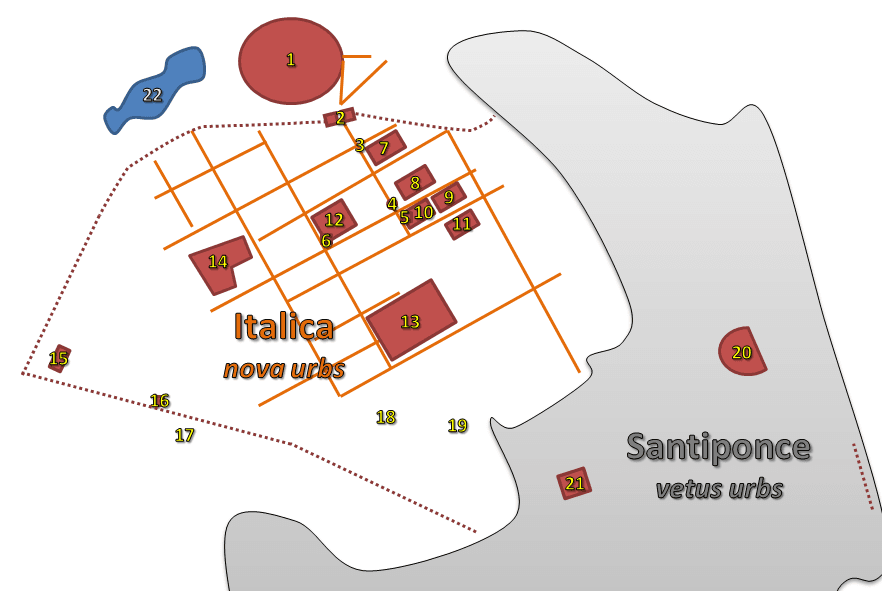
## Connexions impériales et expansion Italica acquit une importance considérable en tant que lieu de naissance de deux empereurs romains : Trajan (qui régna de 98 à 117 apr. J.-C.) et Hadrien (qui régna de 117 à 138 apr. J.-C.). Ces empereurs, en particulier Hadrien, jouèrent un rôle essentiel dans le développement de la ville. Hadrien, né dans la 'Vieille Ville' (Vetus Urbs), entreprit une expansion massive, créant la 'Nouvelle Ville' (Nova Urbs). Cette expansion transforma Italica en une vitrine de l'urbanisme romain, adhérant à des normes architecturales et idéologiques ambitieuses. Sous l'empereur Auguste, la ville était déjà devenue l'une des plus avancées du monde romain, dotée de systèmes de drainage et d'autres services. Hadrien éleva Italica au rang de colonie romaine, lui accordant le titre de Colonia Aelia Augusta Italica.
## Déclin et redécouverte Italica prospéra en tant que centre politique et militaire et fut un grand producteur de céréales et d'huile d'olive. Cependant, sa prospérité commença à décliner au IIIe siècle apr. J.-C. Un facteur important de son déclin fut le changement de cours du fleuve Guadalquivir, qui laissa le port de la ville à sec et entraîna un transfert du commerce vers Hispalis. La 'Nouvelle Ville' fut finalement abandonnée, en partie à cause de l'instabilité géologique du site choisi sur la colline, qui provoqua l'affaissement des bâtiments. Au cours du Moyen Âge et jusqu'au siècle dernier, les ruines d'Italica furent utilisées comme carrière de matériaux de construction pour d'autres constructions, notamment la route de Mérida à Séville et de grandes maisons à Séville. Heureusement, l'abandon de la 'Nouvelle Ville' signifia qu'une grande partie fut préservée plutôt que construite, permettant d'importantes fouilles archéologiques et les impressionnantes ruines visibles aujourd'hui.
Le site archéologique d'Italica offre un éventail fascinant de ruines romaines. La caractéristique la plus proéminente est le grand amphithéâtre, l'un des plus vastes de l'Empire romain, capable d'accueillir 25 000 spectateurs. Les visiteurs peuvent explorer sa fosse centrale, où des animaux sauvages étaient autrefois gardés pour les combats de gladiateurs.
En explorant les anciennes avenues d'Italica, vous découvrirez les vestiges de thermes publics élaborés et de résidences privées ornées de mosaïques complexes. Des exemples notables incluent la Maison des Oiseaux, la Maison du Planétarium et la Maison de l'Exèdre, toutes affichant des œuvres d'art au sol vives et détaillées représentant des scènes mythologiques, des oiseaux et des corps célestes. Le Trajaneum, un temple monumental dédié à l'empereur Trajan, est une autre structure significative. De plus, les vestiges du système d'aqueduc et d'un système d'égouts sophistiqué soulignent la prouesse de l'ingénierie romaine. Un petit théâtre romain, situé dans la partie ancienne d'Italica sous la ville moderne de Santiponce, peut également être observé.
Les périodes les plus agréables pour découvrir Italica sont les mois de printemps et d'automne. Le temps est généralement doux et agréable, ce qui est idéal pour explorer le vaste site archéologique en plein air. Les étés en Andalousie peuvent être assez chauds, ce qui pourrait rendre une exploration prolongée inconfortable. Les hivers sont généralement doux mais peuvent être humides. Consultez toujours le site web officiel pour connaître les heures d'ouverture actuelles, car elles peuvent varier selon les saisons.
Italica est située à environ 9 kilomètres (5,6 miles) au nord de Séville, près de la ville de Santiponce. Elle est facilement accessible en bus public (M-172A Damas) depuis la gare routière Plaza de Armas de Séville, avec des bus circulant fréquemment. Alternativement, des visites guidées depuis Séville sont disponibles, et certains visiteurs optent pour une excursion à vélo.
L'entrée du site archéologique est gratuite pour les citoyens de l'UE munis d'une pièce d'identité valide, tandis que les autres paient une somme modique, généralement inférieure à 3 €. Le site dispose d'une signalisation claire et un musée informatif est disponible pour ceux qui préfèrent explorer de manière autonome. Portez des chaussures confortables adaptées à la marche sur un terrain irrégulier et apportez de l'eau, surtout pendant les mois plus chauds. De nombreux artefacts d'Italica sont exposés au Musée Archéologique de Séville et au Palais de Lebrija à Séville, ce qui peut compléter votre visite.
Italica en coréen, en chinois ou en hébreu — et dans 29 autres langues, chaque étape narrée par une voix native. La plus large gamme de langues de tous les audioguides autoguidés.
Disponible en :