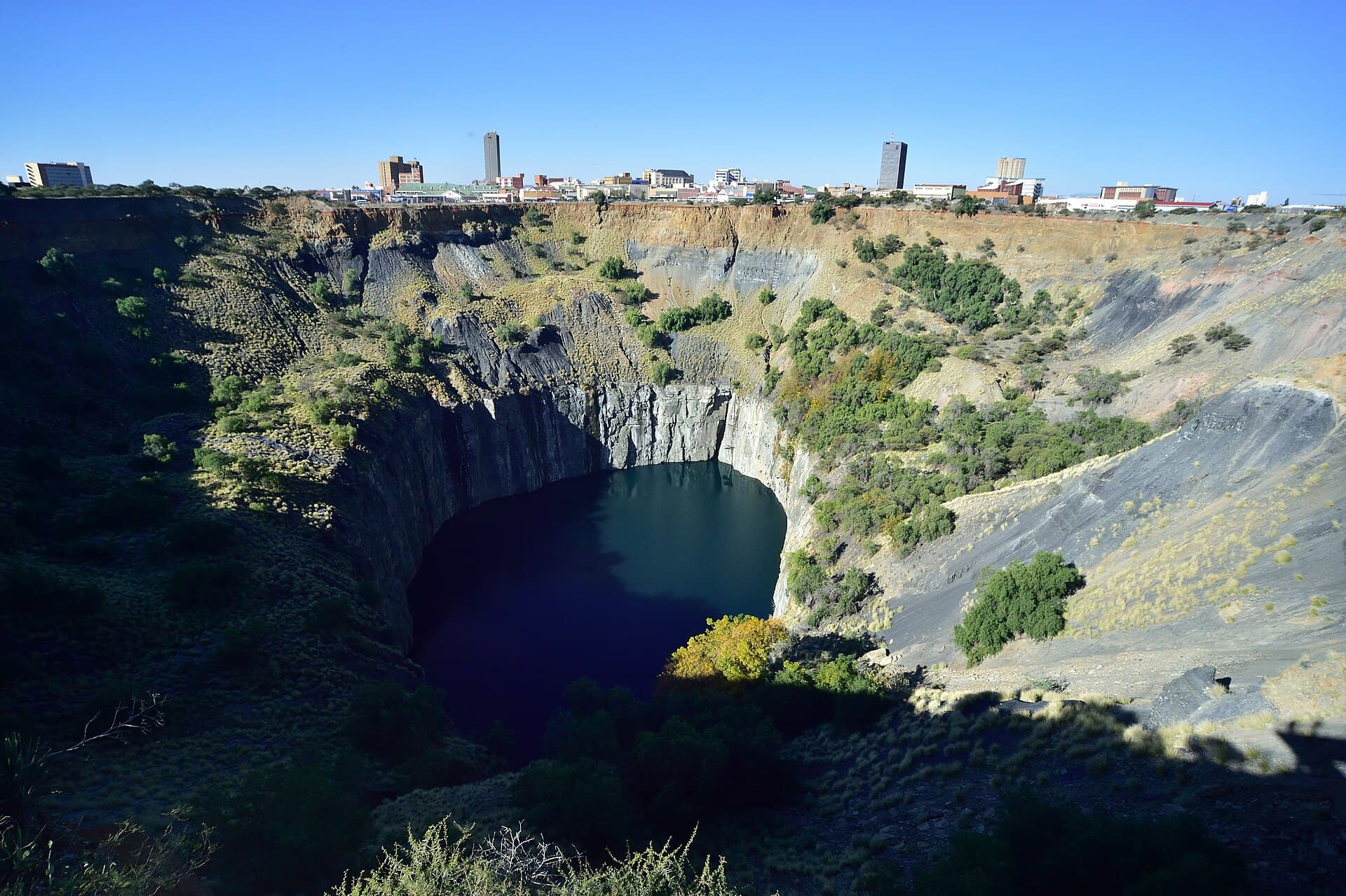
The Big Hole is a testament to human ambition, excavated by tens of thousands of miners. Yet, this monumental pit might not actually be the world's largest hand-dug excavation.
South African Tourism from South Africa / CC BY 2.0, via Wikimedia CommonsKimberley
Self-guided audio walking tour of Kimberley — GPS route, offline playback, story-driven narration in 32 languages.
“Where the earth opened and fortunes were made, Kimberley sparkles with stories.”
Kimberley, as no one tells it.
Not the postcards. The stories even locals don't know — whispered in your ear, right where they happened.
Kimberley swiftly embraced new technologies, becoming a city of firsts in the Southern Hemisphere. One particular innovation illuminated its thoroughfares before many major global cities.
This exclusive establishment once served as the domain of diamond magnates and powerful figures, a place where fortunes were debated and agreements sealed. However, the building itself has undergone numerous transformations beyond its club days.
Discover every secret of Kimberley
Every address, every reveal in full — in your ear, right where it happened.
You pick your stops. You walk. The voice reveals what the others miss.


How long do you have in Kimberley?
Your self-guided audio tour of Kimberley is ready — pick your landmarks, choose your language, and start the moment you arrive.
BuyThe story of Kimberley
Kimberley, the capital of South Africa's Northern Cape province, is a city forged in the crucible of diamond fever. Its very existence owes to the glittering stones unearthed here in the late 19th century, which ignited a monumental diamond rush and transformed a quiet farming district into a bustling center of industry and innovation.
Known as the 'Diamond City,' Kimberley's legacy extends beyond its mineral wealth. It is a place where pioneering achievements in technology and finance took root, leaving behind a distinctive blend of Victorian architecture and historical landmarks. A visit here offers a tangible connection to a pivotal era in South African history, where fortunes were made and the modern landscape of the country began to take shape.
## The Diamond Rush and the Big Hole Kimberley's story began in 1871 with the discovery of diamonds on the Vooruitzicht farm, owned by the De Beer brothers. This find sparked a massive diamond rush, drawing thousands of prospectors to the area, initially known as New Rush. The intensive digging at Colesberg Kopje quickly transformed a small hill into a vast crater, now famously known as the Big Hole.
Between 1871 and 1914, approximately 50,000 miners excavated the Big Hole by hand, yielding an astonishing 2,722 kilograms of diamonds. The sheer scale of this human endeavor is remarkable; the Big Hole has a surface area of 17 hectares and is 463 meters wide, excavated to a depth of 240 meters. While partially infilled with debris and now containing 40 meters of water, 175 meters of its depth remain visible.
## A City of Firsts and Fortunes The diamond discoveries in Kimberley attracted prominent figures like Cecil Rhodes and Barney Barnato, who made their fortunes here. Rhodes went on to establish the powerful De Beers diamond company in 1888, consolidating control over the diamond fields. The city's rapid development led to significant innovations. In 1881, Africa's first stock exchange, the Kimberley Royal Stock Exchange, opened its doors. The following year, on September 2, 1882, Kimberley made history as the first city in the Southern Hemisphere and the second in the world (after Philadelphia) to install electric street lighting.
## The Siege of Kimberley and Beyond Kimberley also played a crucial role during the Second Boer War, enduring a 124-day siege by Boer forces that ended in February 1900. After the apartheid era, in 1994, Kimberley became the capital of the new Northern Cape Province, undergoing considerable development as administrative departments were established. Today, while diamond mining continues in the region, the city's focus has shifted, with much of the modern mining concentrating on processing discarded tailings from the 19th century using innovative technology.
The Big Hole and Kimberley Mine Museum complex stands as the undeniable centerpiece, offering a deep dive into the city's diamond past. Visitors can peer into the immense hand-dug pit from a viewing platform, explore an open-air museum with original and reconstructed 19th-century buildings, and experience a simulated mine shaft. The museum also houses replicas of famous diamonds, including the Eureka Diamond, South Africa's first recorded diamond discovery.
For a broader historical perspective, the McGregor Museum offers extensive collections on Northern Cape history, from prehistoric times to the early 20th century. The William Humphreys Art Gallery showcases South African art alongside Dutch, Flemish, British, and French masters. A trip on the restored 1914 Kimberley Tram provides a novel way to see the city, connecting the City Hall to the museum. Do not overlook the Honoured Dead Memorial, designed by Sir Herbert Baker, commemorating those who died during the Siege of Kimberley. For a singular cultural experience, the Wildebeest Kuil Rock Art Centre features ancient San rock art.
The most pleasant times to visit Kimberley for outdoor activities are during the autumn and spring months. From mid-February to late April and from early September to late December offer mild and comfortable temperatures. The shoulder months of May and September are particularly good for avoiding crowds, with May often still showing lush vegetation from the wet season. While summer (November to February) brings hotter temperatures and occasional afternoon thunderstorms, it is suitable for hot-weather activities. Winter (June to August) is cooler, with clear skies and chilly nights, making it ideal for exploring historical sites.
Kimberley has a small airport, with a slightly busier airport in Bloemfontein, about 200 kilometers away. The city is accessible via major national roads, including the N12 and N8. While exploring the main attractions like the Big Hole complex can be done on foot, a rental car offers more flexibility for venturing to sites further afield, such as the Magersfontein battlefield or the Wildebeest Kuil Rock Art Centre. Sunscreen, a hat, and plenty of water are essential, especially during warmer months. Accommodation options range from luxury hotels to guesthouses and B&Bs, many in historic buildings.
- What is the Big Hole?
- The Big Hole is a massive, hand-dug open-pit mine in Kimberley, created by approximately 50,000 miners between 1871 and 1914 in their search for diamonds.
- Is the Big Hole really the largest hand-dug hole in the world?
- While often claimed to be the largest, some sources suggest the Jagersfontein Mine holds that record. Regardless, it remains an incredibly impressive and significant historical site.
- When were diamonds first discovered in Kimberley?
- Diamonds were first discovered on the Vooruitzicht farm in 1871, sparking the famous Kimberley diamond rush.
- What is Kimberley known for besides diamonds?
- Kimberley is known for its historical significance during the Second Boer War, being the first city in the Southern Hemisphere to have electric streetlights, and hosting Africa's first stock exchange.
- What is the best way to get around Kimberley?
- While central attractions are walkable, a rental car is recommended for exploring further afield. A historic tram also runs between the City Hall and the Kimberley Mine Museum.
- Are there any unique cultural sites in Kimberley?
- Yes, the Wildebeest Kuil Rock Art Centre offers insight into ancient San rock art and the culture of the !Xun and Khwe San people.