Vilakazi Street
It is the sole street globally that sheltered two Nobel Peace Prize laureates.
Full story unlocks in the tour
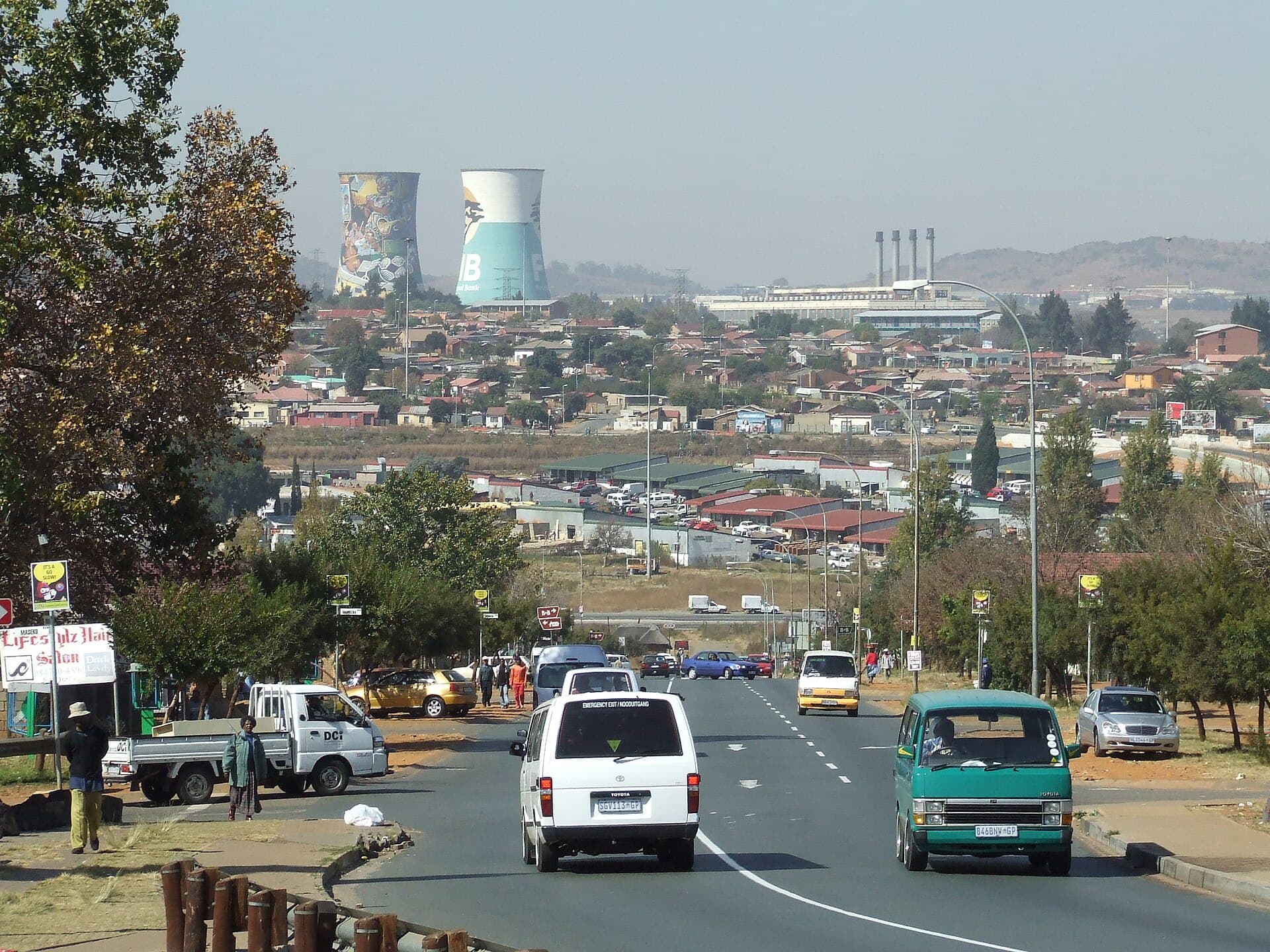 Michael Denne from Hobart, Australia / CC BY-SA 2.0, via Wikimedia Commons
Self-guided audio walking tour of Soweto — GPS route, offline playback, story-driven narration in 32 languages.
“Soweto: A resilient spirit forged in struggle, a community writing its own future.”
Not the postcards. The stories even locals don't know — whispered in your ear, right where they happened.
It is the sole street globally that sheltered two Nobel Peace Prize laureates.
This open-air museum displays sculptures and traditional structures that some believe foretold significant global occurrences.
The striking photograph of a dying boy, carried by a fellow student, became a worldwide emblem of defiance.
Discover every secret of Soweto
Every address, every reveal in full — in your ear, right where it happened.
You pick your stops. You walk. The voice reveals what the others miss.


Your self-guided audio tour of Soweto is ready — pick your landmarks, choose your language, and start the moment you arrive.
BuyLume has a built-in augmented-reality guide. Hold your phone up and its camera shows the street ahead of you, with a glowing arrow laid over the real view that always points to your next stop — no map to puzzle over, no wrong turns. Like everything in Lume, it works fully offline.
Soweto, an acronym for South Western Townships, forms an urban complex southwest of Johannesburg, South Africa. It stands as the nation's largest Black urban settlement, with a population exceeding 1.2 million people. More than 65% of Johannesburg's residents reside within Soweto. Initially a collection of informal settlements that expanded with the 1886 discovery of gold in the Witwatersrand, Soweto was systematically developed under apartheid as a residential area for Black South Africans, separated from white suburbs by deliberate buffer zones.
Today, Soweto serves as a dynamic center of history, culture, and community. It played a crucial part in the anti-apartheid struggle, becoming a symbol of resistance and a testament to the endurance of its people. Visitors can explore important historical locations, immerse themselves in local life, and experience the contemporary Black culture that thrives within its varied communities.
Soweto's origins are deeply embedded in the 1886 discovery of gold in the Witwatersrand, which led to a rapid influx of workers to Johannesburg. As the city expanded, informal settlements formed around the mining areas. In 1904, a bubonic plague outbreak in Johannesburg's inner-city Brickfields area prompted authorities to forcibly relocate Black residents approximately 25 kilometers south to Klipspruit, marking the genesis of what would become Soweto.
Under the Urban Areas Act of 1923, the white government initiated a systematic process of racial segregation, moving Black residents to areas separated from white suburbs by natural barriers like rivers, railway lines, or industrial zones. These segregated areas were known as "cordons sanitaires." In 1931, the township of Orlando was established, followed by others like Tladi, Zondi, Dhlamini, Chiawelo, and Senoane in 1956, and Jabulani, Phiri, and Naledi in 1957.
The name Soweto, an English syllabic abbreviation for South Western Townships, was officially adopted by the city council in 1963 after a competition to find a collective name for the townships southwest of Johannesburg's center. The apartheid government intended Soweto to house the Black labor force required by Johannesburg, with residents having only temporary status until 1976.
Soweto garnered international attention on June 16, 1976, with the Soweto Uprising. This mass protest erupted when police opened fire on approximately 10,000 students marching from Naledi High School to Orlando Stadium, protesting the government's policy to enforce education in Afrikaans. The unrest continued, resulting in the deaths of 23 people on the first day, including 12-year-old Hector Pieterson, whose evocative image became a global symbol of resistance against apartheid. The Soweto Uprising was a turning point in the fight against apartheid, leading to reforms but also continued violence and repression until the first non-racial elections in April 1994.
In 1983, Soweto became an independent municipality, transitioning from Johannesburg council governance to electing its own Black councilors. Since 2002, it has been incorporated into the City of Johannesburg Metropolitan Municipality.
Begin your exploration on Vilakazi Street, the only street in the world where two Nobel Peace Prize laureates, Nelson Mandela and Archbishop Desmond Tutu, once resided. Here, you can visit the Mandela House Museum, Nelson Mandela's former home from 1946 to 1962, now a museum preserving his enduring legacy. A short walk leads to the Hector Pieterson Memorial and Museum, a poignant tribute to the 1976 Soweto Uprising and the students who lost their lives protesting apartheid. The museum displays photographs, personal accounts, and films detailing the events of that pivotal day.
For a deeper understanding of African art and mythology, visit the Credo Mutwa Cultural Village, an outdoor museum exhibiting the sculptures and traditional buildings by the celebrated sangoma and artist, Credo Mutwa. The village offers a distinct perspective on African folklore and traditions. Other notable landmarks include the Regina Mundi Church, the largest Catholic church in South Africa, which served as a sanctuary during the apartheid struggle and still bears marks from police gunfire during the 1976 uprising. The Orlando Towers, brightly painted cooling towers, are a prominent Soweto landmark and provide opportunities for bungee jumping and other adventure activities.
Soweto experiences a temperate subtropical climate with abundant sunshine throughout the year. The most pleasant times to visit are during the spring (September to November) and autumn (April to May) months. During these shoulder seasons, the weather is mild and dry, with comfortable daytime temperatures ideal for exploring historical sites and cultural attractions without the intense heat of summer or the chill of winter. Winter (June to August) is dry and sunny but can have cold nights, with temperatures dropping to 3-4°C. Summer (October to March) is warm and rainy, characterized by short but intense afternoon thunderstorms.
Soweto is generally safe for tourists, especially when visiting main attractions with a guided tour. It is advisable to book with qualified and professional tour operators. When exploring, avoid openly displaying cash or expensive valuables, and keep cell phones and cameras out of sight. Remain in well-lit and tourist-friendly areas, particularly when on foot, and avoid walking alone after dark. If driving, keep car windows closed and doors locked, particularly in built-up areas and at traffic lights, to deter petty criminals. It is recommended to use banking cards for larger purchases and carry only necessary cash for smaller transactions. While water in major cities like Johannesburg is safe to drink, it is best to stick to bottled water in rural areas. Pre-arranging secure and reliable transportation is also key to a smooth visit.
Soweto in Korean, in Chinese or in Hebrew — and 29 more languages, every stop narrated by a native voice. The widest language range of any self-guided audio tour.
Available in: