Beneath the Church of San Pablo
For centuries, local stories spoke of a subterranean world beneath Mitla's colonial church. Scientists recently confirmed these legends, revealing a vast complex.
Full story unlocks in the tour
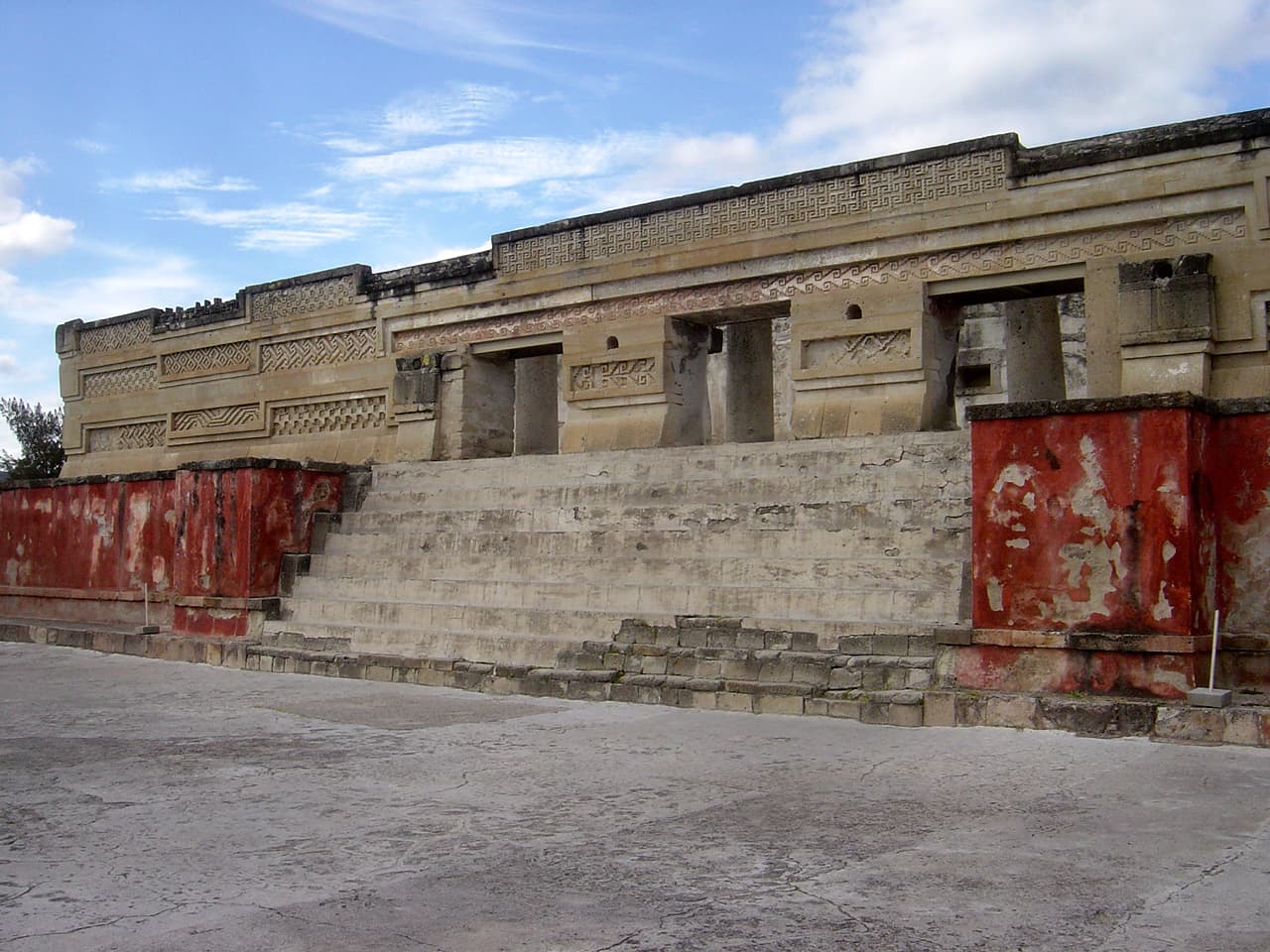 Uploaded into English Wikipedia by en:User:Bobak Ha'Eri / CC BY 2.0, via Wikimedia Commons
Self-guided audio walking tour of Mitla — GPS route, offline playback, story-driven narration in 32 languages.
“Where intricate stone patterns form a language of the underworld, Mitla offers a profound journey into Zapotec spirituality.”
Not the postcards. The stories even locals don't know — whispered in your ear, right where they happened.
For centuries, local stories spoke of a subterranean world beneath Mitla's colonial church. Scientists recently confirmed these legends, revealing a vast complex.
The elaborate geometric patterns gracing Mitla's buildings are more than mere decoration; they may constitute a language carved in stone.
A column at Mitla is said to reveal how many years remain in one's life.
Discover every secret of Mitla
Every address, every reveal in full — in your ear, right where it happened.
You pick your stops. You walk. The voice reveals what the others miss.


Your self-guided audio tour of Mitla is ready — pick your landmarks, choose your language, and start the moment you arrive.
BuyLume has a built-in augmented-reality guide. Hold your phone up and its camera shows the street ahead of you, with a glowing arrow laid over the real view that always points to your next stop — no map to puzzle over, no wrong turns. Like everything in Lume, it works fully offline.
Mitla, known as the 'Place of the Dead' in Nahuatl and 'Lyobaa' or 'place of rest' in Zapotec, is a profoundly spiritual archaeological site in the Tlacolula Valley of Oaxaca, Mexico. Unlike the towering pyramids of other Mesoamerican cities, Mitla distinguishes itself with intricate geometric mosaics and subterranean structures, reflecting its primary role as a sacred religious and funerary center rather than a political one.
This ancient Zapotec settlement, later influenced by the Mixtec, flourished between 900–1500 CE, becoming the most important religious hub in the Valley of Oaxaca after the decline of Monte Albán. Today, the archaeological ruins are interwoven with the modern town of San Pablo Villa de Mitla, offering visitors a unique glimpse into both ancient beliefs and contemporary Zapotec culture.
Mitla's captivating architecture, particularly its precise stone fretwork assembled without mortar, stands as a testament to the advanced craftsmanship of its ancient inhabitants. The site invites exploration of its various groups of buildings, including the impressive Hall of Columns, and offers a tangible connection to Mesoamerican beliefs about death and the afterlife.
## From Ancient Settlements to a Sacred Center Mitla's origins trace back to approximately 900 BCE, with early settlements established around 600 BCE. Initially a fortified village, it gradually evolved into a significant religious center for the Zapotec civilization. The site's main period of occupation and development, however, occurred between 900 and 1500 CE, during the Late Classic and Postclassic periods.
Following the decline of Monte Albán, Mitla ascended in prominence, becoming the spiritual capital of the Zapotec empire. Around 1000 AD, the Mixtec people migrated into the area and exerted influence, contributing to the unique architectural and cultural syncretism visible at the site. Mitla was revered as a sacred burial ground for high-ranking Zapotec nobility, with subterranean tombs believed to house priests and rulers.
The city was still thriving and expanding when the Spanish arrived in the 1520s. Driven by religious zeal, the Spanish brutally destroyed much of the ancient city, using its stones to construct colonial buildings, most notably the Church of San Pablo, which was built directly atop a Zapotec temple. Despite this destruction, Mitla remains one of the best-preserved examples of Zapotec mosaic stonework in Mesoamerica.
Recent archaeological discoveries have further illuminated Mitla's profound past. In 2023, non-invasive technologies confirmed the existence of Lyobaa, a vast subterranean complex of chambers and passageways beneath the Church of San Pablo, long believed to be the Zapotec underworld. This validation of indigenous oral traditions underscores Mitla's enduring spiritual significance and its role as a passage between the world of the living and the dead.
Mitla's archaeological zone is divided into five main groups: the Church Group, the Adobe Group, the Arroyo Group, the South Group, and the Columns Group. The Columns Group, also known as the Palace group, is a highlight, featuring a series of palace buildings adorned with the site's signature geometric mosaics. Do not miss the Hall of Columns and the Patio of Mosaics within this group, showcasing the intricate fretwork.
The Church Group is notable for the Church of San Pablo, a 16th-century colonial church built directly over a pre-Hispanic temple, offering a striking juxtaposition of indigenous and colonial architecture. Beneath this church, recent discoveries have confirmed the existence of Lyobaa, the ancient Zapotec underworld, adding a layer of intrigue to the site.
Explore the underground tombs found in various sections, particularly those reached by descending from the Patio of Tombs, which once held ritual burial rooms for high priests. While signage at the site can be minimal, taking a guided tour can provide valuable historical context. Beyond the ruins, the modern town of San Pablo Villa de Mitla offers a lively market with local crafts and textiles, and opportunities to sample traditional Oaxacan cuisine and mezcal.
The ideal time to visit Mitla for comfortable exploration is during the dry season, from November to April. Temperatures during these months are mild, ranging from an average low of 46°F (8°C) in January to an average high of 83°F (28°C) in April, with minimal rainfall and clearer skies. Visiting early in the morning or late afternoon helps avoid the midday heat and larger tour groups. The rainy season, from May to September, brings heavier showers, making outdoor visits less pleasant.
Mitla is located approximately 27 miles (45 km) southeast of Oaxaca City and is easily accessible. You can reach Mitla by public bus or colectivo (shared taxi) from Oaxaca City, with buses departing frequently. The journey takes about 45 minutes to an hour and 20 minutes, depending on the mode of transport. Private taxis are also available for a more direct and flexible trip.
The Mitla archaeological site is open daily from 8:00 AM to 5:00 PM, with the last entrance at 4:30 PM. The entrance fee is around MXN $100-105 (approximately USD $5-6). It is advisable to bring cash for local vendors and eateries, as ATMs can be limited. Wear comfortable walking shoes, light clothing, a hat, and bring plenty of water, as it can get warm. Consider hiring a local guide at the site for deeper historical context, as signage can be minimal.
Mitla in Korean, in Chinese or in Hebrew — and 29 more languages, every stop narrated by a native voice. The widest language range of any self-guided audio tour.
Available in: