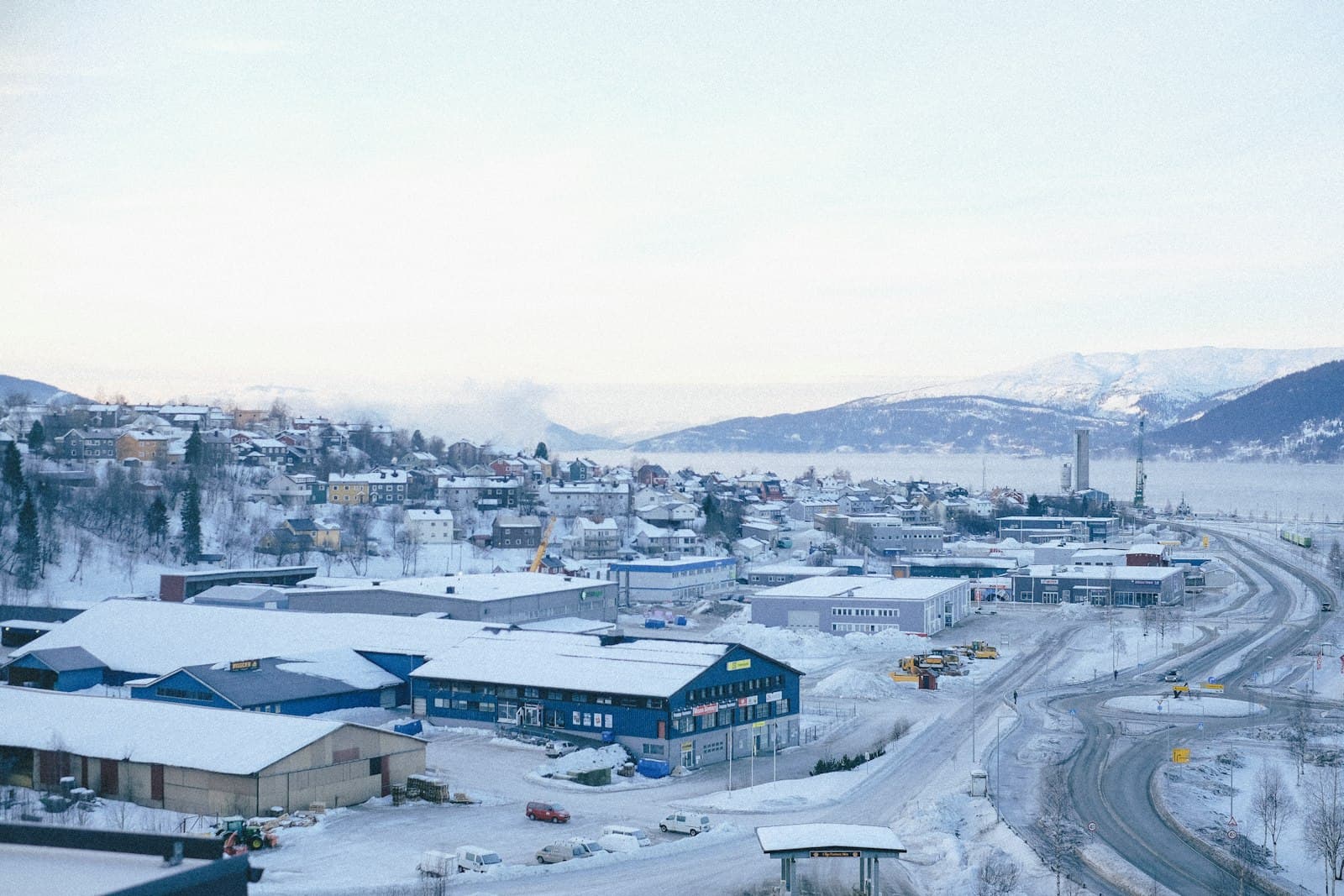
Imagine a library so crucial it safeguards every piece of media published in an entire nation. Now, picture it not in the capital, but in a quiet Arctic town.
HelgelandFakta / CC BY-SA 4.0, via Wikimedia CommonsMo i Rana
Self-guided audio walking tour of Mo i Rana — GPS route, offline playback, story-driven narration in 32 languages.
“Where industry's pulse meets the Arctic's expanse, and quiet wonders lie beneath the surface.”
Mo i Rana, as no one tells it.
Not the postcards. The stories even locals don't know — whispered in your ear, right where they happened.
Mo i Rana is known as Norway's 'Cave Capital,' yet its subterranean marvels invite exploration in distinctly different ways.
A striking figure emerges from the Ranfjord, a silent observer watching over Mo i Rana. This is no ancient myth, but a modern marvel.
Discover every secret of Mo i Rana
Every address, every reveal in full — in your ear, right where it happened.
You pick your stops. You walk. The voice reveals what the others miss.
How long do you have in Mo i Rana?
Your self-guided audio tour of Mo i Rana is ready — pick your landmarks, choose your language, and start the moment you arrive.
BuyThe story of Mo i Rana
Mo i Rana, often referred to as the "Arctic Circle City," is an active urban center positioned at the head of the Ranfjord in Norway's Nordland county. Despite its location just south of the Arctic Circle, it harmonizes modern conveniences with immediate access to a dramatic, untouched wilderness of fjords, mountains, and glaciers. The city serves as a significant cultural and commercial focal point in the Helgeland region, offering a singular combination of cultural activities, shopping, and diverse dining experiences.
Life in Mo i Rana unfolds at a more measured pace than in larger Norwegian cities, yet it remains deeply connected to its industrial heritage. The city has undergone a remarkable transformation from a modest trading post to a major industrial force, now increasingly focusing on sustainability and technological innovation. Visitors can explore a compact city center on foot, where local buses connect to nearby attractions, or venture further afield to discover the region's natural wonders.
From Trading Post to Industrial Powerhouse
The story of Mo i Rana stretches back to ancient times, with the lands inhabited by both the Sami people and Norwegian farmers. The city's name derives from the Old Norse word "Móar," referring to a sandy plain or the name of the Mo farm, and the Rana region, likely connected to the swift waters of the Ranfjord. The official beginning of the settlement's development as a commercial center can be traced to 1730, when a trading post was established. This post became a central point for the entire region, fostering trade between fishermen, farmers, and the Sami people at events like the Tiendebytte fair.
Traditional trades, including skilled shipbuilding, sustained the local economy before the arrival of large-scale industrialization. The discovery of iron ore and other mineral deposits, such as sulfur, copper, zinc, and silver-bearing lead ore, in the late 19th century, particularly by Ole Tobias Olsen in Dunderland in 1879, prepared the ground for the region's industrial future. The establishment of the Dunderland Iron Ore Company in 1902 marked the initial step toward significant industrial growth.
The most dramatic shift occurred after World War II. In 1946, the Norwegian Parliament decided to construct a state-owned ironworks, Norsk Jernverk, in Mo i Rana. This strategic move aimed to make Norway self-sufficient in steel production and stimulate regional employment. The ironworks began production in 1955, transforming Mo i Rana into one of northern Norway's major industrial centers. The industrial expansion led to a rapid population increase, with workers from across Norway and beyond moving to the city, quadrupling its population and shaping its multicultural identity.
In the late 1980s, the steelworks underwent restructuring, leading to the creation of Mo Industripark, one of Norway's largest industrial parks. Today, while heavy industry remains vital, Mo i Rana has diversified, focusing on sustainability, renewable energy, and technological innovation. The city also gained official city status in 1997, solidifying its role as a key regional center. The opening of a branch of the National Library of Norway in 1990, housing copies of all published Norwegian materials, further cemented Mo i Rana's importance beyond its industrial roots.
Mo i Rana offers a compelling blend of natural wonders and cultural attractions. Begin by experiencing the iconic Havmannen (Man from the Sea), a granite sculpture rising from the Ranfjord, best viewed from the waterfront promenade. Delve into the subterranean world by exploring the region's renowned caves. Grønligrotta provides accessible, well-lit paths for all ages, while the more adventurous Setergrotta offers a raw, natural caving experience requiring a guide and specialized equipment.
For a dose of history and science, visit the Rana Museum, which chronicles the industrial, cultural, and Sami heritage of the Helgeland region. Next door, the Vitensenter Nordland (Science Centre) offers interactive exhibits on technology, energy, and northern Norwegian phenomena, appealing to both children and adults. Do not overlook the Mo Church (Mo kirke), the city's oldest building, a beautiful wooden structure dating back to 1724.
Beyond the city, the majestic Svartisen glacier, Norway's second-largest, offers dramatic landscapes and hiking opportunities. Information on trails and access can be obtained from the local tourist office. For a singular Arctic experience, head north on the E6 to the Arctic Circle Center, where you can send postcards with a special Arctic Circle postmark.
The ideal time to visit Mo i Rana depends on your desired activities. For warm-weather pursuits and the Midnight Sun, plan your trip between June and August. July is typically the warmest month, with average highs around 18°C (64°F). During this period, you can enjoy hiking, cycling, and kayaking. For those seeking Northern Lights and winter sports, the optimal viewing season extends from September through March, with September being statistically the best month due to high activity rates and increasing darkness. Winter temperatures can drop significantly, reaching as low as -30°C (-22°F), making it ideal for cross-country skiing and snowmobiling. Be prepared for frequent precipitation year-round, whether it is summer rain or winter snow.
Mo i Rana's city center is compact and easily explored on foot. Local buses provide connections to residential areas, shopping centers, and nearby attractions. For exploring the wider wilderness areas like Svartisen and Saltfjellet, renting a car is advisable. Taxis are also available, with a stand at the train station and booking via phone or the Taxifix-app.
Mo i Rana Airport, Røssvoll (MQN) offers regional flights connecting to larger Norwegian cities. A new airport, Arctic Circle Airport, is also under development. The city is a stop on the scenic Nordland Line railway, connecting Trondheim and Bodø, which is a popular way to experience the Norwegian landscape. The E6 highway provides car access from both northern and southern Norway, and the E12 route connects to Sweden.
As the commercial center of Helgeland, Mo i Rana offers extensive shopping opportunities in large indoor malls and smaller independent stores. Local cuisine heavily features fresh seafood and game meats like reindeer and moose, with traditional Sami flavors.
- What is Mo i Rana most known for?
- Mo i Rana is most known for its industrial heritage, particularly its post-WWII ironworks, and its distinct natural surroundings, including its reputation as the "Cave Capital of Norway" and its proximity to the Arctic Circle and the Svartisen glacier.
- How do I reach Mo i Rana?
- Mo i Rana can be reached by plane via Mo i Rana Airport (MQN), by train on the Nordland Line from Trondheim or Bodø, or by car along the E6 or E12 highways.
- What are the primary attractions in Mo i Rana?
- Key attractions include the Havmannen sculpture, the Grønligrotta and Setergrotta caves, Rana Museum, Vitensenter Nordland (Science Centre), and the nearby Svartisen glacier.
- When is the best time to see the Northern Lights in Mo i Rana?
- The optimal viewing season for the Northern Lights in Mo i Rana is from September through March, with September being statistically the best month due to high aurora activity and increasing darkness.
- What is the local food like in Mo i Rana?
- Local food in Mo i Rana emphasizes fresh seafood such as cod, coalfish, and halibut, along with game meats like reindeer and moose, often served with lingonberries. Kamkaka is a regional specialty.
- Is Mo i Rana suitable for families?
- Yes, Mo i Rana is considered a family-friendly destination, offering attractions like the Vitensenter Nordland (Science Centre), a climbing park, a water park, and accessible caves like Grønligrotta.