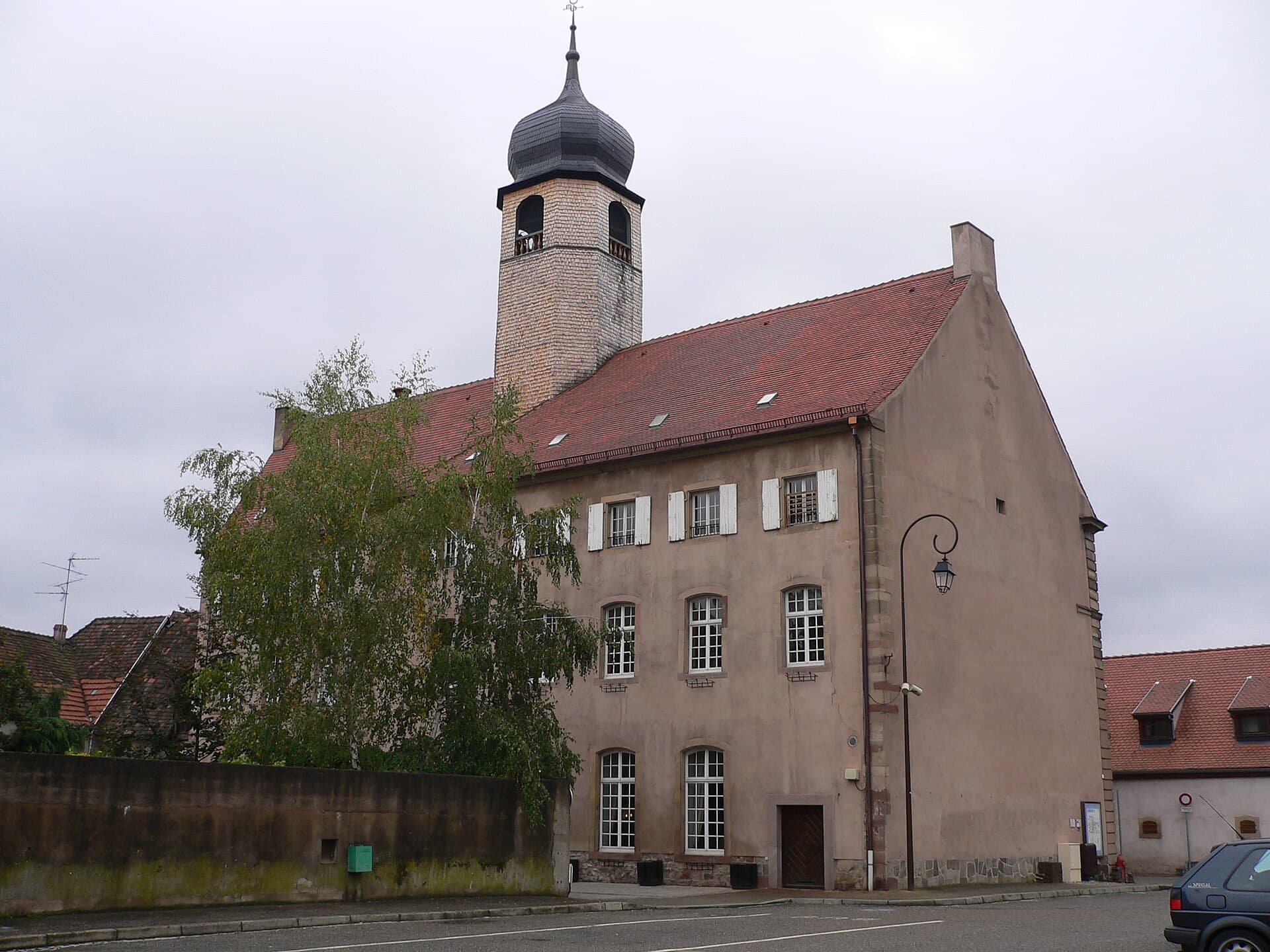
The Town Hall's Belfry
Observe the Town Hall's belfry closely, and you might glimpse a peculiar local resident.
Full story unlocks in the tour
 Lybil / CC BY-SA 4.0, via Wikimedia Commons
Self-guided audio walking tour of Mutzig — GPS route, offline playback, story-driven narration in 32 languages.
“Where Alsatian ingenuity, industry, and history converge.”
Not the postcards. The stories even locals don't know — whispered in your ear, right where they happened.
Observe the Town Hall's belfry closely, and you might glimpse a peculiar local resident.
The celebrated Mutzig beer, once crafted here, has a surprising second life far from Alsace.
This formidable fortress, an early 20th-century engineering marvel, served as a prototype for a much larger, more renowned defensive line.
Discover every secret of Mutzig
Every address, every reveal in full — in your ear, right where it happened.
You pick your stops. You walk. The voice reveals what the others miss.


Lume has a built-in augmented-reality guide. Hold your phone up and its camera shows the street ahead of you, with a glowing arrow laid over the real view that always points to your next stop — no map to puzzle over, no wrong turns. Like everything in Lume, it works fully offline.
Situated at the entrance of the Bruche river valley in France's Bas-Rhin department, Mutzig is a commune that offers a compelling blend of Alsatian character and substantial historical depth. Positioned on the Alsace Wine Route, it serves as a gateway to both scenic vineyards and a past shaped by strategic importance and industrial innovation.
Mutzig's landscape is defined by its location within the Grand Est region, providing a backdrop of gentle hills and the calm flow of the Bruche. The town itself, while charming, carries echoes of a powerful past, from medieval fortifications to a pioneering industrial spirit. It is a place where the tranquility of a French commune meets the tangible remnants of European history.
## From Medieval Stronghold to Industrial Hub Mutzig's origins trace back to the 10th century, first appearing in historical records then. In 1308, it became part of the Prince-Bishopric of Strasbourg, solidifying its early importance in the region.
### The Ascendance of Rohan and the Age of Firearms The 18th century marked a period of prominence for Mutzig's Rohan Castle, which served as the episcopal residence for four Cardinals of Rohan. However, the castle's destiny shifted dramatically with the French Revolution, leading to its pillaging and eventual sale in 1799 to the Coulaux brothers. These arms manufacturers established a significant firearms factory on the castle grounds, where the celebrated Chassepot rifle, conceived by Mutzig native Antoine Alphonse Chassepot, was manufactured. This industrial venture solidified Mutzig's role as a center of innovation in the 19th century.
### German Influence and a Fortified Legacy The late 19th century brought a new chapter under German rule. Following the annexation of Alsace by the German Reich in 1871, Kaiser Wilhelm II ordered the construction of the Feste Kaiser Wilhelm II, now known as Fort de Mutzig, in 1893. This massive military installation, built to defend Strasbourg against potential French incursions, was a groundbreaking project. It was among the first fortifications to be constructed with concrete and equipped with electricity, setting a precedent for future defensive structures like the Maginot Line. The fort, sprawling over 250 hectares and designed to house 7,000 soldiers, represented the apex of military engineering at the time.
### Brewing Heritage Beyond its military and industrial past, Mutzig is also recognized for its brewing heritage. The Brasserie Mutzig, founded by Antoine Wagner in 1810, produced a popular Pilsner-style lager that became a regional favorite. Although the original brewery closed in 1989 after being acquired by Heineken, the Mutzig name persists as a prominent beer brand in Africa. The old brewery building, acquired by the city in 1992 and designated a historical monument in 2001, was renovated in 2009 and now functions as a business incubator.
Begin your exploration at the 14th-century Untertor (Strasbourg Gate), a remnant of medieval fortifications, observing its 16th-century gunports and oriel window. Nearby, the Lavoirs Passage offers a glimpse of small houses leaning against the old town wall.
Visit the Château des Rohan, a Baroque structure that served as an episcopal residence and later housed a firearms factory. Today, it contains a cinema, library, and the municipal museum, displaying a collection of historic rifles.
Discover the oldest synagogue in Alsace, dating back to 1787, situated in an inner courtyard off Rue du 18 Novembre 1918, a testament to Mutzig's once considerable Jewish community. The imposing neo-Gothic Saint Maurice Church, constructed in 1879, features a 72-meter tower, the tallest steeple in the Bruche Valley.
Do not overlook the Town Hall, a classical-style building from 1742, topped with a distinctive onion-shaped tower and an automaton that wiggles its ears and extends its tongue on the hour. The town's central fountain, with a basin from 1911 and a column from 1667, also merits attention. For a deeper immersion into military history, the Fort de Mutzig (Feste Kaiser Wilhelm II), a sprawling 254-hectare fortification, offers guided tours through its engine room, dormitories, kitchens, and firing points, providing sweeping views of the Bruche Valley.
The most favorable time to visit Mutzig for agreeable weather and outdoor pursuits is from mid-June to early September, with a peak in the first week of August. During these months, the weather is warm and suitable for exploring the town and its environs. The shoulder seasons of late spring (May-June) and early fall (September-mid-October) also offer mild weather, verdant landscapes, and fewer crowds, making them ideal for wine tasting and village hopping along the Alsace Wine Route.
Mutzig is located approximately 30 kilometers from Strasbourg, making it accessible for day trips or extended stays. While Mutzig has a train station, the nearby town of Molsheim, about 3 kilometers away, also offers train connections. The Molsheim-Mutzig Tourist Office can assist with guided tours, accommodation reservations, and provide maps and information on local attractions.
For accommodation, Mutzig offers choices such as the Hôtel L'Ours De Mutzig, situated near the City Hall, with some rooms in Alsatian style and an outdoor pool. Other nearby options include aparthotels with kitchenettes. Public parking, restrooms, and picnic areas are available in the region. Many local businesses accept credit cards, checks, and cash.
Mutzig in Korean, in Chinese or in Hebrew — and 29 more languages, every stop narrated by a native voice. The widest language range of any self-guided audio tour.
Available in: