German Leather Museum
Offenbach once stood as a global center for a particular craft, and its dedicated museum holds an astonishingly varied collection.
Full story unlocks in the tour
 Adrianflamind / CC BY-SA 4.0, via Wikimedia Commons
Self-guided audio walking tour of Offenbach — GPS route, offline playback, story-driven narration in 32 languages.
“Beyond Frankfurt's reach, a city unfolds with unexpected histories and a lively contemporary pulse.”
Not the postcards. The stories even locals don't know — whispered in your ear, right where they happened.
Offenbach once stood as a global center for a particular craft, and its dedicated museum holds an astonishingly varied collection.
This Renaissance palace, now a university, once hosted pivotal discussions that shaped the course of European history.
A grand 18th-century manor, the Büsing Palais, shares a surprising connection to one of Germany's most celebrated literary figures.
Discover every secret of Offenbach
Every address, every reveal in full — in your ear, right where it happened.
You pick your stops. You walk. The voice reveals what the others miss.


Your self-guided audio tour of Offenbach is ready — pick your landmarks, choose your language, and start the moment you arrive.
BuyLume has a built-in augmented-reality guide. Hold your phone up and its camera shows the street ahead of you, with a glowing arrow laid over the real view that always points to your next stop — no map to puzzle over, no wrong turns. Like everything in Lume, it works fully offline.
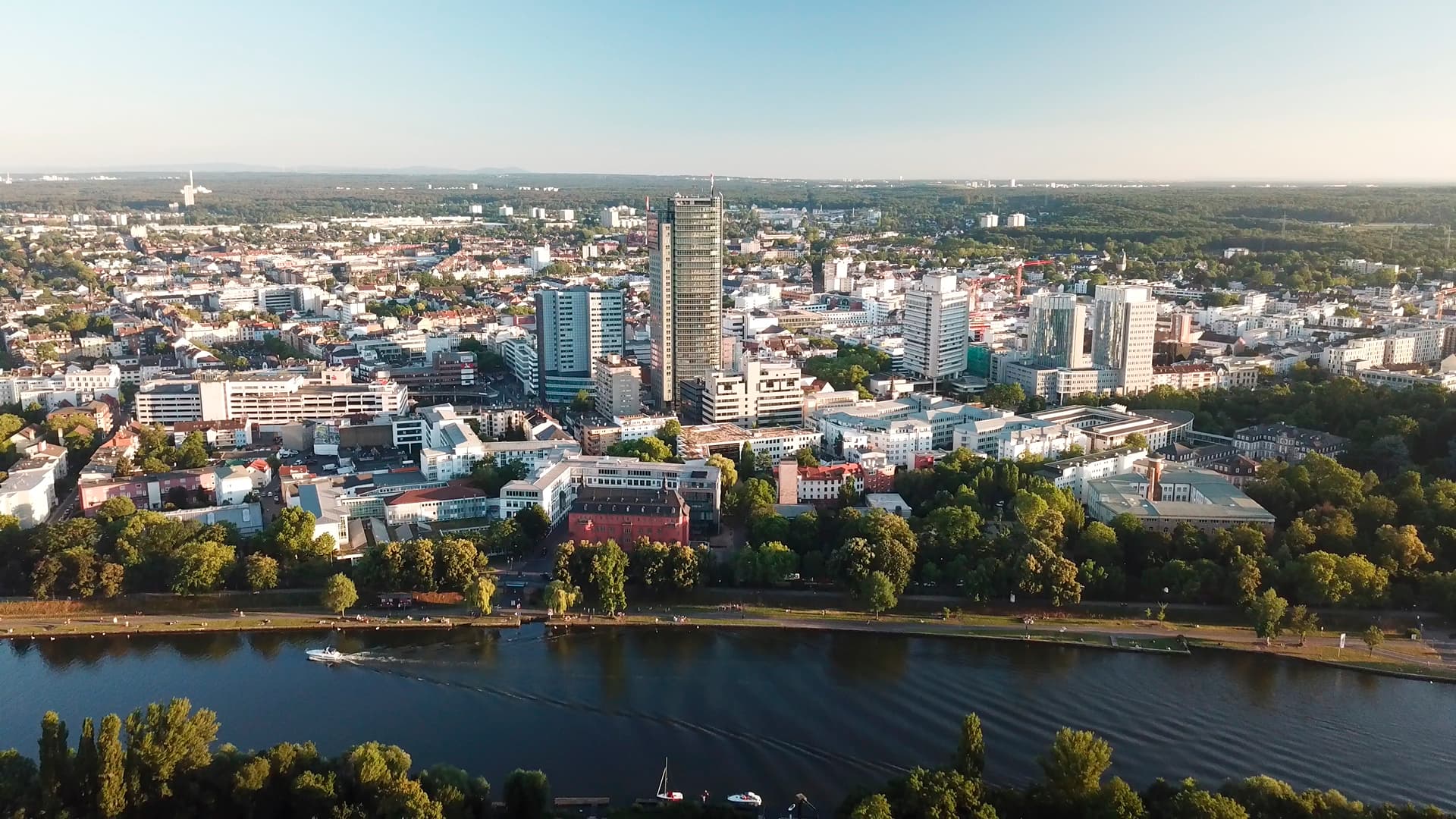
Offenbach am Main, often perceived in the shadow of its larger neighbor Frankfurt, possesses a distinct character and a compelling narrative. Situated on the left bank of the Main River, it once stood as an industrial powerhouse, particularly celebrated for its leather production and typography. Today, it emerges as Germany's most multicultural city, a dynamic center where historical elegance converges with a lively, diverse community.
Those who visit Offenbach will discover a city that has gracefully embraced its past while looking firmly toward the future. From Renaissance palaces to specialized museums, and from tranquil riverside paths to bustling markets, Offenbach offers a singular blend of cultural, historical, and contemporary experiences. Its accessibility, just a short distance from Frankfurt Airport and central station, makes it an ideal destination for those seeking an authentic German experience beyond the well-trodden tourist paths.
## From Imperial Forest to Industrial Hub Offenbach's origins can be traced back to 977, when it was first mentioned in a document by Holy Roman Emperor Otto II. Before that, a suburb of Offenbach was referenced as early as 770. For centuries, it was part of the imperial forest of Dreieich, and a mint was established here in 1407.
In 1486, the city was acquired by the Count (later Prince) von Isenburg-Birstein, marking a significant turn in its development. The true catalyst for Offenbach's prosperity, however, came at the turn of the 18th century. Between 1698 and 1703, an influx of Huguenot craftsmen, French Protestant refugees, settled in Offenbach. They brought with them advanced craftsmanship and industrial techniques, including knowledge of tobacco, which helped transform Offenbach into a center for cigar rolling and a diverse range of other industries like wool manufacturing, silk weaving, and tanning.
## The Rise of Leather and Typography The 19th and early 20th centuries saw Offenbach flourish as a leading industrial city. It gained a worldwide reputation as a hub for the leather goods industry, earning it the nickname 'leather capital of Germany.' This legacy is proudly preserved at the German Leather Museum. Beyond leather, Offenbach also became a European center for typography and design. Pioneering companies like Gebr. Klingspor and Linotype (inventors of typefaces such as Optima and Palatino) had strong ties to the city, a heritage celebrated today at the Klingspor Museum.
## Wartime Devastation and Modern Rebirth Offenbach suffered heavy damage during World War II. However, many of its historic palaces and manors remarkably escaped largely unscathed and have since been restored, now housing museums and cultural institutions. After the war, the city was rebuilt, with new structures including the city hall and several federal offices.
In the latter half of the 20th century, while still maintaining its industrial base in machinery and electrical products, Offenbach began a shift towards a service-oriented economy, with a growing cluster of creative agencies and design firms. Today, Offenbach is recognized for its dynamic, multicultural population, with a significant percentage of its residents having a migration background, contributing to a diverse and lively urban atmosphere.
Offenbach offers a compelling array of sights, blending its industrial heritage with elegant architecture and green spaces. Begin at the German Leather Museum (Deutsches Ledermuseum), a world-class institution showcasing leather artifacts spanning millennia and continents, a testament to the city's historical dominance in the industry. Nearby, the Klingspor Museum delves into the art of typography and book design, highlighting Offenbach's significant contributions to the printing world.
Architectural enthusiasts will appreciate the Isenburg Palace (Isenburger Schloss), a 16th-century Renaissance castle now home to the Hochschule für Gestaltung design university. The magnificent Büsing Palais, an 18th-century neo-Baroque mansion set within a public park, is another architectural marvel. For a more serene experience, wander through the Alter Friedhof (Old Cemetery), a listed monument with historic memorials and an impressive alley of plane trees.
The Mainufer (Main Embankment) provides a scenic riverside path ideal for walking and cycling, often hosting festivals and a popular flea market. Families might enjoy the Wetterpark Offenbach, a unique weather-themed park run by the German Weather Service. For a glimpse into the city's broader past, the Haus der Stadtgeschichte (House of City History) displays a Celtic prince's wagon burial and other artifacts.
The most pleasant time to visit Offenbach is from May through September, when the weather is generally mild and ideal for exploring. During these months, average daytime temperatures range from 20°C (68°F) to 26°C (79°F), offering comfortable conditions for outdoor activities and enjoying the city's parks and riverside. July is typically the sunniest month, with approximately 7.8 hours of sunshine daily. For those seeking fewer crowds and potentially better value, the quieter months from November to February offer cooler temperatures, though they are generally considered less favorable due to colder conditions and less sunshine.
Offenbach is easily accessible, particularly due to its proximity to Frankfurt. Frankfurt International Airport (FRA) is only a 20-minute drive or a 30-minute subway ride away. Frankfurt's central station is just a 15-minute S-Bahn ride from Offenbach's Marktplatz, the city's main hub.
Within Offenbach, the city center is largely walkable. For longer distances, an extensive public transport system of S-Bahn (suburban trains) and buses makes navigation seamless. S-Bahn lines S1, S2, S8, and S9 connect Offenbach to Frankfurt city center, Frankfurt Airport, and Wiesbaden. Day or weekly transit passes are available at ticket machines or via mobile apps. For eco-friendly travel, the city is bike-friendly, with rental stations near the waterfront.
The official currency is the Euro (€). While credit cards are widely accepted, it's advisable to carry some cash for smaller purchases. When using ATMs, always choose to be charged in Euros to avoid unfavorable exchange rates.
Offenbach in Korean, in Chinese or in Hebrew — and 29 more languages, every stop narrated by a native voice. The widest language range of any self-guided audio tour.
Available in: