The Church of Saints Peter and Paul
Look closely at the capitals inside the Church of Saints Peter and Paul, and you'll find something truly unique.
Full story unlocks in the tour
 Drew de F Fawkes / CC BY 2.0, via Wikimedia Commons
Self-guided audio walking tour of Rosheim — GPS route, offline playback, story-driven narration in 32 languages.
“Where Romanesque stone tells a thousand years of stories.”
Not the postcards. The stories even locals don't know — whispered in your ear, right where they happened.
Look closely at the capitals inside the Church of Saints Peter and Paul, and you'll find something truly unique.
This ancient stone house, built in 1154, holds a secret in its very name, hinting at theories about its origins.
In 1525, when marauding peasants threatened to pillage Rosheim, the town's Jewish community was spared through an unexpected negotiation.
Discover every secret of Rosheim
Every address, every reveal in full — in your ear, right where it happened.
You pick your stops. You walk. The voice reveals what the others miss.


Your self-guided audio tour of Rosheim is ready — pick your landmarks, choose your language, and start the moment you arrive.
BuyLume has a built-in augmented-reality guide. Hold your phone up and its camera shows the street ahead of you, with a glowing arrow laid over the real view that always points to your next stop — no map to puzzle over, no wrong turns. Like everything in Lume, it works fully offline.
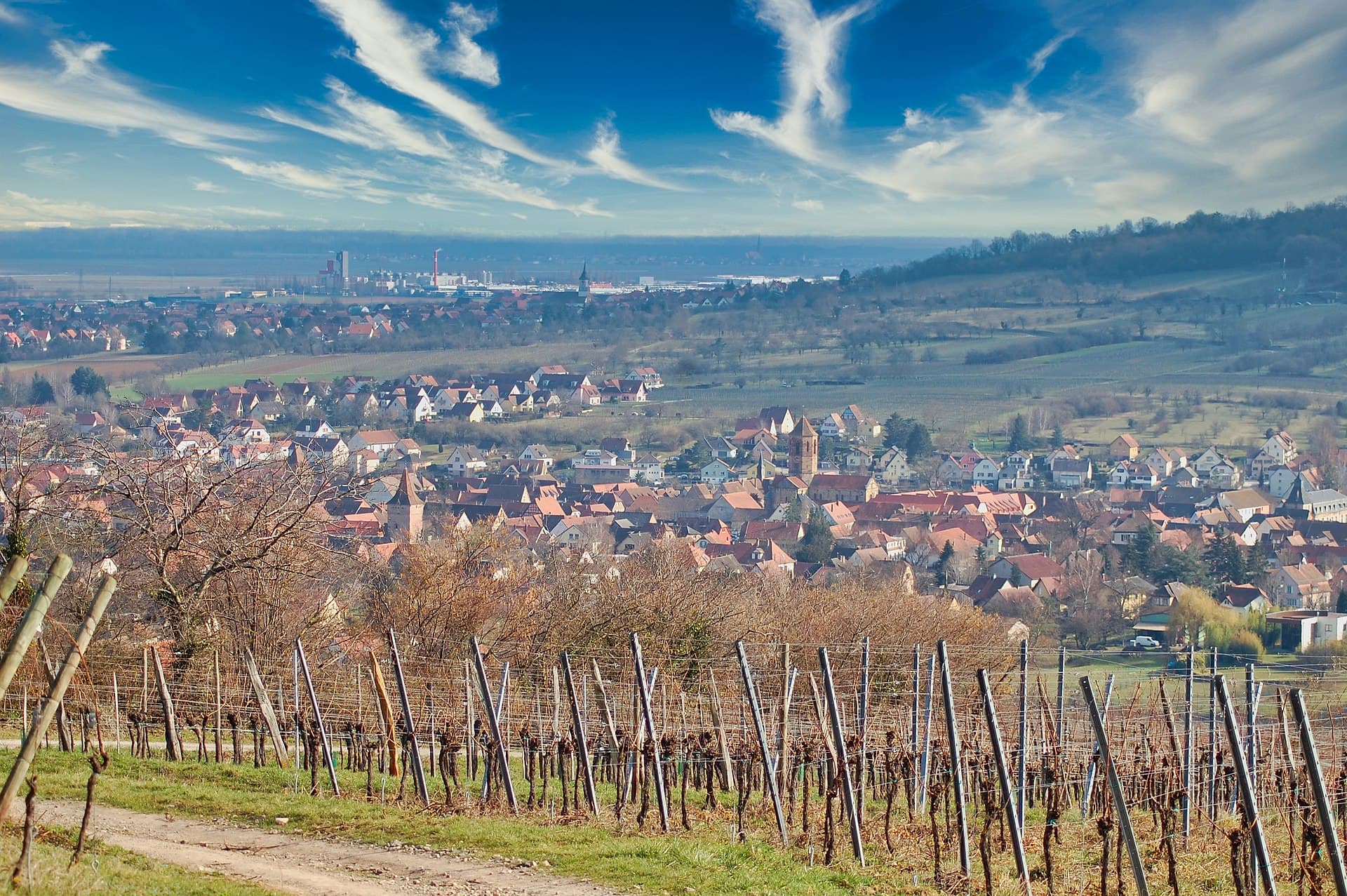
Rosheim, a captivating town in France's Bas-Rhin department, rests at the foot of Mont Saint-Odile, along both the Alsace Wine Route and the Romanesque Road. With a chronology stretching back thousands of years, the village as it is known today was established in the 8th century. Rosheim is particularly recognized for its well-preserved Romanesque architecture, earning it the designation "Romanesque city."
This town offers a quieter, more authentic Alsatian experience, away from the more crowded tourist destinations. Its compact town center is easily explored on foot, revealing a wealth of historical buildings and quaint streets. Rosheim's deep architectural heritage provides a tangible link to its past, inviting visitors to step back in time.
Beyond its historical appeal, Rosheim is a winegrowing center, offering opportunities to experience the local viticulture. It serves as an excellent base for exploring the surrounding region, including other picturesque villages, vineyards, and natural landscapes.
Rosheim's origins trace back to a continuous human presence spanning several millennia, with archaeological remains attesting to Neolithic, Bronze Age, and Iron Age settlements, as well as Gallo-Roman civilization. The town was first officially mentioned in a document from 778 as "Rodasheim."
In 1132, the early church in Rosheim was destroyed by fire during a conflict between Hohenstaufen forces and the Bishop of Strasbourg. The town was subsequently rebuilt thanks to generous donations from the future emperors of the Holy Roman Empire, the Hohenstaufen. Rosheim gained its town charter in 1262, which included the right to construct a town wall. By the early 14th century, it had become a free imperial city.
In 1354, Rosheim became a founding member of the Décapole, a confederation of ten Alsatian imperial cities formed to protect their rights and maintain independence within the Holy Roman Empire. This alliance lasted until the late 17th century. However, the Thirty Years' War brought significant devastation, with the town being pillaged and ravaged by various armies. Rosheim gradually lost its independence and was eventually annexed by France through the Peace of Westphalia in 1648 and the Treaties of Nijmegen in 1679.
Despite these hardships, Rosheim experienced a period of remarkable expansion in the 18th century, though the French Revolution of 1789 brought an end to its remaining privileges. The town saw considerable development during the Second Empire, with its population reaching nearly 4,000 inhabitants. Today, Rosheim continues to embrace modernization while honoring its profound historical legacy.
Rosheim is a deep trove of Romanesque architecture. The Church of Saints Peter and Paul, constructed in the mid-12th century from yellow sandstone, is considered a prime example of Alsatian Romanesque art. Its exterior features twisted columns, Lombardy bands, and intricate friezes, while inside, you'll find rib-vaulted bays and unique capitals, including one adorned with 21 distinct human faces.
Another significant site is the Romanesque House, also known as the Pagan House, dating back to 1154. This pink sandstone edifice is one of Alsace's oldest civil buildings, showcasing remarkable medieval urban architecture.
As you explore, you'll encounter remnants of Rosheim's medieval fortifications, including four monumental gates that were once part of the old ramparts. The Porte de l'Horloge (Clock Tower) and the Porte de la Vierge (Virgin Gate) are particularly impressive. Do not miss the Renaissance well with six buckets and the charming Town Hall, built in the mid-18th century. For a peaceful interlude, visit the medieval garden, filled with domestic and wild plants. The former synagogue, built in 1884 in a Neo-Romanesque style, is also worth seeing, though its interior has been converted into guest rooms.
The ideal time to visit Rosheim for pleasant weather and outdoor activities is from mid-June to mid-September. During this period, the weather is warm, and the vineyards are lush and green. Early autumn, from September through mid-October, also offers mild, sunny weather and bright autumn colors in the vineyards, with fewer crowds than the peak summer season. While winter is cold, Rosheim's Christmas market in December offers a festive atmosphere.
Rosheim is easily accessible by car, located approximately 20 kilometers from Strasbourg. The town center is compact and best explored on foot. For detailed information and maps, the Rosheim tourist office is a valuable resource. Guided tours of the town and specific buildings like the Romanesque church and house are available. If you're looking for local specialties, try the Ropfkueche, a brioche topped with nuts, cinnamon, and cream. The Boulangerie Rohmer is noted as the oldest bakery in France, dating back to 1602.
Rosheim offers a tranquil atmosphere, making it a good option if you prefer to avoid large crowds. It can be visited as part of a larger trip to the Alsace region, combined with nearby towns like Obernai or a bike ride on the greenway to Saint-Nabor.
Rosheim in Korean, in Chinese or in Hebrew — and 29 more languages, every stop narrated by a native voice. The widest language range of any self-guided audio tour.
Available in: