The Palace of the Governors
This unassuming adobe building on the Plaza holds a secret about its enduring purpose.
Full story unlocks in the tour
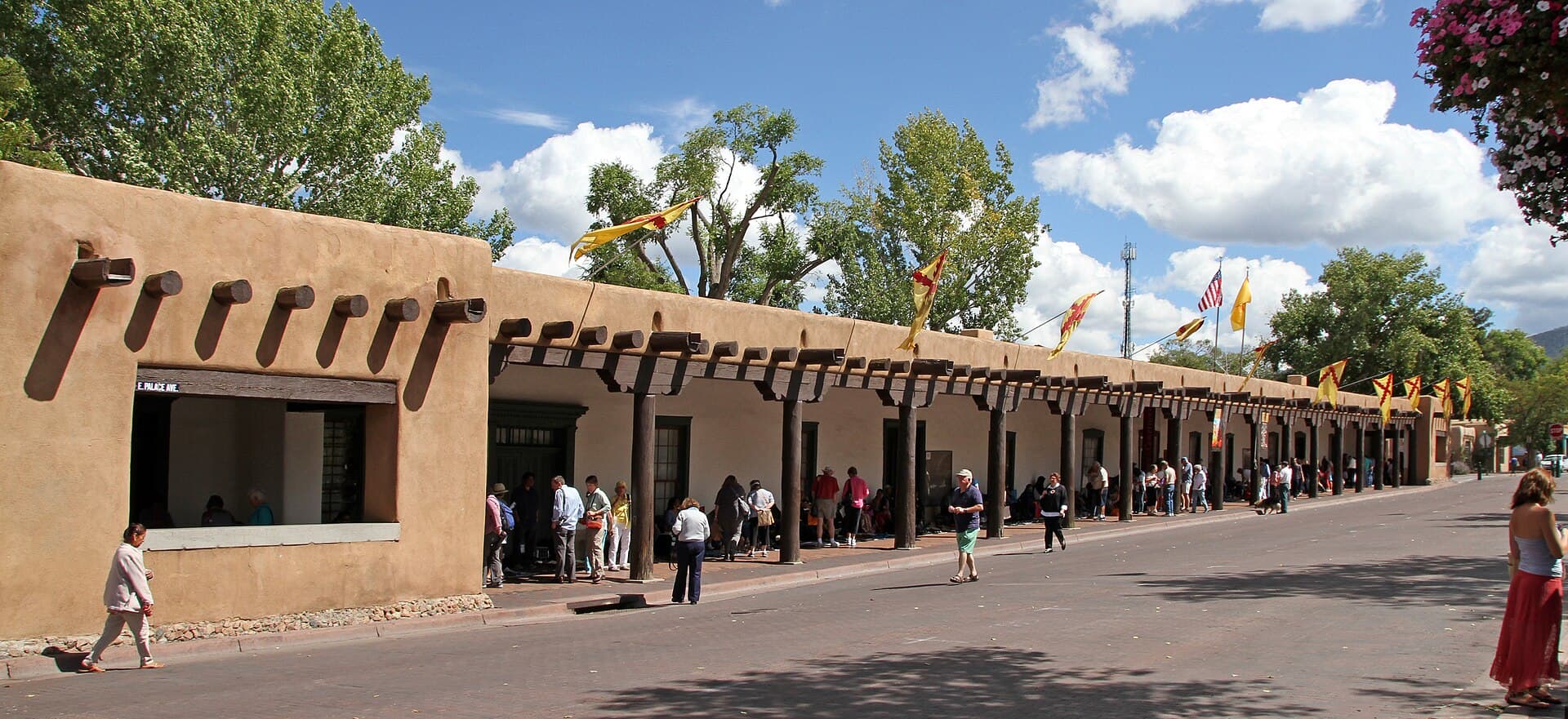 Tony Hisgett from Birmingham, UK / CC BY 2.0, via Wikimedia Commons
Self-guided audio walking tour of Santa Fe — GPS route, offline playback, story-driven narration in 32 languages.
“Where ancient traditions meet contemporary culture under a vast New Mexico sky.”
Not the postcards. The stories even locals don't know — whispered in your ear, right where they happened.
This unassuming adobe building on the Plaza holds a secret about its enduring purpose.
Inside this chapel, a mysterious staircase defies architectural logic.
When American traders first arrived in Santa Fe in the 1820s and 1830s, they were surprised by the local women.
Discover every secret of Santa Fe
Every address, every reveal in full — in your ear, right where it happened.
You pick your stops. You walk. The voice reveals what the others miss.


Your self-guided audio tour of Santa Fe is ready — pick your landmarks, choose your language, and start the moment you arrive.
BuyLume has a built-in augmented-reality guide. Hold your phone up and its camera shows the street ahead of you, with a glowing arrow laid over the real view that always points to your next stop — no map to puzzle over, no wrong turns. Like everything in Lume, it works fully offline.
Santa Fe, Spanish for 'Holy Faith,' serves as the capital city of New Mexico and stands as the oldest state capital in the United States. Established in 1610, it also marks the earliest European settlement west of the Mississippi River. Known affectionately as 'The City Different,' Santa Fe offers a distinctive fusion of Native American, Hispanic, and Anglo cultures, evident in its adobe architecture, culinary landscape, and flourishing arts. Situated at an elevation of 6,998 feet at the foothills of the Sangre de Cristo Mountains, it holds the distinction of being the highest capital city in the U.S.
The city's singular allure lies in its capacity to gracefully interweave centuries of heritage with a thriving contemporary arts and culture scene. From its historic Plaza, the very pulse of the city, to its numerous art galleries and museums, Santa Fe provides an experience both stimulating and serene. The surrounding desert and mountains offer a dramatic backdrop, inviting outdoor exploration and a deep appreciation for the high desert landscape.
The land now known as Santa Fe carries a legacy of human presence stretching back millennia. Archaeological findings indicate that ancient peoples inhabited areas southwest of the current city as early as 3000 BCE, gradually shifting from foraging to farming by 600 CE. Various Pueblo Indian villages occupied the site of present-day Santa Fe between 600 and 1425 CE, though these settlements lay uninhabited for approximately two centuries before the arrival of the Spanish.
Spanish conquistador Don Francisco Vasques de Coronado laid claim to the 'Kingdom of New Mexico' for Spain in 1540. Formal Spanish settlement commenced in 1607, and in 1610, Governor Don Pedro de Peralta established La Villa Real de la Santa Fé de San Francisco de Asís – 'The Royal Town of the Holy Faith of Saint Francis of Assisi' – as the capital of Nuevo México. This designation makes Santa Fe the oldest continuously used seat of government in North America.
Santa Fe flourished as a pivotal commercial and transportation nexus, benefiting from routes such as El Camino Real de Tierra Adentro and the Santa Fe Trail. After Mexico achieved independence from Spain in 1821, Santa Fe became the capital of the Mexican territory of Santa Fe de Nuevo México. The Santa Fe Trail, inaugurated in the 1820s, fostered lucrative trade and migration with the American frontier.
Following the Mexican-American War, New Mexico was ceded to the United States in 1848, and Santa Fe was named the capital of the U.S. Territory of New Mexico in 1851. It officially became New Mexico's state capital in 1912. The city's growth and character have been profoundly shaped by these successive Spanish, Mexican, and American periods. In the early 1940s, the establishment of the Los Alamos Scientific Laboratory, 35 miles northwest, brought new economic vitality to the region.
Begin your exploration at the Santa Fe Plaza, the historic heart of the city, encircled by shops, restaurants, and museums. Adjoining the Plaza is the Palace of the Governors, the oldest continuously occupied public building in the U.S., offering glimpses into colonial and territorial history. Along its facade, you can often find Native American artists presenting authentic crafts.
A brief walk from the Plaza, the Georgia O'Keeffe Museum displays a significant collection of the artist's work, spanning her entire career. On Old Santa Fe Trail, the Loretto Chapel is a compelling stop for its unique 'miraculous staircase,' an architectural marvel constructed without visible support. For an immersive and interactive art experience, visit Meow Wolf Santa Fe, which blends science fiction and art installations to tell a captivating narrative. Do not overlook the Cathedral Basilica of Saint Francis of Assisi, a prominent landmark with striking architecture. Santa Fe is also known for its numerous art galleries, particularly along Canyon Road, presenting a diverse array of traditional and contemporary art.
Santa Fe experiences a high desert climate with clear, sunny skies for most of the year. The most agreeable times to visit are during spring (March to May) and fall (September and October) when temperatures are mild and pleasant for outdoor activities. Spring offers blossoming landscapes and fewer crowds. Summers (July to September) are warm with daytime highs in the low to mid-80s Fahrenheit, often accompanied by brief evening showers during monsoon season. Winters bring colder temperatures and occasional snowfall, ideal for those seeking nearby ski slopes.
Santa Fe is situated at a high altitude of nearly 7,000 feet, so it’s advisable to stay hydrated and allow yourself time to acclimatize, especially if arriving from sea level. The closest international airport is Albuquerque International Sunport (ABQ), approximately an hour's drive away. From ABQ, you can take the Rail Runner train from downtown Albuquerque to Santa Fe, with a shuttle connecting the airport to the train station. Regional flights are also available to Santa Fe Airport (SAF). Once in Santa Fe, the downtown area is walkable, but a car is useful for exploring beyond the immediate city center. Local guides and publications like the Santa Fe Reporter and Pasatiempo (the arts and culture publication of the New Mexican) are excellent resources for current events, gallery openings, and dining recommendations. Be sure to make advance restaurant reservations, as Santa Fe's culinary scene is popular.
Santa Fe in Korean, in Chinese or in Hebrew — and 29 more languages, every stop narrated by a native voice. The widest language range of any self-guided audio tour.
Available in: