Château du Haut-Barr
This medieval fortress, often called the "Eye of Alsace," conceals a tale of a legendary drinking challenge.
Full story unlocks in the tour
 Rolf Krahl (Rotkraut) / CC BY 4.0, via Wikimedia Commons
Self-guided audio walking tour of Saverne — GPS route, offline playback, story-driven narration in 32 languages.
“Where Alsatian grace meets ancient fables and architectural splendor.”
Not the postcards. The stories even locals don't know — whispered in your ear, right where they happened.
This medieval fortress, often called the "Eye of Alsace," conceals a tale of a legendary drinking challenge.
Saverne's symbol, the unicorn, possesses a fantastical origin story connected to a local fountain.
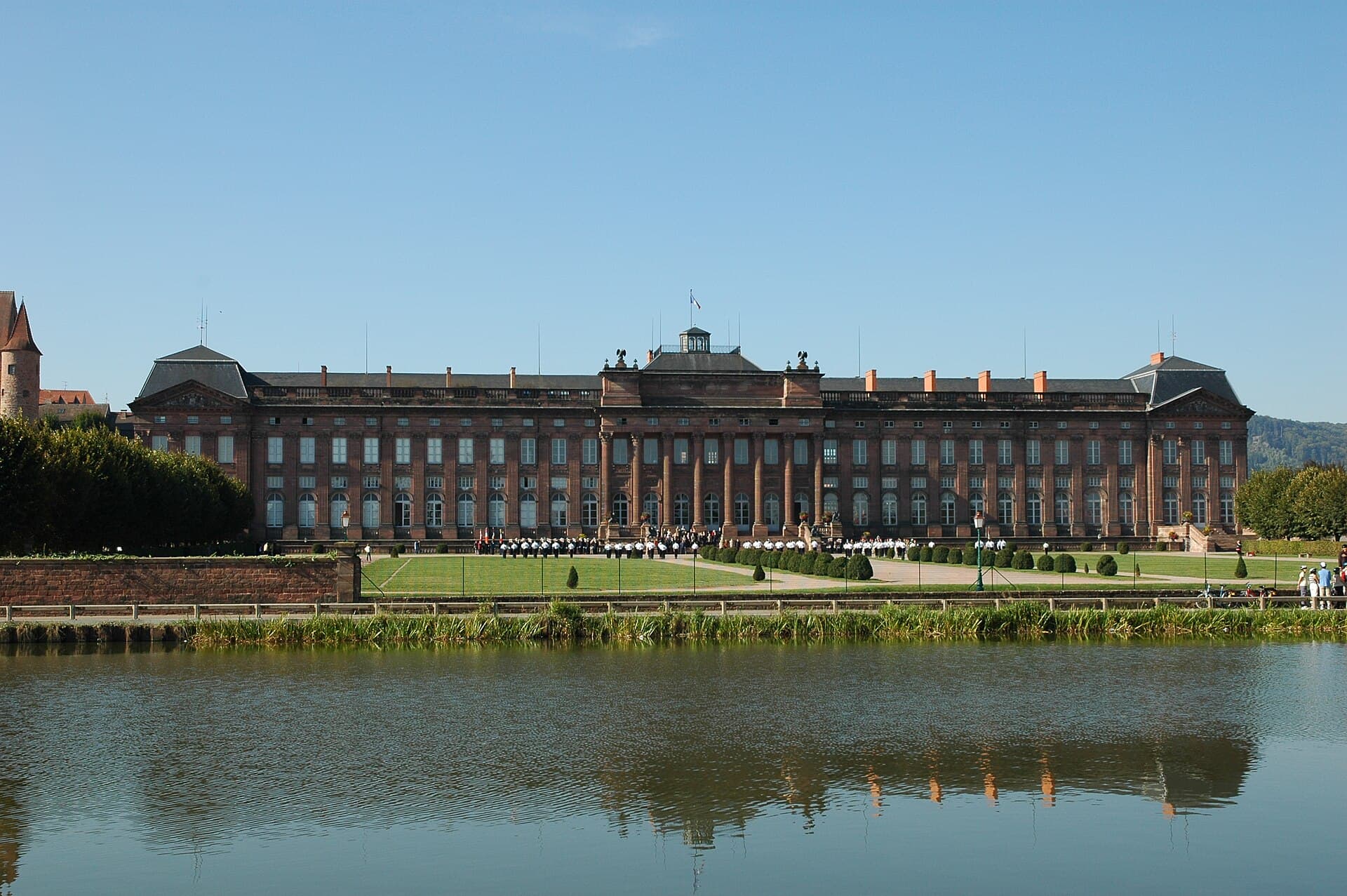
This imposing neoclassical palace, sometimes called the "Alsatian Versailles," holds a surprising history beyond its aristocratic residents.
Discover every secret of Saverne
Every address, every reveal in full — in your ear, right where it happened.
You pick your stops. You walk. The voice reveals what the others miss.

Your self-guided audio tour of Saverne is ready — pick your landmarks, choose your language, and start the moment you arrive.
BuyLume has a built-in augmented-reality guide. Hold your phone up and its camera shows the street ahead of you, with a glowing arrow laid over the real view that always points to your next stop — no map to puzzle over, no wrong turns. Like everything in Lume, it works fully offline.
Saverne, a town in the Bas-Rhin department of France, rests at the foot of the Vosges Mountains, serving as a historical passage between the Alsace plain and the Lorraine plateau. Its strategic position meant it was an important Roman encampment, then known as "Tres Tabernae" (Caesar's three taverns), and later a significant residence for the Bishops of Strasbourg.
Today, Saverne is a town of about 12,000 inhabitants, presenting a fusion of historical architecture and natural beauty. The Marne-Rhine Canal flows through the town, enhancing its scenic charm and offering opportunities for riverside walks. The town is also recognized as the "City of Roses," a designation earned from its remarkable rose garden.
## From Roman Outpost to Episcopal Seat Saverne's beginnings extend back to Roman times, when it was a crucial stopping point called "Tres Tabernae" due to its location on a challenging route to the Lorraine plateau. After its destruction by the Alemanni, Emperor Julian rebuilt the town. By 870 AD, it became part of East Francia, eventually joining the Holy Roman Empire.
## The Influence of the Prince-Bishops From the 13th century, Saverne functioned as the capital of the Prince-Bishopric of Strasbourg, with the Prince-Bishops often residing there due to political tensions with Strasbourg's citizens. This period saw the construction of significant structures, including the Château des Rohan. The current neoclassical palace, built between 1780 and 1790, replaced earlier episcopal residences, one of which was consumed by fire in 1779. The 140-meter-wide façade, crafted from red Vosges sandstone, remains a striking architectural element.
## Shifting Nationalities and Modern Adaptations Saverne experienced periods of German and French authority. It was absorbed by the French after 1680, then conquered by Imperial Germany after the Franco-Prussian War, only to be returned to French control after World War I. The Château des Rohan, following the abolition of clerical rule, lost its initial purpose. It was later renovated by Napoleon III and converted into military barracks, and today serves multiple functions, including a museum, cultural center, primary school, and youth hostel. The town also played a part in the notable "Saverne Affair" in 1913.
Begin your exploration at the Château des Rohan, a grand neoclassical palace sometimes called the "Little Alsatian Versailles." Its impressive 140-meter-long façade of red Vosges sandstone overlooks the Marne-Rhine Canal. Inside, you will find the Saverne Museum, with archaeological collections and exhibits on art, history, and the collections of journalist Louise Weiss.
Stroll through the historic town center to admire the half-timbered houses, particularly the ornate Katz House on La Grand'Rue, constructed in 1605. The Unicorn Fountain on Place du Général de Gaulle, featuring a unicorn statue, stands as a central emblem of the town.
Just a short distance from the town, discover the Château du Haut-Barr, known as the "Eye of Alsace." Situated on three rocky spurs at an altitude of 470 meters, this 12th-century medieval castle offers expansive views of the Alsace plain and the Zorn valley. You can even discern the spire of Strasbourg Cathedral on a clear day. A footbridge, known as the "Devil's Bridge," connects two of the rocks.
Do not miss the Rose Garden of Saverne, the second oldest in France. This 1.5-hectare garden, located at the base of the Col de Saverne pass, displays around 8,500 rosebushes across 550 varieties. The Rose Festival in June is a highlight. Nearby, the Jardin Botanique du Col de Saverne offers a diverse collection of alpine and medicinal plants.
The most agreeable weather for exploring Saverne is typically from May to September. During these months, daytime temperatures are comfortable, ranging from 69°F to 79°F (20°C to 26°C) in July. July and August are the warmest months, with abundant sunshine. The Rose Garden is open from mid-May to the end of August, with the Rose Festival held in June. Winters are cold, with January experiencing freezing nights around 0°C (32°F).
Saverne is located approximately 45 kilometers (27 miles) northwest of Strasbourg. It is easily accessible by car, with parking available at attractions like the Château du Haut-Barr. The town is a favored stopping point for boats traversing the Marne-Rhine Canal, with a 70-berth marina. The historic center is pedestrian-friendly, ideal for unhurried walks. The Saverne Tourist Office, located at 37 Grand Rue, can provide additional information and maps. Local markets offering regional products are held on Tuesday and Saturday mornings.
Saverne in Korean, in Chinese or in Hebrew — and 29 more languages, every stop narrated by a native voice. The widest language range of any self-guided audio tour.
Available in: