The name 'Specchia'
The name of this appealing village is not merely a pleasant sound; it directly connects to its ancient origins and a crucial defensive strategy.
Full story unlocks in the tour
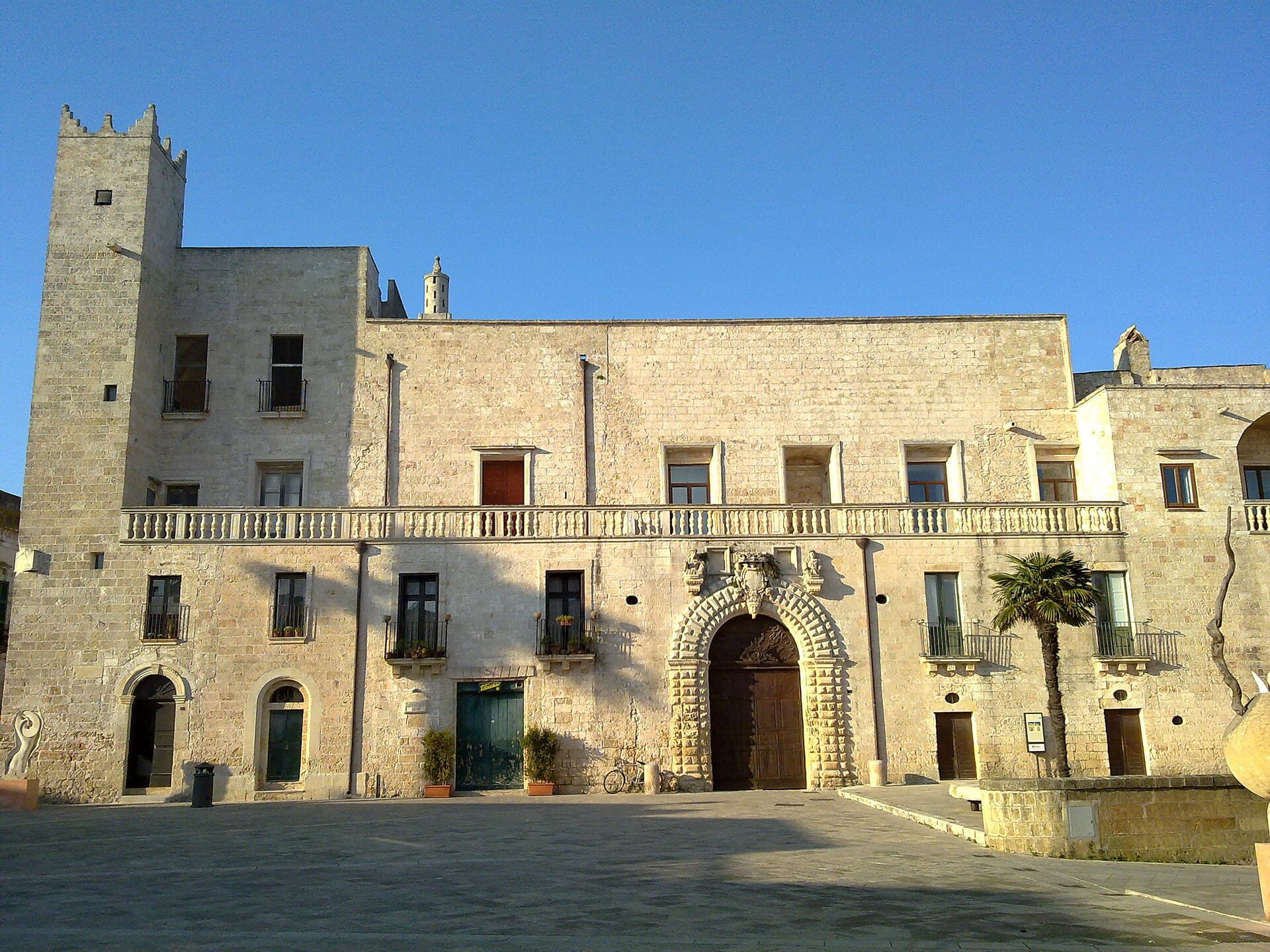 Lupiae / cc by-sa 3.0, via Wikimedia Commons
Self-guided audio walking tour of Specchia — GPS route, offline playback, story-driven narration in 32 languages.
“Where ancient stones recount Saracen raids and liquid gold flows beneath the earth.”
Not the postcards. The stories even locals don't know — whispered in your ear, right where they happened.
The name of this appealing village is not merely a pleasant sound; it directly connects to its ancient origins and a crucial defensive strategy.
The primary square is more than a gathering place; it conceals a secret that once allowed some to evade the grasp of the law.
Beneath Specchia's appealing thoroughfares lies a subterranean world that sustained the local economy for centuries.
Discover every secret of Specchia
Every address, every reveal in full — in your ear, right where it happened.
You pick your stops. You walk. The voice reveals what the others miss.


Your self-guided audio tour of Specchia is ready — pick your landmarks, choose your language, and start the moment you arrive.
BuyLume has a built-in augmented-reality guide. Hold your phone up and its camera shows the street ahead of you, with a glowing arrow laid over the real view that always points to your next stop — no map to puzzle over, no wrong turns. Like everything in Lume, it works fully offline.
Situated on a hilltop in the southeastern Salento region of Puglia, Specchia is a village that lives up to its designation as one of "I Borghi più Belli d'Italia" (The Most Beautiful Villages in Italy). This appealing town, with a population of just under 5,000, offers expansive views over the olive groves that stretch across the plains below, providing a quiet and authentic atmosphere.
Its historic center is a maze of winding streets and appealing alleys, where pale stone houses, intimate squares, and ancient churches reveal themselves at every turn. Specchia is a place to be savored slowly, away from the crowds of more popular coastal destinations, offering a genuine glimpse into Salento's unhurried side. The town's heritage is deeply intertwined with the olive oil industry, a tradition that continues to shape its cultural and gastronomic identity.
Specchia's strategic hilltop location, just a few kilometers from the Adriatic Sea, tells a story of centuries past, when residents sought refuge inland from Saracen invaders and other marauders. Today, this position makes it an ideal base for exploring both the Ionian and Adriatic coasts, offering diverse seaside experiences within a short drive.
The origins of Specchia can be traced back to the 9th century, when a small community of shepherds and peasants settled on this strategic hill to escape Saracen attacks from the sea. The very name 'Specchia' is a testament to its ancient defensive purpose, deriving from the Messapian practice of constructing conical dry stone piles as watchtowers.
With the arrival of the Normans in the 11th and 12th centuries, Specchia began to thrive, marking the beginning of a period of upward mobility that continued for centuries. In 1189, it became part of the County of Lecce and was enfeoffed to Filiberto Monteroni. The town's strategic importance led to the construction of a castle and protective walls during the Middle Ages. However, Specchia's history was not without its trials. In 1269, it was granted to Rodolfo D'Alnay after the Battle of Benevento, and later purchased by the Ramondello Orsini Del Balzo family in 1319, becoming part of the principality of Taranto.
Queen Giovanna II of Naples, envious of the Orsini del Balzo's power, sent an army that besieged, conquered, and destroyed the stronghold of Specchia. It wasn't until 1452 that Raimondello del Balzo Orsini received permission to repopulate the town, leading to the rebuilding of the castle and walls. Over the centuries, numerous feudal lords, including the Di Capua, Gonzaga, Brajda, Trane, Protonobilissimo, and finally the dè Liguoro, held sway until feudal suppression in 1806. In 1860, the Plebiscite in the Kingdom of Naples led to its unification with the Kingdom of Italy, marking a new chapter for Specchia.
Today, Specchia's historic center is considered one of the most compelling in Salento, a perfectly preserved medieval system enclosed within the 700-meter perimeter of its ancient walls. Recent decades have seen significant restoration efforts, including the underground placement of electric cables, allowing the town's historic architecture to shine in its full glory.
Begin your exploration in the historic center, a compelling maze of narrow streets and alleys that lead to unexpected discoveries. The core of the old town is Piazza del Popolo, an elegant open-air lounge where history and art converge. Here, you will find the impressive Palazzo Risolo, originally a 16th-century castle transformed into a noble residence, which now hosts exhibitions and conferences. Nearby stands Palazzo Baronale Ripa, another architectural marvel that once served as the seat of governing counts.
Religious architecture abounds, with the Church of the Presentation of the Blessed Virgin Mary, Specchia's main church, dating back to the 15th century and featuring a Baroque facade and a Latin cross plan. Do not miss the Convent of the Black Franciscans, a 16th-century complex renovated in Baroque style, which houses the beautiful Chapel of St. Catherine Martyr with its Byzantine frescoes. A true Byzantine marvel is the Church of Sant'Eufemia, a small, appealing chapel from the 9th-10th century surrounded by olive trees, just outside the historic center.
Perhaps Specchia's most distinctive attractions lie beneath its streets: the Underground Oil Mills (Frantoi Ipogei). These ancient subterranean presses, some dating back to the 15th century, offer a compelling glimpse into the town's historical olive oil production. Many guided tours include a visit to these restored spaces. Another subterranean marvel is the Crypt of the Madonna del Passo, a Byzantine-origin site rediscovered in the 16th century and transformed into a church.
The best time to experience Specchia's appeal is during the spring and early autumn, specifically from May, June, September, and October. These months offer pleasant weather, ideal for strolling through the historic center and exploring the surrounding countryside. While July and August bring warmer temperatures, they are also the busiest, with many Italians taking their summer vacations. August is particularly lively with local festivals, but September provides a perfect balance of warm waters and food-centric events like the Dried Fig Festival. The winter months are cooler and quieter, with some attractions potentially having shorter hours.
Specchia is located in the Salento peninsula, in the province of Lecce, roughly 40 km south of Lecce city. While a car is highly recommended for exploring Specchia and the wider Salento region due to limited public transport, it is not impossible to reach. The nearest train station, Morciano di Leuca, is a few kilometers away, connecting to local lines from Lecce. The main airports are Brindisi and Bari, both requiring a rental car for convenient access to Specchia.
Once in Specchia, parking can be found on the roadside on the fringes of Piazza del Popolo. The town has a tourist information center in Piazza del Popolo, offering free maps and information in both English and Italian. The historic center is compact and easily explored on foot in a couple of hours, making it an ideal stop for a coffee or lunch. For a more immersive experience, a 2-3 day stay is recommended to fully appreciate the village, its crypts, mills, and local festivals. Specchia is generally considered safe for visitors.
Specchia in Korean, in Chinese or in Hebrew — and 29 more languages, every stop narrated by a native voice. The widest language range of any self-guided audio tour.
Available in: