La Cabotina
This unassuming house on Triora's edge carries a chilling reputation.
Full story unlocks in the tour
 Alessandro Vecchi / CC BY-SA 3.0, via Wikimedia Commons
Self-guided audio walking tour of Triora — GPS route, offline playback, story-driven narration in 32 languages.
“Where medieval shadows speak of witchcraft and resilience.”
Not the postcards. The stories even locals don't know — whispered in your ear, right where they happened.
This unassuming house on Triora's edge carries a chilling reputation.
Examine the altarpiece in Triora's primary church; you will find a familiar scene, yet not quite as anticipated.
The village's name and its ancient coat of arms are often linked to its agricultural past, but another, darker interpretation exists.
Discover every secret of Triora
Every address, every reveal in full — in your ear, right where it happened.
You pick your stops. You walk. The voice reveals what the others miss.

Your self-guided audio tour of Triora is ready — pick your landmarks, choose your language, and start the moment you arrive.
BuyLume has a built-in augmented-reality guide. Hold your phone up and its camera shows the street ahead of you, with a glowing arrow laid over the real view that always points to your next stop — no map to puzzle over, no wrong turns. Like everything in Lume, it works fully offline.
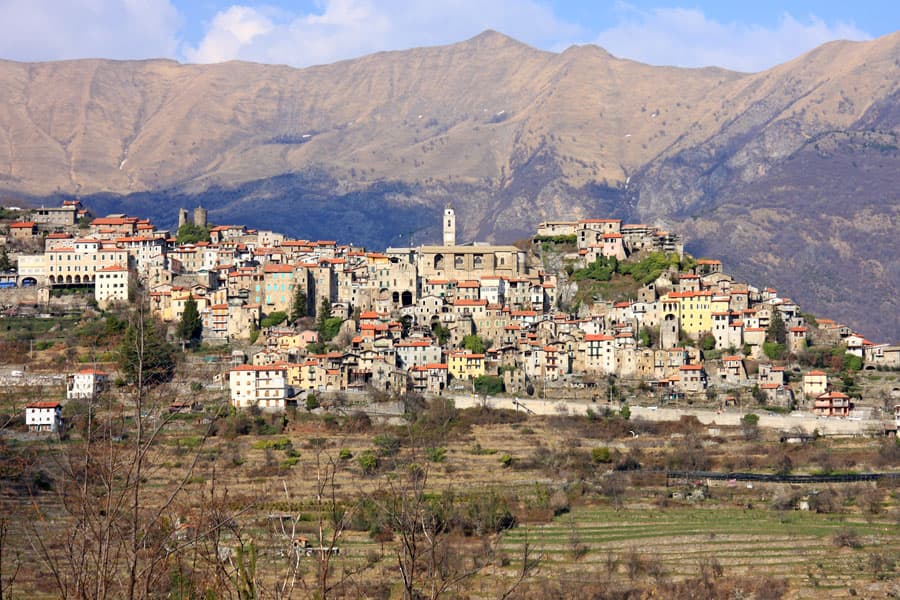
Deep in the rugged Ligurian hinterland, high in the Argentina Valley, stands Triora, a medieval village that captivates with its evocative charm and a history both beautiful and unsettling. Often called the 'Salem of Italy,' Triora is known for the infamous witch trials that gripped the community in the late 16th century. Its winding, stone-paved paths, ancient stone dwellings, and Gothic architecture evoke a powerful sense of stepping back in time.
Beyond its mysterious past, Triora is a village of unexpected endurance and artistic renewal. After being severely damaged by an earthquake in 1887 and largely abandoned, artists from across Europe began to rediscover and revitalize the village in the mid-20th century, transforming it into a thriving artists' commune. Today, the village stands as a testament to this creative spirit, with murals, sculptures, and artisan workshops adorning its ancient corners. A visit to Triora offers a unique blend of historical intrigue, artistic discovery, and the serene beauty of the Ligurian Alps.
Triora is officially recognized among the 'Most Beautiful Villages in Italy' (Borghi Più Belli d'Italia) and has received the Orange Flag from the Touring Club Italiano for its exceptional character and high-quality hospitality. It is a destination for those seeking to explore Italy's esoteric past, immerse themselves in local culture, and enjoy the striking natural landscapes of the Ligurian Alps Park.
The earliest archaeological evidence suggests human presence around Triora dates back to the mid-Neolithic age, between 3800 and 3000 BC, during the era of the 'Culture of the square-mouthed pottery' in Northern Italy. In the 5th and 6th centuries, Colombiani abbots introduced the cultivation of Taggiasca olives, which remain vital to the region today.
By the 13th century, Triora had become a significant and strategically important town. It featured five fortresses, tall tower houses, and a formidable boundary wall, presenting a considerable challenge to the Republic of Genoa's expansion. Despite its military strength, Triora eventually came under Genoese rule in 1261, not through force, but by purchase. It then became the 9th Podesteria (jurisdiction) of the Republic of Genoa and was known as the 'City of Bread' due to its substantial grain production.
The late 16th century brought a somber period to Triora. A severe famine, caused by an exceptionally hot summer and poor harvests between 1587 and 1589, led the struggling community to seek scapegoats. Over 30 local women were accused of witchcraft, blamed for everything from crop failures and unusual weather to unexplained illnesses and even cannibalism. The accusations escalated into one of the bloodiest and most extensive witch trials in Italian history.
Inquisitors from Genoa and Albenga were summoned, and brutal interrogations, often involving torture, were employed to extract confessions. Some accused women, including Isotta Stella, perished during these tortures. While some faced death sentences, the intervention of Genoa's Senate ultimately halted the trials, sparing many from execution. This tragic episode earned Triora the lasting nickname 'Salem of Italy.'
After the witch trials, Triora experienced periods of peace and development, constructing churches and monuments. However, a devastating earthquake in 1887 deeply affected the village, rendering it unlivable and leaving it largely deserted for many decades. A surprising renewal began in the mid-20th century when artists from across Europe discovered the abandoned village. Captivated by its potential, they transformed it into an internationally recognized artists' commune. Today, Triora embraces its rich, multifaceted past, blending its medieval charm with a lively artistic present and a haunting legacy that continues to attract visitors.
Triora's compact size makes it ideal for exploration on foot, with its winding stone-paved paths, vaulted passageways, and medieval stone dwellings. The village offers a unique combination of historical sites and artistic expressions.
Begin your journey at the Ethnographic and Witchcraft Museum (MES), located in the historic Stella Palace, where accused witches were once held. The museum provides an authentic and thoughtful presentation of Triora's troubled past, with artifacts and documents from the trials. Afterwards, seek out La Cabotina, known as 'the witches' house,' a place full of mystery where legends say witches gathered.
For a look into the village's religious heritage, visit the Collegiate Church of Our Lady of the Assumption, dating back to the 16th century. It features a Gothic portal and houses artistic masterpieces, including Taddeo di Bartolo's 1397 'Baptism of Christ' and a copy of Guido Reni's 'Assumption of Mary.' Just beyond the village, the 15th-century Church of San Bernardino offers a tranquil escape with its beautiful frescoes. Do not miss the evocative ruins of Triora Castle and the remnants of its five fortresses, which speak to the village's strategic past. As you wander, observe the numerous artworks, murals, and sculptures that adorn the village, a legacy of its artistic revival. For expansive views, head to Poggio della Croce, a viewpoint named for its iron cross and surrounded by ancient chestnut trees.
The most pleasant time to visit Triora for warm-weather activities is from mid-June to early September, when average daily high temperatures are above 72°F (22°C). July is typically the warmest month, with an average high of 78°F (26°C), and also the clearest and driest. For comfortable weather, July and August are generally recommended.
Triora is particularly evocative around Halloween and during its annual 'Strigora' witches' festival in August, when the village comes alive with historical reenactments and cultural events. While the village hosts events year-round, including local produce festivals, visitors should note that accommodations can be limited, especially during peak times, so booking in advance is advisable.
Triora is located in the province of Imperia, in western Liguria, at an elevation of 780 meters above sea level. While it is a small village, exploring on foot is the best way to experience its narrow streets and alleys. Comfortable shoes are essential due to the steep, stone-paved terrain.
Reaching Triora is most convenient by car. Take the A10 motorway (Genoa-Ventimiglia), exit at Arma di Taggia, and follow signs for Triora. The drive from Arma di Taggia takes approximately one hour via winding mountain roads. Public transportation is more complex, requiring a train to Arma di Taggia or Sanremo, followed by an infrequent local bus service; checking timetables in advance is crucial.
Accommodation within Triora itself is limited, consisting mainly of private rooms, small B&Bs, and rural apartments, rather than conventional hotels. Advance booking is highly recommended, especially during summer or Halloween. Nearby towns like Arma di Taggia, Sanremo, or Agaggio Superiore offer a wider range of hotel options within a reasonable driving distance.
Triora in Korean, in Chinese or in Hebrew — and 29 more languages, every stop narrated by a native voice. The widest language range of any self-guided audio tour.
Available in: