Roosisaare Suspension Bridge
Võru's longest footbridge leads to an island with a surprising past.
Full story unlocks in the tour
 Bandaranaice / CC BY-SA 4.0, via Wikimedia Commons
Self-guided audio walking tour of Võru — GPS route, offline playback, story-driven narration in 32 languages.
“Where the Võro spirit thrives by the lake.”
Not the postcards. The stories even locals don't know — whispered in your ear, right where they happened.
Võru's longest footbridge leads to an island with a surprising past.
This church, named after an empress, has faced more than just the passage of time.
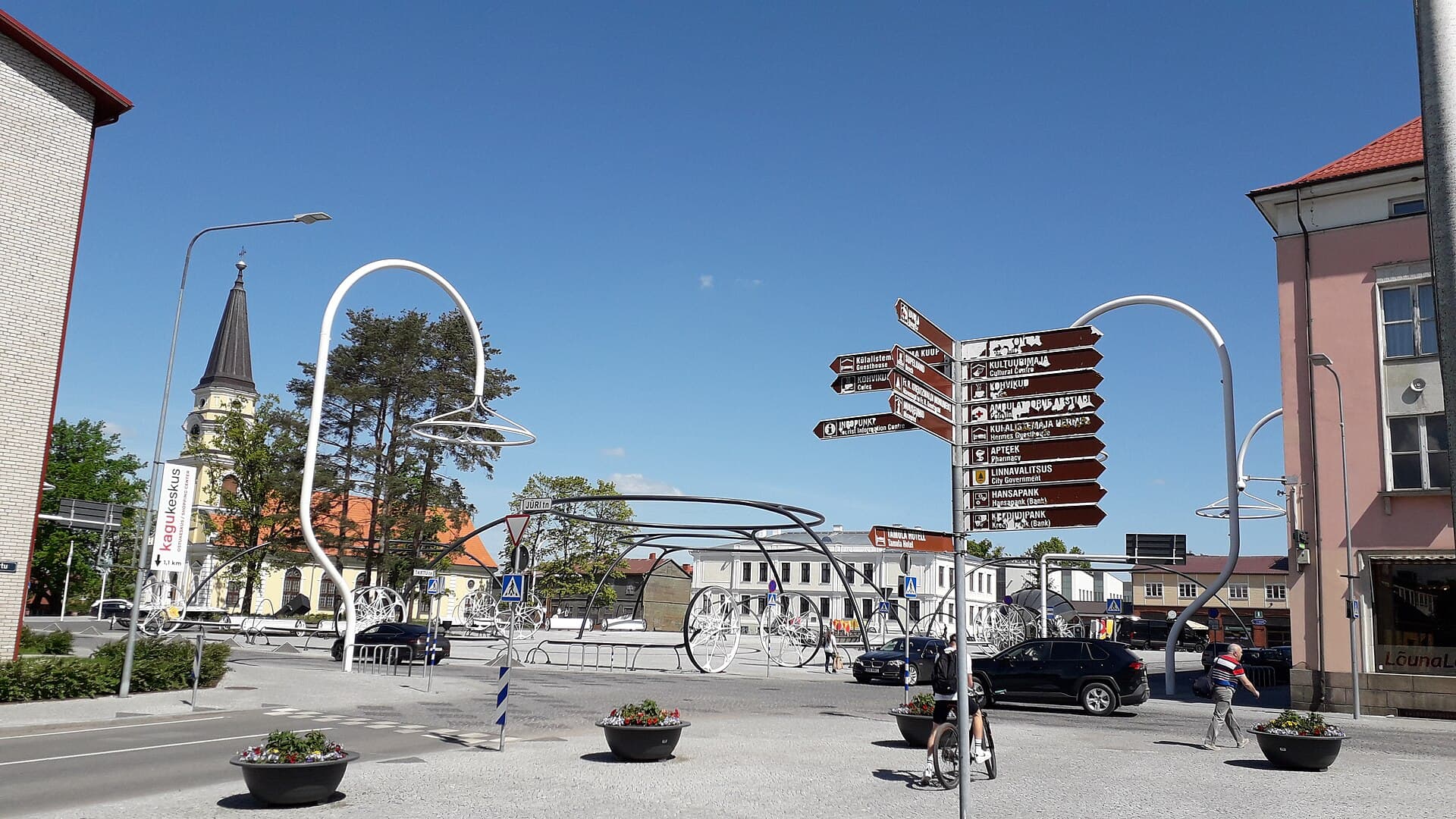
The modern central square holds a subtle nod to its urban planning origins.
Discover every secret of Võru
Every address, every reveal in full — in your ear, right where it happened.
You pick your stops. You walk. The voice reveals what the others miss.


Your self-guided audio tour of Võru is ready — pick your landmarks, choose your language, and start the moment you arrive.
BuyLume has a built-in augmented-reality guide. Hold your phone up and its camera shows the street ahead of you, with a glowing arrow laid over the real view that always points to your next stop — no map to puzzle over, no wrong turns. Like everything in Lume, it works fully offline.
Võru, a city in Southern Estonia, offers a blend of natural beauty and a distinctive cultural identity. Situated on the shore of Lake Tamula, the city provides a peaceful retreat with its scenic promenade and sandy beaches. The city is the heart of the Võrumaa region, known for its strong local identity and the Võro language, a regional language spoken by approximately 75,000 people.
Founded in 1784, Võru is characterized by its orderly street plan and 19th-century wooden architecture. It serves as a gateway to Estonia's diverse natural landscapes, including the nearby Haanja Nature Park, home to Suur Munamägi, the highest point in the Baltics. The city's relaxed pace and cultural offerings, from local museums to the Võru Folk Festival, make it a destination for those seeking an authentic Estonian experience.
Võru's origins trace back to an imperial decree. The city was founded in 1784 by order of Catherine the Great, Empress of Russia, intended as a military settlement and administrative center. This founding established a distinctive grid-like street plan, a feature that sets it apart from many older Estonian towns. The first street in Võru was named after Catherine the Great, leading from the central square and Catherine's Church towards Lake Tamula.
The area around Võru, known as Võrumaa, has a much older history, with evidence of human settlement on Roosisaare, an island in Lake Tamula, dating back nearly 5,000 years to the Stone Age. This deep historical root contrasts with the city's relatively recent formal establishment, highlighting the continuous human presence in this naturally rich region.
Over the centuries, Võru developed as a hub for trade and culture. A significant figure in its history is Friedrich Reinhold Kreutzwald, a doctor who lived and worked in Võru for 44 years from 1833 to 1877. During his time in Võru, Kreutzwald compiled the Estonian national epic, 'Kalevipoeg,' contributing significantly to Estonian literature and language. His former home is now a museum dedicated to his life and work.
The arrival of the Pskov-Riga railway in 1889 further boosted Võru's development, connecting it directly to Riga and St. Petersburg and fostering trade and industry. Throughout the 20th century, Võru County also played a role in Estonian resistance, with the Estonian Forest Brothers being active in the area from 1944 to 1953.
Today, Võru embraces its unique cultural heritage, particularly the Võro language and traditions. The Võro Institute, established in 1995, actively promotes and preserves the Võro language and culture, including organizing language education. The smoke sauna tradition of Võromaa, a part of everyday life, was recognized by UNESCO in 2014, further cementing the region's distinct cultural identity.
Begin your exploration at the Lake Tamula Promenade, a modern waterfront area with walking paths, beaches, and views of the lake. In summer, it's a lively spot for swimming and outdoor festivals; in quieter seasons, it offers a peaceful escape. From the promenade, you can cross the Roosisaare Suspension Bridge, one of Estonia's longest footbridges, leading to Roosisaare Island, a site of Stone Age settlement.
The Central Square of Võru is the city's historical heart, surrounded by significant buildings like the Lutheran St. Catherine's Church (1793) and the grammar school building, one of the city's oldest. The square, redesigned in 2019, is a place for both reflection and community gatherings. Nearby, the Dr. Friedrich Reinhold Kreutzwald Memorial Museum offers insight into the life and work of the author of the Estonian national epic, 'Kalevipoeg,' who practiced medicine in Võru for 44 years.
For those seeking nature, Võru is a base for exploring the Haanja Nature Park, home to Estonia's highest peak, Suur Munamägi, which offers panoramic views from its observation tower. The region is also known for its deep gorges and numerous lakes. Don't miss the opportunity to experience a traditional Võromaa smoke sauna, a UNESCO-recognized intangible cultural heritage, offered at various farms in the area.
The best time to visit Võru for warm-weather activities is from late June to mid-August, when temperatures average between 18°C and 23°C. This period offers comfortable conditions for swimming in Lake Tamula and attending local outdoor festivals like the Võru Folk Festival. Spring (March to May) and Fall (September) provide milder temperatures and fewer crowds, ideal for a relaxed experience and enjoying the autumn colors of the surrounding forests. Winters are cold and snowy, with temperatures dropping to -1°C to -8°C, offering opportunities for cross-country skiing in the nearby hills.
Võru is a compact city, with most attractions accessible on foot. The pace of life is slower than in larger Estonian cities. While Estonian is the standard language, the distinct Võro dialect is widely spoken, and Russian and English are also understood by many. The currency used is the Euro (€).
Public transport to nearby nature sites can be limited, so renting a car is recommended for exploring the wider Võrumaa region, especially destinations like Haanja Nature Park. Buses connect Võru to Tartu (about an hour's journey) and Tallinn (3.5-4 hours). The Võru Tourist Information Centre, located at Tartu tn.31, can provide maps and further assistance. Accommodation options include small hotels and guesthouses.
Võru in Korean, in Chinese or in Hebrew — and 29 more languages, every stop narrated by a native voice. The widest language range of any self-guided audio tour.
Available in: