Château de Wangenbourg
The castle, though a ruin, holds a secret about its construction, linking it to another significant Alsatian fortress.
Full story unlocks in the tour
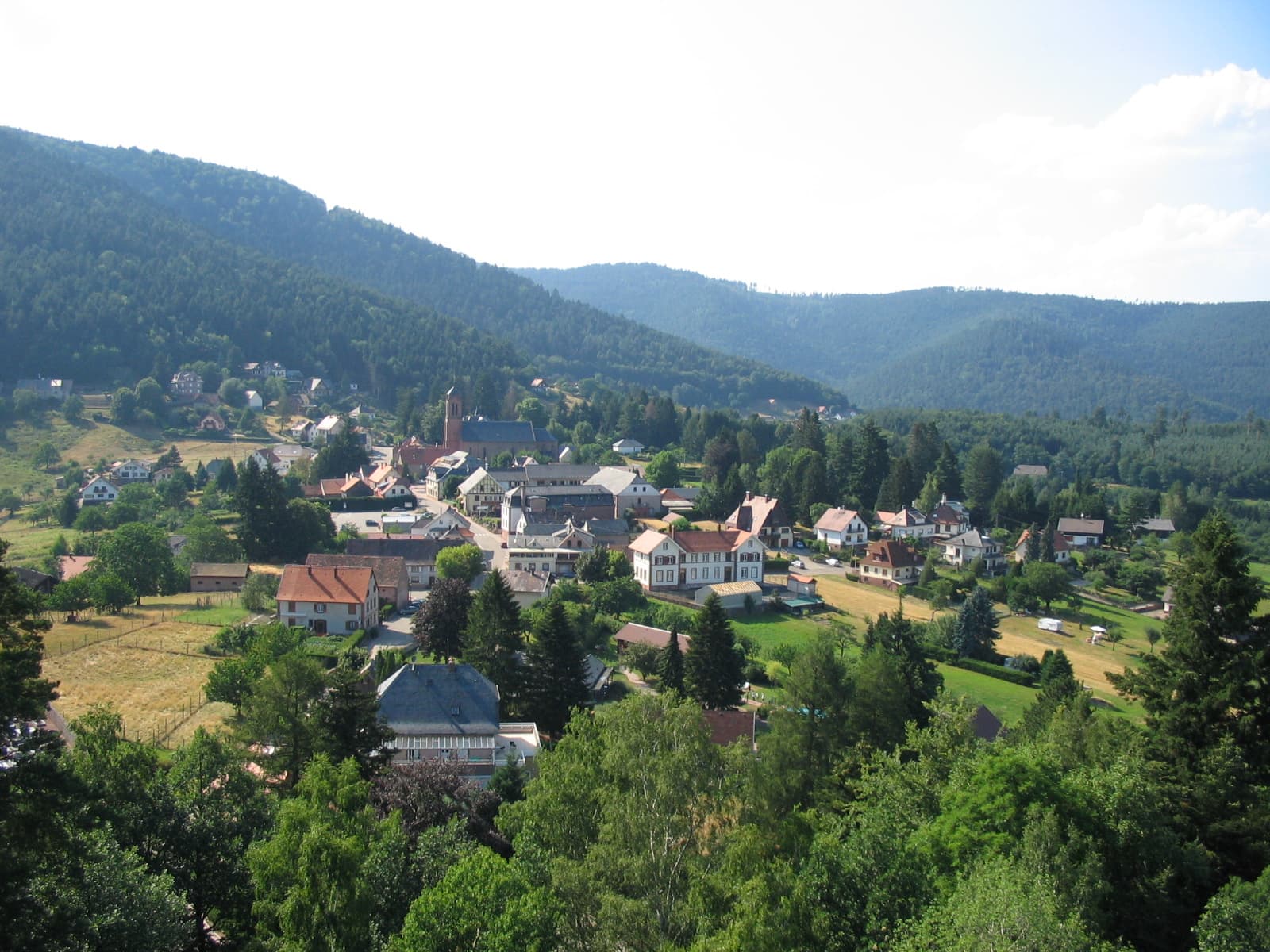 Denis Helfer / CC BY 2.5, via Wikimedia Commons
Self-guided audio walking tour of Wangenbourg — GPS route, offline playback, story-driven narration in 32 languages.
“Where Vosges forests meet Alsatian heritage, a tranquil escape awaits.”
Not the postcards. The stories even locals don't know — whispered in your ear, right where they happened.
The castle, though a ruin, holds a secret about its construction, linking it to another significant Alsatian fortress.
This quiet village played an unexpected, high-stakes role during the early days of World War II, hosting some of the most prominent figures of the era.
Beyond its stone walls, Wangenbourg Castle is said to be haunted by a sorrowful spirit, a remnant of a brigand lord's cruel past.
Discover every secret of Wangenbourg
Every address, every reveal in full — in your ear, right where it happened.
You pick your stops. You walk. The voice reveals what the others miss.
Your self-guided audio tour of Wangenbourg is ready — pick your landmarks, choose your language, and start the moment you arrive.
BuyLume has a built-in augmented-reality guide. Hold your phone up and its camera shows the street ahead of you, with a glowing arrow laid over the real view that always points to your next stop — no map to puzzle over, no wrong turns. Like everything in Lume, it works fully offline.
Wangenbourg-Engenthal, often called the “Switzerland of Alsace” for its picturesque, alpine-like scenery, is a tranquil village cradled within the largest forest massif of the Vosges mountains. Just 40 kilometers west of Strasbourg, this Alsatian commune offers a refreshing escape into nature, characterized by its dense pine and hardwood forests, rolling hills, and pure mountain air. The village, a classified "Green Station" since 1997, thrives on tourism, offering a blend of outdoor activities and historical intrigue.
With altitudes ranging from 400 to 961 meters, culminating at the Schneeberg, Wangenbourg-Engenthal is a haven for those seeking active exploration or peaceful contemplation. The scattered dwellings across its valleys and plateaus contribute to its bucolic charm, making it an idyllic setting for a rejuvenating getaway. Whether you're drawn to its compelling history, the allure of its medieval castle, or the extensive network of hiking and biking trails, Wangenbourg provides a sensory journey that feels a world away from the bustling city.
The commune, formed in 1974 by the merger of Wangenbourg and Engenthal, maintains a strong connection to its heritage and natural environment. Its commitment to preserving its unique character is evident in local efforts to restore historical sites and promote sustainable tourism.
The history of Wangenbourg-Engenthal stretches back to the 9th century when the area, then known as Wangberg (meaning 'mountain of pasture'), was granted to the Andlau Abbey by its founder, Saint Richarde, in 880. The strategic importance of the location, situated near a vital route connecting Obersteigen and Dabo, led to the construction of fortifications.
During the 13th century, the De Dicka family, vassals of the Andlau Abbey, administered its lands. Henri De Dicka is credited with overseeing the construction of both Wangenbourg Castle and Freudeneck Castle, drawing inspiration from the architectural style of Spesbourg Castle. However, the De Dicka lineage ended abruptly with the death of the last De Dicka at the Battle of Sempach in 1386. The castle then passed to Jean de Wangen, whose descendants gradually gained full ownership of the domain.
By the late 14th and 15th centuries, the Wangen family faced financial difficulties, leading to the castle's decline. In 1504, Emperor Maximilian I, after his victory in the Bavarian War of Succession, confiscated the castle from the Wangen cousins, Hans and Stephan, eventually selling it to the Bishop of Strasbourg in 1518. Despite this, Georg and Hartmann de Wangen, descendants of the original family, continued to reside there, undertaking significant Renaissance-style renovations to their living quarters between 1535 and 1550. A dispute over property rights arose in 1578 between the Bishop of Strasbourg and the Wangen lords, resulting in their expulsion, though they were reinstated in 1595.
The 17th century brought devastation. In 1633, during the Thirty Years' War, Swedish troops ravaged the castle, leaving it in ruins. The village itself suffered greatly, with its population dwindling to just 15 inhabitants by 1701. The castle was never fully rebuilt after this destruction, eventually falling into complete disrepair by 1702.
The last private owner of the castle was Baron Frédéric-Antoine-Henri-Louis, a squadron leader in the Royal-Allemand at the end of the 18th century. The property remained with his family until 1918, when the French state seized it after the armistice. Recognizing its historical significance, the ruins of Wangenbourg Castle were classified as a monument historique in December 1898. Initial restoration efforts began in the early 20th century, with further work in 1931, 1961, and 1987. The medieval pontoon bridge leading to the castle, for instance, was replaced by a footbridge in 1961.
At the heart of Wangenbourg stands the impressive Château de Wangenbourg, a 13th-century ruined castle on a rocky outcrop. A short, five-minute walk from the tourist office leads you to its medieval pontoon bridge, transporting you back in time. Explore the polygonal enclosure, the dry moat, and the remains of domestic buildings within the bailey. Look for the vestiges of a Gothic-style dwelling and a Renaissance chimney, hinting at its past grandeur. From April to September, ascend the 24-meter keep for a 360-degree panoramic view of the surrounding Vosges forest.
Beyond the main castle, the ruins of Freudeneck Castle lie a few kilometers away in the forest, currently undergoing restoration by local enthusiasts. History enthusiasts will also appreciate the exhibition in tribute to General de Gaulle in the socio-cultural room opposite the tourist office, detailing his stay in Wangenbourg. For nature lovers, Wangenbourg is a starting point for numerous walks, including sections of the GR53 trail, with routes suitable for all levels. The forest is a playground for mountain bikers, and road cyclists can tackle nearby mountain passes. Do not miss the sculpture symposium, a 2.5-hour walk featuring contemporary sculptures by local and international artists. For a taste of local craft, visit Brasserie Mercière in the nearby village of Cosswiller, just 8km away, to enjoy a locally brewed beer.
The best time to visit Wangenbourg for warm-weather activities is from late June to late August, when average daily high temperatures are above 66°F (19°C) and skies are clearest. July is the warmest month, with an average high of 72°F (22°C). Spring (April to June) and early autumn (September to mid-October) also offer pleasant temperatures, verdant scenery, and fewer crowds, making them ideal for exploring. While winter (November to March) brings snowy landscapes and colder temperatures, it's a quiet period with opportunities for winter sports in the Vosges mountains.
Wangenbourg-Engenthal is located approximately 40 kilometers west of Strasbourg. If traveling by train, take a train to Strasbourg, then transfer to bus line 232, which provides direct service to Wangenbourg-Engenthal. The total journey by public transport is approximately four hours. Alternatively, driving from Strasbourg via the A351 motorway takes about 45 minutes. Parking is available in the village. The Tourist Office, located at 32 A - Rue Général de Gaulle, can provide maps and information on local attractions and hiking routes.
For dining, local specialties are available at establishments like Auberge du Château and Auberge du Vieux Hêtre, offering homemade dishes in a friendly atmosphere. The Freudeneck hotel-restaurant, on the outskirts of Wangenbourg, is known for its seasonal dishes and foie gras. A mini-market in the village provides a range of food products.
Wangenbourg in Korean, in Chinese or in Hebrew — and 29 more languages, every stop narrated by a native voice. The widest language range of any self-guided audio tour.
Available in: